



KOSPI wavers on AI doubts, but "chips remain top pick"
Aug 04, 2026, 10:19 am


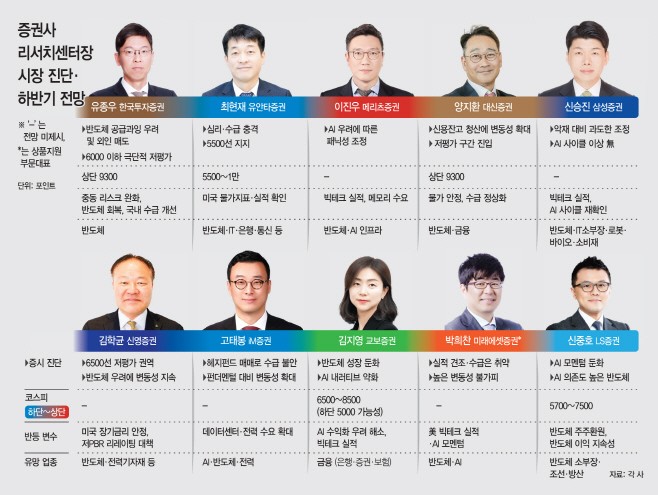 |
Amid heightened volatility in the domestic stock market, the heads of research at major securities firms diagnosed the recent Kospi decline as excessive relative to corporate earnings. They attributed the likely continuation of choppy trading to a combination of supply-demand distortion from single-stock leveraged products, foreign selling, and doubts over the sustainability of AI investment. Accordingly, major brokerages have been successively lowering their Kospi forecast ranges.
Even so, the prevailing view is that the market still has a good chance of rebounding in the second half of the year, led by semiconductors, with AI, power, financials, and undervalued value stocks also seen as potential drivers of rotational buying that could support the index.
According to the financial industry on the 3rd, research centers at 10 major securities firms — Kyobo, Daishin, Meritz, Mirae Asset, Samsung, Shinyoung, Yuanta, Korea Investment, iM, and LS Securities — assessed the recent sharp Kospi drop as an excessive correction, while lowering their Kospi forecast ranges to as low as 5,500 points. They noted that while corporate earnings, particularly in semiconductors, show no major problems, volatility has proven larger than initially expected due to supply-demand distortion from single-stock leveraged products combined with foreign selling.
Kim Ji-young, head of research at Kyobo Securities, lowered the second-half Kospi range from 7,000-10,000 to 6,500-8,500, reflecting slowing semiconductor growth and a reversal in the trend of upward earnings revisions. Kim said further declines are possible if weakness in semiconductors and AI continues alongside valuation compression from monetary tightening, adding that resolving concerns over AI investment profitability is the key variable for a second-half rebound. She named banking, brokerage, and insurance stocks as promising sectors.
LS Securities also lowered its second-half Kospi range from 6,300-8,500 to 5,700-7,500, leaving the lower bound open at 5,700 to reflect the recent sharp decline. Shin Joong-ho, head of research at LS Securities, said the AI cycle's momentum has slowed and it is difficult to expect monetary or fiscal stimulus that could drive a quick recovery, adding that expanded shareholder returns and sustained earnings need to be confirmed before volatility in large-cap chip stocks stabilizes. He added that overlooked large-caps in semiconductor equipment and materials, shipbuilding, defense, and power equipment deserve attention.
Continued high volatility in the second half was a common theme. Analysts said investor sentiment is likely to remain subdued until doubts over the sustainability of AI investment and supply-demand instability are resolved.
Park Hee-chan, head of product support at Mirae Asset Securities, said U.S. big tech earnings could serve as a catalyst for a domestic market rebound, but noted that volatility is unavoidable for now given weak domestic supply-demand conditions. He added that if stock prices rebound, renewed foreign selling could emerge, and with the National Pension Service's capacity for additional buying limited, supply-demand instability could persist.
Lee Jin-woo, head of research at Meritz Securities, said the current market reflects accumulated concerns over overinvestment, with growing doubts about the sustainability of the AI investment cycle that has continued for more than a year. He assessed that relative to the scale of corporate earnings, current stock prices have undergone a larger correction than at any point before.
Daishin Securities lowered its full-year Kospi target from 11,500 to 9,300 in a report that day. However, it said the recent sharp index decline reflects excessive undervaluation driven by worsening investor sentiment and supply-demand instability rather than damage to corporate fundamentals, suggesting a phased buying strategy is valid in the Kospi 6,000-point range. Yang Ji-hwan, head of research at Daishin Securities, explained that during the first-half rally, retail investors absorbed more than 150 trillion won in net foreign selling, while margin loan balances grew to over 38 trillion won, adding that the unwinding of margin positions during the market correction unleashed selling unrelated to stock prices or valuations, amplifying volatility.
Choi Hyun-jae, head of research at Yuanta Securities, likewise said the current correction reflects a price adjustment driven by sentiment and supply-demand instability rather than damaged corporate earnings, and lowered his second-half Kospi range from 7,500-11,500 to 5,500-10,000. Choi said the Kospi has fallen about 39% from its peak — a decline on par with past global crises — amid the combined burden of high oil prices, high inflation, high interest rates, concerns over AI investment payoffs, and amplified supply-demand effects from single-stock leveraged ETFs. He added that the current 12-month forward price-to-earnings ratio (PER) is around 5 times, lower than even the trough of the global financial crisis, representing an extreme undervaluation zone that is difficult to explain by fundamentals, with 5,500 as a meaningful support level.
Kim Hak-kyun, head of research at Shinyoung Securities, said the 6,500-point range represents undervalued territory at a 12-month forward PER of 5.5 times, but predicted that stock price volatility will remain very high as controversy over the semiconductor industry outlook is unlikely to be resolved easily.
Yoo Jong-woo, head of the research division at Korea Investment & Securities, said concerns over China's expanding chip supply and foreign selling are behind the recent sharp market decline, but assessed that Kospi levels below 6,000 represent an extreme undervaluation zone. He projected that easing tensions in the Middle East, a recovery in the semiconductor industry, and improved domestic supply-demand conditions could serve as catalysts for a rebound.
Shin Seung-jin, head of the investment information team at Samsung Securities, said the AI cycle itself remains intact, but investor sentiment has contracted sharply, causing an excessive decline. He said the AI investment cycle could see renewed confirmation through improving memory chip industry conditions and U.S. big tech earnings, which could set the stage for a rebound.
Major research center heads commonly named semiconductors as a promising sector, while also suggesting AI, power, financials, and undervalued value stocks as attractive areas for the second half. Kim Hak-kyun recommended semiconductor and power equipment-related sectors, adding that undervalued stocks across industries are also worth watching, defined by criteria such as return on equity (ROE) above 10%, price-to-book ratio (PBR) below 1, and dividend yield above 3%.
Koh Tae-bong, head of research (executive director) at iM Securities, said semiconductors will likely lead the rally, with power and battery-related sectors such as energy storage systems (ESS) also expected to show positive momentum going forward, adding that AI-related value chain sectors could show relative strength.
Yoon Seo-young
Park Ju-yeon
Han Hye-sung
Most Read
-
1
Celltrion’s Omlyclo gains ground in major European..

-
2
Trump demands rates fall below 1% as Fed hikes for..

-
3
Hyundai Motor Group breaks ground on integrated st..

-
4
U.S. strikes 3 Iranian oil tankers, Iran vows reta..

-
5
Trump makes $1 trillion bet ahead of midterm elect..

-
6
Iran resumes ballistic missile production, assembl..

-
7
Samsung Electronics, Mistral AI to jointly develop..

PEOPLE







-
Address : In-Young Bldg., 34, Uisadang-daero 1-gil, Yeongdeungpo-gu, Seoul
Copyright by ASIATODAY CO., LTD. All rights resereved