



Heat-related illnesses surge as scorching heatwave continues
Aug 04, 2026, 09:30 am


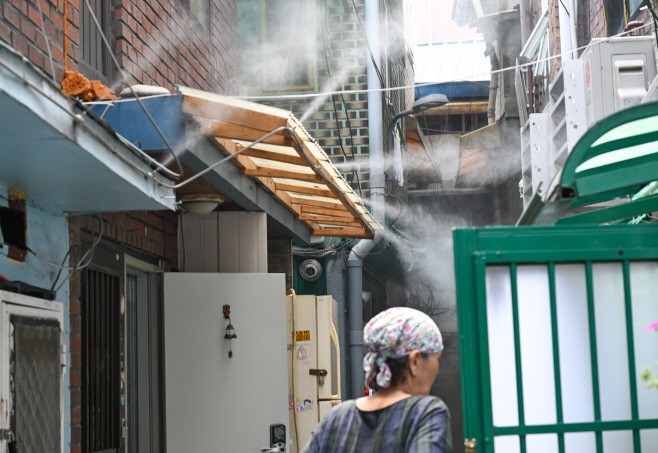 |
| Cooling fog is sprayed in an alley of a low-income "jjokbang" housing area in Jongno-gu, Seoul on the 3rd, as heatwave warnings remain in effect across most of the country. / Jung Jae-hoon, Staff Photographer |
Health authorities are on alert as heat-related illnesses rise rapidly amid record-breaking heat blanketing the country. With elderly people, whose ability to regulate body temperature is diminished, and outdoor workers and other vulnerable groups exposed to the heat for long periods particularly at risk, authorities plan to step up safety checks.
According to the Korea Disease Control and Prevention Agency (KDCA) on the 3rd, a cumulative 2,025 cases of heat-related illness have been recorded since the emergency room surveillance system for such illnesses began operating on May 15, running through August 2. Of these, 16 people have died.
Heat-related illness is an acute condition that occurs from prolonged exposure to hot environments. Symptoms can include headache, dizziness, muscle cramps, fatigue, and impaired consciousness, and can become life-threatening if not addressed promptly.
Elderly people are especially vulnerable to extreme heat. According to the KDCA's in-depth analysis of heat's health effects, when the perceived temperature reaches 38 degrees, the overall mortality risk for those aged 65 and older rises by 19%, and the risk of death from cardiovascular disease rises by 14%. This is higher than the corresponding increases for those under 65 — 4% for overall mortality risk and 7% for cardiovascular death risk. Among these, elderly people working in fields face even greater risk, as age and working conditions compound as risk factors.
In response, the Ministry of Health and Welfare is stepping up safety checks for high-risk elderly residents in areas under heat wave advisories. Officials will call or visit in person once a day during heat wave watches and warnings, and twice a day during heat wave critical alerts, to check on residents' health and guide them to cooling shelters.
Health and Welfare Minister Jeong Eun-kyeong visited Asan, South Chungcheong Province that day to check on protective measures for heat-vulnerable populations. Asan is flying drones to spot residents working in fields, using speakers mounted on the drones to announce work stoppages and heat safety guidelines. Since it's difficult for people to physically monitor large farming areas on their own, the city aims to use drones to quickly locate outdoor workers.
Senior job programs will also fully suspend outdoor activities when a heat wave critical alert is issued. Participants will be sent home or switched to indoor activities in air-conditioned spaces, and all participants' health will be checked. Phone and in-person checks and on-site patrols are also being expanded for elderly people living alone, dementia patients, homeless people, and residents of cramped rooming houses.
Risks are also rising at outdoor and high-heat workplaces such as construction sites, farms and livestock operations, and shipbuilding and steel plants. When the perceived temperature reaches 33 degrees or higher, employers are required to give workers at least 20 minutes of rest every two hours. The Ministry of Employment and Labor is treating the heat wave as a climate disaster and stepping up inspections and oversight of vulnerable workplaces.
Minister Jeong said, "We now need an even more thorough response to prevent harm from the heat wave from growing worse," adding, "As local governments protect the public's life and safety through creative approaches and technological innovation, such as using new tools like drones, the government will also watch closely and actively support what's needed on the ground so that the public can stay healthy and safe through the end of this summer."
Lee Se-mi
Most Read
-
1
Alteogen secures European patent for Keytruda SC,..

-
2
Trump shares map on social media labeling Strait o..

-
3
Kia Sportage outperforms Mazda CX-5 in German auto..

-
4
U.S. deploys carrier, 10,000 more troops to Middle..

-
5
Trump rejects Iran's offer to open Strait of Hormu..

-
6
N. Korea conducts first swarm attack drill with dr..

-
7
U.S.-China summit falls short on substance as Trum..

PEOPLE





HEADLINE NEWS
- Pyongyang calls DMZ explosion Seoul's fabrication and grave provocation
- U.S. Department of Defense completely halts use of blacklisted Anthropic AI
- 2026 Nobel Prize in Physics awarded to Francis Halzen for neutrino research
- French students take to streets, expressing frustration over economy, educa..

-
Address : In-Young Bldg., 34, Uisadang-daero 1-gil, Yeongdeungpo-gu, Seoul
Copyright by ASIATODAY CO., LTD. All rights resereved