



Ceuta border crisis calms, but casualties and social division persist
Aug 03, 2026, 03:10 pm


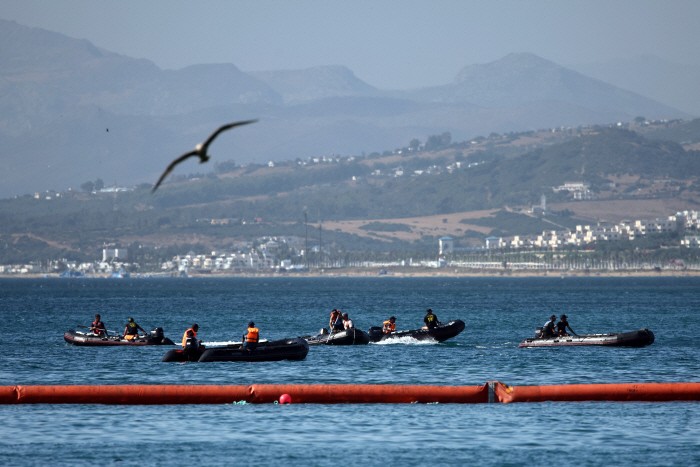 |
| People travel on a rubber boat near a border checkpoint in the Spanish enclave of Ceuta on August 2 (local time). / Courtesy of AFP, Yonhap |
While the massive influx of migrants into the Spanish North African enclave of Ceuta has entered a phase of stabilization, the aftermath continues with casualties, social division, and controversy over European immigration policy, reported AP and Reuters on August 2 (local time).
According to AP, the city regained a measure of stability over the weekend. Most of the roughly 60,000 migrants who had crossed into Ceuta from Morocco by swimming or walking since July 30 are understood to have returned home by that day.
Spanish authorities announced that at least 72 people have died from drowning and other causes as of August 2, with search operations ongoing along the coast.
Moroccan authorities announced that 11 people died in their border area, though it remains unclear whether this count overlaps with the Spanish tally. The Moroccan government pointed to the spread of misinformation and human trafficking networks as the root causes of the border crisis, stating it has launched an investigation.
Among local residents, controversy is mounting over where accountability lies. Some migrants who returned to Morocco testified that the border was effectively left open, claiming authorities stood by while thousands crossed over. A resident of Ceuta argued, "If you leave the border open, everyone is bound to enter," adding, "The authorities are to blame."
The incident has brought debate over immigration policy back to the surface within Europe. Right-wing politicians, including Member of the European Parliament Alvise Pérez and Vox party leader Santiago Abascal, visited Ceuta to demand the deportation of all migrants, criticizing the government's failure in border security.
Following the Ceuta incident, 22 European Union (EU) member states issued a joint letter urging coordinated efforts to protect external borders and formulate countermeasures.
Italy temporarily suspended the Schengen Agreement (visa-free travel) for Spain for one month. Finland, France, and Portugal are also considering introducing border checks.
Spain had pursued relatively inclusive policies toward migrants compared to other EU nations, recently introducing a system to grant residency rights to more than 500,000 undocumented immigrants. The Spanish government dismissed claims that such policies fueled the unauthorized entry into Ceuta, making clear that those who entered illegally cannot move to mainland Spain or other Schengen member states.
Lee Jeong-eun
Most Read
-
1
Celltrion’s Omlyclo gains ground in major European..

-
2
Trump demands rates fall below 1% as Fed hikes for..

-
3
Trump makes $1 trillion bet ahead of midterm elect..

-
4
Iran resumes ballistic missile production, assembl..

-
5
Samsung Electronics, Mistral AI to jointly develop..

-
6
Trump warns countries not helping U.S. must pay re..

-
7
Apple launches first foldable, 1 million won prici..

PEOPLE






HEADLINE NEWS
- Trump to roll out ‘unprecedented welcome’ for Xi with B-2 bombers, F-22 fighters
- S. Korea, U.S., and Japan form united front on Taiwan and economic coercion..
- Trump administration moves to impose sweeping sanctions on International Cr..
- Xi to make state visit to U.S. Sept. 23-25, dispelling rumors over his heal..

-
Address : In-Young Bldg., 34, Uisadang-daero 1-gil, Yeongdeungpo-gu, Seoul
Copyright by ASIATODAY CO., LTD. All rights resereved