



United on war, divided on exit strategy: Iran's leadership split on hardliners vs. pragmatists
Aug 03, 2026, 02:18 pm


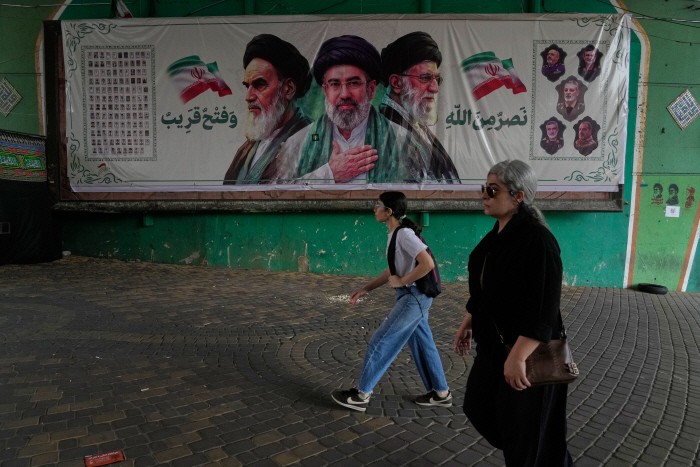 |
| A banner featuring portraits of Iran's late revolutionary leader Ayatollah Khomeini (left), Supreme Leader Ayatollah Mojtaba Khamenei (center), and former Supreme Leader Ayatollah Ali Khamenei (right)—who was killed in U.S. and Israeli airstrikes on February 28—is seen in Tehran, Iran, on August 2 (local time). / Courtesy of AP, Yonhap |
As Iran continues attacks targeting U.S. military bases and allied nations, its leadership maintains a united, hardline stance externally, but internally remains sharply divided over the ultimate goal of the war and post-war governance.
According to the Associated Press on August 2 (local time), Iran is split into an extreme hardline faction rejecting any compromise with the U.S. and a pragmatist camp seeking to leverage military pressure to boost bargaining power, intensifying an internal struggle for hegemony.
The camp led by Iranian President Masoud Pezeshkian and Parliament Speaker Mohammad Baqer Qalibaf supports pragmatic diplomacy and talks with the U.S. Viewing military action as a complementary tool to extract practical concessions, they maintain that negotiations with the U.S. are inevitable to alleviate lingering economic hardship and public discontent.
Mehdi Mohammad, an advisor to Speaker Qalibaf, previously stated, "Negotiations are a political tool to complement military action and compel the adversary to make real concessions."
The pragmatist camp warns that if worsening economic conditions—such as the depreciation of Iran's currency, inflation, and rising unemployment—are left unaddressed, public dissatisfaction could threaten the regime's survival.
Indeed, in July, around 250 former lawmakers and academics issued a statement calling for an end to the conflict and peace, while voices criticizing mass executions of protesters have continued.
Yousef Pezeshkian, the president's son and advisor, also emphasized the need to consider economic reality over clinging to an unattainable victory, stating, "Iran is sickened by long-standing sanctions and confrontation."
In contrast, hardliners centered around Saeed Jalili, represented by the "Front of Islamic Revolution Stability (Paydari)", advocate for nothing less than complete victory. They oppose any compromise with the U.S. and demand stronger ideological control over the Islamic Republic.
During a U.S.-Iran ceasefire agreement passed by the Iranian Supreme National Security Council in April with 12 out of 13 votes, Jalili was reportedly the sole dissenting vote.
Experts analyze that while Jalili's faction is small in number, it exerts significant influence through vast financial resources and networks within the Islamic Revolutionary Guard Corps (IRGC).
The key variable in the confrontation between both sides is the orientation of Mojtaba Khamenei, who succeeded as Supreme Leader after Ayatollah Ali Khamenei was killed in U.S. airstrikes on February 28. Injured in the airstrike and yet to appear publicly, both factions claim to hold his backing.
Experts are paying close attention to whether Mojtaba will serve as a safeguard to rein in the hardliners or exacerbate political instability by allowing factional infighting to go unchecked.
Lee Jeong-eun
Most Read
-
1
Celltrion’s Omlyclo gains ground in major European..

-
2
Trump demands rates fall below 1% as Fed hikes for..

-
3
Trump makes $1 trillion bet ahead of midterm elect..

-
4
Iran resumes ballistic missile production, assembl..

-
5
Samsung Electronics, Mistral AI to jointly develop..

-
6
Trump warns countries not helping U.S. must pay re..

-
7
Apple launches first foldable, 1 million won prici..

PEOPLE





HEADLINE NEWS
- Trump to roll out ‘unprecedented welcome’ for Xi with B-2 bombers, F-22 fighters
- S. Korea, U.S., and Japan form united front on Taiwan and economic coercion..
- Trump administration moves to impose sweeping sanctions on International Cr..
- Xi to make state visit to U.S. Sept. 23-25, dispelling rumors over his heal..

-
Address : In-Young Bldg., 34, Uisadang-daero 1-gil, Yeongdeungpo-gu, Seoul
Copyright by ASIATODAY CO., LTD. All rights resereved