



Trump holds off on Iran airstrike at last minute, easing brink-of-war tension
Aug 03, 2026, 10:23 am


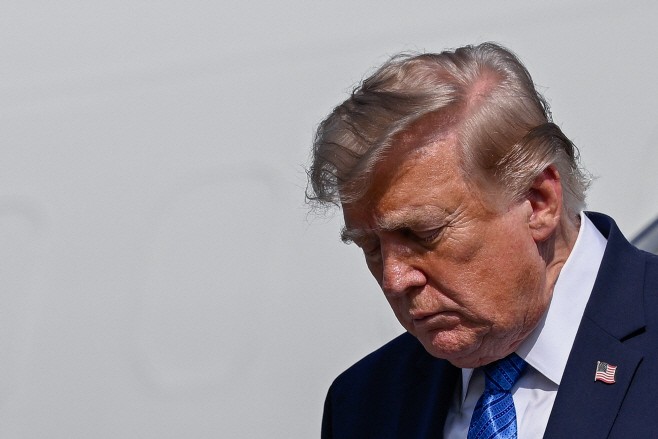 |
| U.S. President Donald Trump disembarks from the presidential aircraft Air Force One at Morristown Municipal Airport in New Jersey, U.S., on July 31 (local time). / Courtesy of Reuters Yonhap |
U.S. President Donald Trump abruptly canceled a military operation against Iran scheduled for August 1–2 (local time). With large-scale U.S. and Israeli airstrikes on the brink of launch, military confrontation appears to have passed a critical juncture for now as Iran and Middle Eastern nations requested a hold on strikes, bolstered by mediation from Saudi Arabia.
On August 1, President Trump announced the cancellation of attacks against Iran on his social media platform Truth Social, stating, "I have been asked by Iran and other Middle Eastern nations to hold off on any attacks, as an agreement framework has been consented to." He added, "I have agreed to cancel the attacks under the condition that a swift agreement can be reached," noting that "Israel joins me in this commitment."
Earlier, reports from media outlets such as U.S. network CBS and The Wall Street Journal (WSJ) that the U.S. and Israel were preparing large-scale airstrikes targeting Iran's energy infrastructure, including oil refineries, had pushed tensions in the Middle East to a peak.
Saudi diplomatic mediation was reportedly key to the cancellation of the airstrikes. According to Axios and the Associated Press (AP), Crown Prince Mohammed bin Salman conveyed concerns to President Trump during a phone call that day that attacks against Iran could escalate into a region-wide conflict, urging restraint on airstrikes.
A source briefed on the call between President Trump and Crown Prince Mohammed told AP that "Saudi Arabia is concerned about the possibility of Iran launching retaliatory attacks against energy facilities in Saudi Arabia and other Gulf nations."
Another source noted that Crown Prince Mohammed also requested details regarding the specific nature of the military responses being considered by the U.S.
The crisis also impacted global energy markets. Driven by military tensions and maritime transport disruptions, Brent crude surged from under $72 per barrel in early July to recently cross $90. U.S. investment research firm Melius Research estimated that about 10% of global refining capacity is effectively offline due to a combination of the Strait of Hormuz blockade, attacks on Russian oil refineries, and China's suspension of petroleum product exports.
Experts view that while a immediate crisis was averted by holding off on airstrikes, stability will not return easily to the Middle East.
According to WSJ, Andrew Leber, a researcher at the Carnegie Endowment for International Peace, analyzed that the cycles between escalation and de-escalation are becoming increasingly shorter. Ali Vaez, Iran Project Director at the International Crisis Group (ICG), projected that temporary truces and limited attacks will recur over the coming weeks. The New York Times (NYT) characterized this dynamic as a new form of "forever war."
Ha Man-joo
Most Read
-
1
Celltrion’s Omlyclo gains ground in major European..

-
2
Trump demands rates fall below 1% as Fed hikes for..

-
3
Trump makes $1 trillion bet ahead of midterm elect..

-
4
Iran resumes ballistic missile production, assembl..

-
5
Samsung Electronics, Mistral AI to jointly develop..

-
6
Trump warns countries not helping U.S. must pay re..

-
7
Apple launches first foldable, 1 million won prici..

PEOPLE






HEADLINE NEWS
- Trump to roll out ‘unprecedented welcome’ for Xi with B-2 bombers, F-22 fighters
- S. Korea, U.S., and Japan form united front on Taiwan and economic coercion..
- Trump administration moves to impose sweeping sanctions on International Cr..
- Xi to make state visit to U.S. Sept. 23-25, dispelling rumors over his heal..

-
Address : In-Young Bldg., 34, Uisadang-daero 1-gil, Yeongdeungpo-gu, Seoul
Copyright by ASIATODAY CO., LTD. All rights resereved