



Rollercoaster KOSPI shakes retail investors as forced liquidations top 810 billion won in July
Aug 03, 2026, 10:14 am


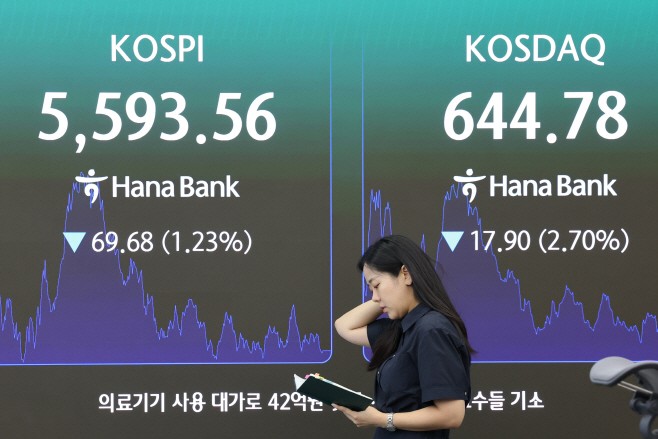 |
| View of the Hana Bank dealing room on July 30 / Courtesy of Yonhap News |
Amid extreme volatility in the domestic stock market, individual investors who engaged in leveraged trading were hit with over 810 billion won in forced liquidations during July. Even during the sharp rebound that immediately followed a steep index drop, panic-stricken retail investors sold off more than 10 trillion won in stocks. Furthermore, they exacerbated their losses by purchasing over 500 billion won in inverse exchange-traded funds (ETFs) betting on an index decline. With forced liquidations exceeding 4 trillion won this year alone and the number of individual bankruptcy filings in the first half of the year surging compared to the same period last year, concerns are rising that stock market instability is spilling over into real economic debt burdens.
According to the Korea Financial Investment Association on August 2, the amount of forced liquidations arising from defaults on brokerage consignment accounts in July reached approximately 812.8 billion won. In particular, forced liquidations on July 30 stood at around 103.7 billion won, more than four times the daily average for this year (approx. 25.7 billion won).
Forced liquidation is a mechanism where brokerages forcibly sell off shares to recover funds when investors who purchased stock on credit or margin fail to deposit funds within a set settlement deadline. When stock prices drop sharply, collateral values fall rapidly, leading to a sudden wave of forced liquidation sell-offs.
Forced liquidations showed a steep surge starting from the stock market drop in late July. After remaining around 7.3 billion won per day on July 23–24, the volume rose to the 20 billion won range on July 27 before soaring past 100 billion won on July 30 as market declines deepened. This is more than a 7.5-fold increase compared to July 28 (13.9 billion won), when the KOSPI plunged 10.84%.
As market fear peaked during the dramatic rebound on the following day, individual investors failed to overcome fears of further declines and continued stop-loss selling. On July 31, when the KOSPI index surged over 17%, foreign investors posted a record net purchase of 8.7709 trillion won in the KOSPI market, whereas retail investors logged a record net sale of 10.3884 trillion won. Weary from consecutive market drops, retail investors rushed into stop-loss sales, missing out on the opportunity to recover prior losses.
Retail investors' inverse ETF investments betting on index drops also led to additional losses. On July 31, when the KOSPI surged, individual investors net purchased over 500 billion won in index inverse ETFs in a single day. Contrary to their expectations, however, the index continued to rebound, resulting in another round of massive unrealized losses.
Meanwhile, as cumulative forced liquidations this year surpassed 4 trillion won, concerns are mounting that investment losses from the stock market crash are heightening debt burdens in the real economy. According to the Monthly Court Statistics, the number of personal rehabilitation applications filed in courts nationwide during the first half of this year reached 81,723, a 13.2% increase compared to the same period last year.
Han Hye-seong
Most Read
-
1
Celltrion’s Omlyclo gains ground in major European..

-
2
Trump demands rates fall below 1% as Fed hikes for..

-
3
Hyundai Motor Group breaks ground on integrated st..

-
4
U.S. strikes 3 Iranian oil tankers, Iran vows reta..

-
5
Trump makes $1 trillion bet ahead of midterm elect..

-
6
Iran resumes ballistic missile production, assembl..

-
7
Samsung Electronics, Mistral AI to jointly develop..

PEOPLE







-
Address : In-Young Bldg., 34, Uisadang-daero 1-gil, Yeongdeungpo-gu, Seoul
Copyright by ASIATODAY CO., LTD. All rights resereved