



Retail investors switch to main U.S. index ETFs as domestic market fatigue grows
Aug 03, 2026, 09:58 am


 |
Investors feeling fatigued by the extreme volatility in the domestic stock market are turning their attention to U.S. equities that combine stability and growth potential. As the KOSPI and KOSDAQ markets present unpredictable trends, U.S. representative indices, which have demonstrated steady performance over the long term, are re-emerging as investment alternatives.
Against this backdrop, U.S. index ETFs offered by domestic asset managers featuring low total expense ratios are rapidly drawing in funds. As consensus spreads that tech companies will continue to dominate market leadership, U.S. representative indices focused on tech stocks are being re-highlighted as core vehicles for long-term dollar-cost averaging investments. Furthermore, ETFs incorporating specialized management strategies are expanding choices for investors who are unsatisfied with simple passive index tracking.
According to Korea Securities Depository data on August 2, South Korean investors' net purchases of U.S. stocks reached 4.64241 billion dollars (6.7129 trillion won) in July, showing a month-by-month upward trend following net sales of 939.77 million dollars (1.3589 trillion won) in May and net purchases of 632.96 million dollars (915.2 billion won) in June this year.
Under these circumstances, the concentration of capital into U.S. representative index ETFs is also clear. According to Korea Investment Management, net individual purchases of ACE U.S. Nasdaq 100 and ACE U.S. S&P 500 totaled 129.8 billion won in July alone, reaching 130 billion won just one month into the second half of the year. By product, ACE U.S. Nasdaq 100 increased its net purchase volume from 75.9 billion won in June to 80.6 billion won in July, and ACE U.S. S&P 500 also expanded its net purchase size from 31.8 billion won in June to 49.2 billion won in July.
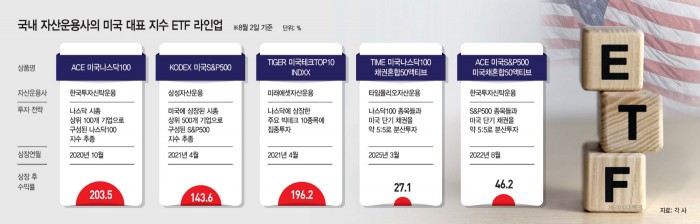
ACE U.S. Nasdaq 100 tracks the Nasdaq 100 index composed of the top 100 tech companies by market capitalization on the Nasdaq, recording a return of 203.5% since its listing in October 2020. ACE U.S. S&P 500 follows the Standard & Poor's (S&P) 500 index composed of the top 500 U.S.-listed companies by market cap, achieving a return of 183.2% since its listing in August 2020.
The capital inflow into both products is attributed primarily to industry-lowest expense competitiveness. This stems from the fact that accumulated annual cost differences exert a significant impact on final returns in long-term dollar-cost averaging investments. ACE U.S. Nasdaq 100's total expense ratio is 0.006% per annum, markedly lower than the average expense ratio of 0.092% per annum for Nasdaq 100 products issued by other asset managers. ACE U.S. S&P 500 also applies a 0.004% per annum expense ratio, representing the cheapest level among U.S. S&P 500 tracking products listed domestically.
The Nasdaq 100 index is consistently recommended as a core pillar of long-term dollar-cost averaging investments. Bae Jae-kyu, CEO of Korea Investment Management, previously emphasized tech stock investments, noting, "The entities leading the world are ultimately tech companies." Tech stocks based on the Nasdaq 100 index are the key players. Nam Yong-soo, Head of the ETF Management Division at Korea Investment Management, stated, "When constructing an equity asset portfolio, U.S. representative index ETFs must be included."
Mirae Asset Global Investments also addressed the significance of investing in the Nasdaq 100 in its guidebook published in February this year. Mirae Asset explained, "The Nasdaq 100 invests in the global trends shaped by new technologies," adding, "The Nasdaq 100 reflects rapid earnings growth into stock prices."
Products from other asset managers tracking the Nasdaq 100 and S&P 500 indices, similar to Korea Investment Management, have also shown high performance since listing. Samsung Asset Management's KODEX U.S. Nasdaq 100 recorded a return of 165.2% since its listing in April 2021, while KODEX U.S. S&P 500, listed in the same month, achieved a return of 143.6%.
For investors seeking options beyond single-track index tracking strategies, products combining differentiated management structures may prove suitable. Mirae Asset Global Investments' TIGER U.S. Tech TOP10 INDXX employs a strategy of concentrating investments in 10 major big tech stocks listed on the Nasdaq, including Apple, Nvidia, and Alphabet (Google). Recording a 196.2% return since its listing in April 2021, it proved its performance centered around large-cap tech stocks.
For risk-averse investors with concerns about market downturns, bond-mixed ETFs combining U.S. indices and bonds are presented as alternatives. Timefolio Asset Management's TIME U.S. Nasdaq 100 Bond-Mixed 50 Active utilizes a strategy of lowering volatility by diversifying investments roughly 50-50 between Nasdaq 100 stocks and short-term U.S. bonds. Korea Investment Management's ACE U.S. S&P 500 Treasury Bond Mixed 50 Active also enhances stability by allocating roughly 50-50 between S&P 500 stocks and short-term U.S. bonds.
Park Isak
#ETF #Stock
Copyright by Asiatoday
Most Read
-
1
Celltrion’s Omlyclo gains ground in major European..

-
2
Trump demands rates fall below 1% as Fed hikes for..

-
3
Hyundai Motor Group breaks ground on integrated st..

-
4
U.S. strikes 3 Iranian oil tankers, Iran vows reta..

-
5
Trump makes $1 trillion bet ahead of midterm elect..

-
6
Iran resumes ballistic missile production, assembl..

-
7
Samsung Electronics, Mistral AI to jointly develop..

PEOPLE







-
Address : In-Young Bldg., 34, Uisadang-daero 1-gil, Yeongdeungpo-gu, Seoul
Copyright by ASIATODAY CO., LTD. All rights resereved