



Bitcoin stuck below $65,000 despite rate freeze — why the resistance?
Jul 31, 2026, 02:02 pm


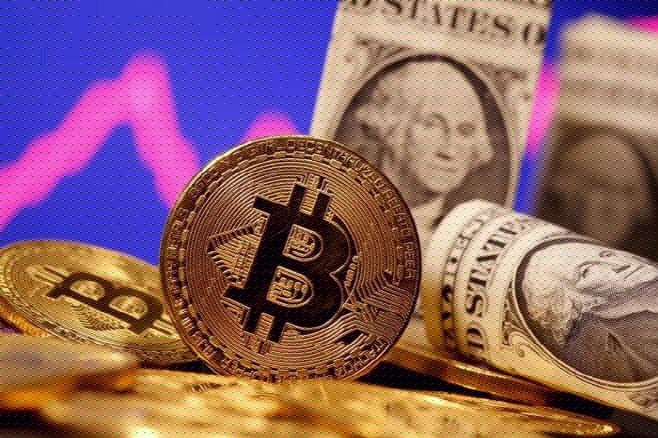 |
| Bitcoin image. / Reuters-Yonhap |
Bitcoin failed to break through the $65,000 threshold even as the U.S. Federal Reserve's decision to hold interest rates steady raised hopes for gains in Bitcoin and major altcoins. Analysts say the rate-hold had largely been priced in already, and continued uncertainty over monetary policy kept investor sentiment in check.
According to U.S. crypto exchange Coinbase, Bitcoin was trading at $64,274 as of 12:50 p.m. on the 31st, up 0.3% from the previous day. Ethereum, meanwhile, was down 0.21% at $1,905.80 at the same time, indicating that major altcoins, including Bitcoin, are trading sideways.
Prices showed limited movement even after the Federal Open Market Committee (FOMC) kept its benchmark rate unchanged the previous day. While a rate hold typically serves as good news for risk assets, the market appears to have already priced in the likelihood of a hold to a significant degree, preventing it from becoming a fresh catalyst for gains this time.
In particular, Fed Chair Kevin Warsh maintained his previously cautious stance on the future policy direction. He reaffirmed that policy decisions would depend on confirming economic indicators such as whether inflation is slowing and the state of the labor market, offering none of the clear easing signals the market had hoped for. As a result, U.S. Treasury yields rose, and investors' appetite for risk assets pulled back somewhat.
Internal disagreement within the FOMC also weighed on prices. At this meeting, 3 of the 12 voting members dissented, arguing instead for a rate hike. With the Fed itself showing continued vigilance over inflationary pressure, the market appears mindful of the possibility that a tighter policy stance could persist for some time.
On top of this, the pace of inflows into U.S. spot Bitcoin ETFs has recently slowed, with some products even seeing outflows. Institutional investors appear to be taking a wait-and-see approach, looking to confirm economic indicators after the FOMC meeting rather than aggressively expanding their risk-asset exposure.
Experts expect key U.S. economic indicators, such as the personal consumption expenditures (PCE) price index and employment data, to shape the price outlook going forward. Some observers note that if inflation is confirmed to be slowing, expectations for monetary easing later this year could revive, creating a more favorable environment for Bitcoin.
Ryan Lee, chief analyst at Bitget, said, "The market is placing more weight on the future path of monetary policy than on the rate hold itself," adding, "Volatility could widen in the short term depending on macroeconomic variables, but the medium- to long-term uptrend should remain intact as long as institutional demand holds up."
Geoff Kendrick, head of digital asset research at Standard Chartered, said, "Bitcoin's long-term investment case still rests on institutional inflows through spot ETFs and expanding corporate Bitcoin holdings," adding, "While a short-term correction could occur, there is a chance it will attempt new highs again if the macro environment improves."
Citi, in contrast, lowered its 12-month Bitcoin price target from $112,000 to $82,000 in a recent report, reflecting weaker-than-expected U.S. spot Bitcoin ETF flows so far this year. Lowering its ETF inflow projections, the bank assessed that "unless institutional inflows pick up meaningfully again, Bitcoin's rate of appreciation could remain limited."
Kim Min-ju
Most Read
-
1
Celltrion’s Omlyclo gains ground in major European..

-
2
Trump demands rates fall below 1% as Fed hikes for..

-
3
Hyundai Motor Group breaks ground on integrated st..

-
4
U.S. strikes 3 Iranian oil tankers, Iran vows reta..

-
5
Trump makes $1 trillion bet ahead of midterm elect..

-
6
Iran resumes ballistic missile production, assembl..

-
7
Samsung Electronics, Mistral AI to jointly develop..

PEOPLE







-
Address : In-Young Bldg., 34, Uisadang-daero 1-gil, Yeongdeungpo-gu, Seoul
Copyright by ASIATODAY CO., LTD. All rights resereved