



Trump administration weighs $100,000 fee for foreign grads seeking jobs in U.S.
Jul 31, 2026, 10:48 am


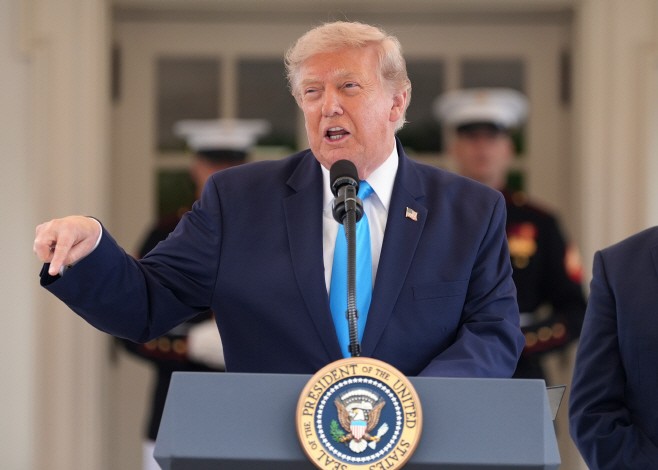 |
| U.S. President Donald Trump announces the "Freedom Haulers" initiative to support veterans' employment as commercial truck drivers at the White House in Washington, D.C. on the 30th (local time). / AP-Yonhap |
The Trump administration is considering imposing a $100,000 (142.55 million won) fee on foreign students' Optional Practical Training (OPT) after graduating from U.S. universities, the Wall Street Journal (WSJ) reported on the 30th (local time).
As of 2024, about 419,000 foreign nationals were working under OPT, and it has not yet been decided who would bear the fee or whether the White House will approve the measure.
Trump administration weighs $100,000 fee for OPT work authorization, affecting 419,000 users
OPT is a program that allows foreign graduates of U.S. universities to work for one to three years while still holding student status. STEM graduates can work for up to three years using STEM OPT. The Trump administration is discussing the $100,000 OPT fee within the Department of Homeland Security (DHS). WSJ noted the move could discourage foreign students from choosing to study in the U.S. and could also hurt universities that rely on international student tuition.
OPT fee directly targets U.S. university hiring-to-H-1B pipeline
U.S. information technology (IT) and accounting firms mainly hire foreign workers directly from abroad using H-1B professional work visas. Major Silicon Valley and Wall Street firms, by contrast, prefer to hire foreign graduates from top U.S. universities, employ them under OPT, and convert them to H-1B visas years later.
The Trump administration initially sought to impose the $100,000 fee on all H-1B visas but narrowed the scope to new hires recruited from outside the U.S. after pushback from tech companies. WSJ assessed that the OPT fee more directly targets tech and finance firms that use U.S. universities as a talent pipeline.
First Circuit blocks H-1B fee collection as $100,000 policy expands
The U.S. Court of Appeals for the First Circuit, based in Boston, upheld on the 24th a lower court ruling blocking the Trump administration from imposing the $100,000 fee on H-1B visas. The court found the administration was unlikely to be able to prove it had the authority to impose the fee.
The administration is now considering imposing the same fee on OPT as well. The State Department is also preparing a plan to require a $100,000 bond from foreign nationals applying for permanent residency from abroad. Applicants would only get the bond back after moving to the U.S. and obtaining citizenship.
Immigration restrictionists call for ending STEM OPT; DHS to unveil overhaul this fall
OPT advocates argue the program is a key factor drawing foreign students to study in the U.S., saying that without it, students would leave the country right after graduation and take the skills they gained at U.S. universities to markets abroad. Immigration restrictionists counter that there are no rules preventing companies from hiring foreign graduates at lower wages than American graduates.
During the first Trump administration, Stephen Miller, then White House senior policy adviser (now deputy White House chief of staff), pushed to eliminate STEM OPT. However, business-friendly aides, including then-presidential son-in-law and White House senior adviser Jared Kushner, opposed the move, and it was not eliminated.
This month, DHS introduced fixed terms of stay for foreign students and a new application process for the stay extensions required to use OPT. DHS is also expected to unveil a full overhaul of OPT rules as early as this fall.
Ha Man-ju
Most Read
-
1
Celltrion’s Omlyclo gains ground in major European..

-
2
Trump demands rates fall below 1% as Fed hikes for..

-
3
Trump makes $1 trillion bet ahead of midterm elect..

-
4
Iran resumes ballistic missile production, assembl..

-
5
Samsung Electronics, Mistral AI to jointly develop..

-
6
Trump warns countries not helping U.S. must pay re..

-
7
Apple launches first foldable, 1 million won prici..

PEOPLE






HEADLINE NEWS
- Trump to roll out ‘unprecedented welcome’ for Xi with B-2 bombers, F-22 fighters
- S. Korea, U.S., and Japan form united front on Taiwan and economic coercion..
- Trump administration moves to impose sweeping sanctions on International Cr..
- Xi to make state visit to U.S. Sept. 23-25, dispelling rumors over his heal..

-
Address : In-Young Bldg., 34, Uisadang-daero 1-gil, Yeongdeungpo-gu, Seoul
Copyright by ASIATODAY CO., LTD. All rights resereved