



Delinquency rates rise in manufacturing, real estate, retail as banks brace for rate, oil risks
Jul 31, 2026, 10:39 am


 |
| This image was generated by AI. |
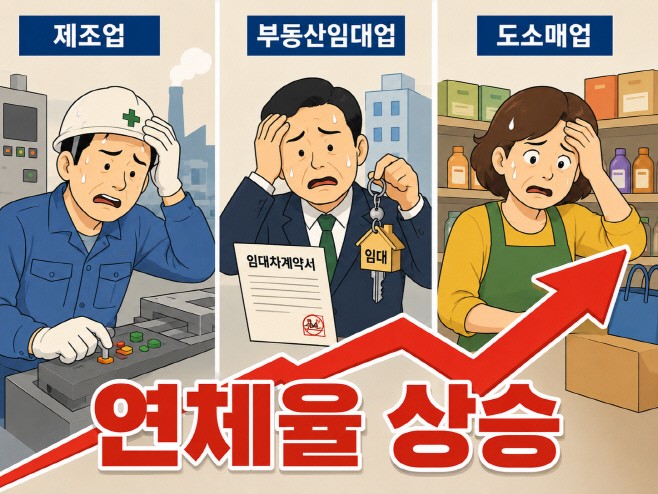
Delinquency rates in industries with heavy corporate loan exposure — manufacturing, wholesale/retail, and real estate leasing — are rising, heightening concern in the banking sector. Since roughly 70% of commercial banks' corporate loans are concentrated in these industries, even a modest rise in delinquency rates could substantially expand the bad-debt risk banks must absorb. Concerns are mounting that delinquency rates could climb further, given lingering variables such as the aftereffects of the base rate hike and a spike in oil prices from the prolonged Middle East conflict, which could worsen business conditions across major industries.
According to the financial industry on the 30th, the simple average corporate loan delinquency rate at the four major banks — KB Kookmin, Shinhan, Hana, and Woori — stood at 0.42% at the end of the second quarter this year, up 0.08 percentage points from the end of last year (0.34%), and up 0.03 percentage points from the same period last year. This is 0.13 percentage points higher than the household loan delinquency rate (0.29%). Within corporate loans, the large-enterprise loan delinquency rate was relatively low at 0.09%, while the SME loan delinquency rate was high at 0.55%.
By industry, the rise was most pronounced in real estate leasing. The average delinquency rate for real estate leasing at the four banks was 0.45%, up 0.18 percentage points from the end of last year (0.27%), marking the sharpest increase. By bank, Woori Bank had the highest rate at 0.62%, followed by Hana Bank at 0.57%, Shinhan Bank at 0.42%, and KB Kookmin Bank at 0.16%. A commercial bank official explained that real estate leasing is an industry sensitive to economic shifts, with delinquency rates moving in tandem with factors like commercial vacancy rates and small business closures.
Manufacturing delinquency rates also rose. The four banks' average second-quarter manufacturing delinquency rate was 0.38%, up 0.06 percentage points from the end of last year. While export-driven sectors such as semiconductors and shipbuilding performed well, this is attributed to expanding bad debt from continued weakness in traditional manufacturing sectors such as steel, petrochemicals, and textiles.
The wholesale and retail delinquency rate also rose, from 0.49% at the end of last year to 0.53% in the second quarter this year, an increase of 0.04 percentage points. This reflects both the corporate rehabilitation proceedings of large retailers such as Homeplus and rising costs for retailers as higher oil and raw material prices fed into domestic inflation during the second quarter.
The banking sector does not see the rising delinquency rates as likely to immediately spiral into a soundness crisis. Still, since a significant portion of corporate loans is concentrated in these industries, there is concern that a spread of bad debt could quickly increase the burden on bank soundness. As of the first quarter this year, the four banks' outstanding real estate leasing loan balance stood at 192.4905 trillion won, the largest among all industries excluding the "other" category. Manufacturing followed at 185.3701 trillion won and wholesale/retail at 98.4437 trillion won, ranking second and third. Combined, loans to these three industries account for about 68% of total corporate loans.
The concern is that delinquency rates could rise further in the second half of the year. The Bank of Korea raised its base rate by 0.25 percentage points in July, and there is a prevailing view that it could raise rates once more before year-end. Meanwhile, renewed intensification of the U.S.-Iran conflict has pushed Dubai crude above $80 per barrel, adding to oil price pressure. In its financial stability report last month, the Bank of Korea noted that financial institutions' exposure to "industries requiring caution," such as wholesale/retail and real estate, is large and that their delinquency rates are also higher than the average across all industries, pointing to the need for asset soundness management.
A banking industry official said, "This isn't an immediate cause for concern, but since loans are heavily concentrated in these industries, we are closely monitoring the related indicators," adding, "We will do our utmost to manage delinquency rates by preemptively resolving bad debt while also supporting debt recovery and normalization."
Han Sang-wook
Most Read
-
1
Celltrion’s Omlyclo gains ground in major European..

-
2
Trump demands rates fall below 1% as Fed hikes for..

-
3
Hyundai Motor Group breaks ground on integrated st..

-
4
U.S. strikes 3 Iranian oil tankers, Iran vows reta..

-
5
Trump makes $1 trillion bet ahead of midterm elect..

-
6
Iran resumes ballistic missile production, assembl..

-
7
Samsung Electronics, Mistral AI to jointly develop..

PEOPLE







-
Address : In-Young Bldg., 34, Uisadang-daero 1-gil, Yeongdeungpo-gu, Seoul
Copyright by ASIATODAY CO., LTD. All rights resereved