



[Exclusive] Asset managers say delisting single-stock leveraged ETFs should be considered
Jul 31, 2026, 09:05 am


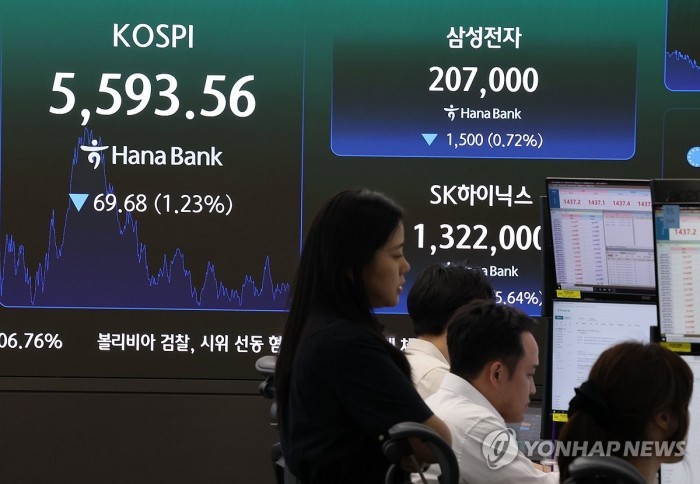 |
| The KOSPI closing index is displayed on an electronic board in the dealing room of Hana Bank in Jung-gu, Seoul, on July 30. The KOSPI closed at 5,593.56, down 69.68 points (1.23%) from the previous day. / Yonhap News |
CEOs of major asset management companies have reportedly gone so far as to raise the possibility of delisting single-stock leveraged products linked to "Samjeonnix" (Samsung Electronics and SK Hynix). At an emergency meeting hosted by the chairman of the Korea Financial Investment Association on July 29, asset management CEOs shared concerns over the risks of single-stock leverage and agreed that higher entry barriers should be established through delisting or equivalent regulatory measures to prevent further investor losses. It is unusual for the asset management industry, which created these single-stock leveraged products, to reflect critically on them.
Asset management heads agreed on this stance as criticism mounted that leveraged products targeting Samsung Electronics and SK Hynix were the primary driver behind recent stock market volatility. Indeed, circuit breakers were triggered on both the KOSPI and KOSDAQ markets for two consecutive days on July 28 and 29 for the first time in history.
The issue is that the views of asset managers diverge from those of the government. Kim Yong-beom, chief presidential secretary for policy, recently assessed KOSPI volatility by saying, "Because the concentration in semiconductors is so high, it cannot be viewed solely as a leverage problem." While the government previously suggested only early implementation of measures such as raising basic margin requirements alongside stronger industry self-regulation, market operators themselves are now calling for stronger countermeasures.
According to the financial investment industry on July 30, heads of major asset management firms agreed with the option of delisting leveraged products during an emergency meeting held the previous day for executives in charge of single-stock leveraged product operations and liquidity providers (LPs) at brokerage firms.
An official who attended the meeting said, "While supplementary measures for leverage may temporarily cool volatility, the situation remains a ticking time bomb. Taking into account the risks, volatility, and investor losses associated with leveraged products, CEOs of major asset management companies agreed to go as far as delisting them in the worst-case scenario."
The reason CEOs of major asset management firms raised the possibility of delisting Samjeonnix leverage is the extreme stock market volatility and rising losses among retail investors. Following the circuit breakers on July 28 and 29, the stock market continued its decline for a third consecutive day on July 30. Over those three days, the KOSPI index plummeted 17%, while shares of Samsung Electronics and SK Hynix dropped sharply by 18.50% and 27.20%, respectively, during the same period. Since leveraged products track twice the return of their underlying assets, single-stock leveraged products plummeted to about one-third of their initial listing values due to the steep drop in Samjeonnix stock prices.
Regarding the previous day's meeting, the Korea Financial Investment Association stated it would implement voluntary measures, such as encouraging asset managers to spread out intra-day rebalancing trades, prompting LP brokerages to expand liquidity, and enhancing investor education. However, these measures do not differ significantly from previously announced plans. This has drawn criticism that the government is responding with a complacent view that current market volatility is not solely due to leverage. Consequently, voices within the asset management industry itself argue that strong regulations on leveraged products are necessary to prevent further investor losses.
A key point to watch is the plan to raise basic margin requirements set to take effect on July 31. The government will implement a measure raising the requirement from the previous 10 million won to 30 million won in cash. Previously, up to 70% of the 10 million won requirement could be covered by held stock value, meaning investors needed only 3 million won in cash alongside 7 million won in stock holdings to trade leverage. Moving forward, having 30 million won in cash will be required.
Regarding the size of the margin requirement, some in the industry argue it should be raised to at least 100 million won. The rationale is that while existing retail investors in leveraged products cannot be undone, steps must be taken to prevent new investors from jumping into leveraged products and incurring losses. In highly volatile markets, the structure of leveraged products inevitably magnifies the scale of losses.
According to a market report by global investment bank Citi Global Markets, the market capitalization of leveraged ETFs based on South Korean assets shrank from 52.5 billion dollars (around 75 trillion won) on June 22 to 19 billion dollars (around 27 trillion won) recently. Estimated losses for domestic retail investors stand at approximately 56 trillion won.
On the previous day, government officials, including Deputy Prime Minister Koo Yun-cheol, held an emergency market situation review meeting (F4) and announced plans to limit individual investment caps to within 20% of total investment funds.
Meanwhile, some observers believe the effect of raising basic margin requirements will be significant. Moving forward, unsettled funds will no longer be counted as margin, preventing investors from reinvesting funds from sold stock before those funds are settled. Analysis suggests this will curb day trading by investors who previously bought and sold multiple times a day. An asset management industry official noted, "Previously, because unsettled funds from stock sales were recognized as margin, investors traded repeatedly. Going forward, investors will need 30 million won in cash to trade, and those who sell today cannot buy again until two days later when the proceeds arrive. This is expected to reduce day trading and lower turnover rates."
Yoon Seo-young
Most Read
-
1
Celltrion’s Omlyclo gains ground in major European..

-
2
Trump demands rates fall below 1% as Fed hikes for..

-
3
Hyundai Motor Group breaks ground on integrated st..

-
4
U.S. strikes 3 Iranian oil tankers, Iran vows reta..

-
5
Trump makes $1 trillion bet ahead of midterm elect..

-
6
Iran resumes ballistic missile production, assembl..

-
7
Samsung Electronics, Mistral AI to jointly develop..

PEOPLE







-
Address : In-Young Bldg., 34, Uisadang-daero 1-gil, Yeongdeungpo-gu, Seoul
Copyright by ASIATODAY CO., LTD. All rights resereved