



Elections in Pakistan-administered Kashmir turn bloody
Jul 30, 2026, 05:03 pm


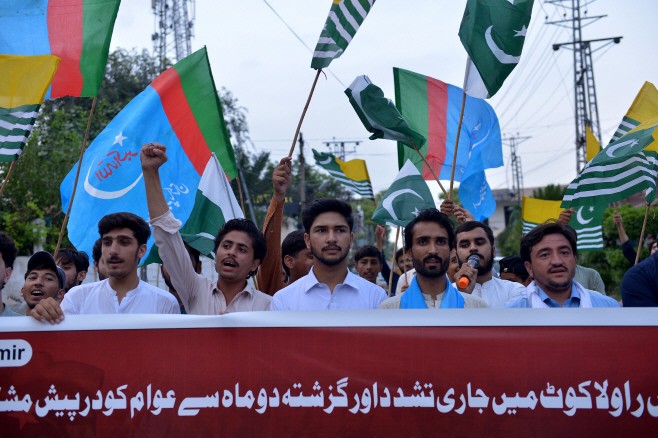 |
| Members of Islami Jamiat-e-Talaba, the student wing of Jamaat-e-Islami, shout slogans in Peshawar, Pakistan, on July 29 (local time). The demonstration was held to protest the bloodshed during the local elections in Pakistan-administered Kashmir (Azad Jammu and Kashmir) and to call for peaceful dialogue. / EPA Yonhap News |
Protests surrounding local elections in Pakistan-administered Kashmir have escalated into bloodshed.
On July 30 (local time), the leadership of the Joint Awami Action Committee (JAAC), which has been leading the protests in the region, claimed that more than 30 people were killed in clashes with security forces in the Rawalakot area ahead of the second phase of voting the previous day.
The exact death toll remains unconfirmed. Following the local government's designation of the JAAC as a banned organization in June, violent protests ensued, leading to widespread shutdowns of internet services, banking, and roads. Given the difficulty of local news reaching the outside world, Reuters reported that it could not independently verify the JAAC's tally of over 30 fatalities.
The casualties confirmed by authorities are significantly lower. Authorities stated that one security personnel was killed and five others were injured in clashes on July 27. An official speaking on condition of anonymity said at least three protesters were known to have been killed in Mirpur this week. Pakistani authorities have justified their hardline response by claiming that Indian-backed armed militants joined the protesters, an assertion India has previously denied.
The elections were originally scheduled to take place on July 27, but authorities split the process into three regional phases citing security concerns. In the first phase held on July 27 across three districts—Mirpur, Kotli, and Bhimber—the Pakistan Muslim League-Nawaz (PML-N), the leading party in Pakistan's ruling coalition, secured 9 out of 13 seats. This outcome came amid a boycott by the Pakistan Tehreek-e-Insaf (PTI), founded by former Prime Minister Imran Khan—who won the 2021 election—due to concerns over electoral fraud.
Allegations of fraud did not end with the boycott. Disputes over the results erupted among participating candidates, with rival parties accusing each other of snatching ballot boxes and rigging votes. Government officials confirmed that, separate from the JAAC protests, clashes between supporters of the ruling coalition's two main parties—PML-N and the Pakistan Peoples Party (PPP)—left one person dead and several others injured.
A resident in Muzaffarabad, the regional capital, said on July 29, "The entire election was rigged." On the same day, a rally in support of Kashmir's peaceful protesters was held in Islamabad, the capital of Pakistan. Sardar Mazhar, a participant at the rally, said, "We hope this issue is resolved peacefully."
The current crisis stems from decades of underlying conflict. Groups demanding greater autonomy in this Pakistan-administered region have long argued that the central government intervenes in local politics while economically neglecting the area. Discontent has primarily erupted over economic grievances. In 2022, residents staged protests over high electricity tariffs, despite the region supplying cheap hydroelectric power to other parts of Pakistan.
Formed in 2023, the JAAC rallied this anger to demand electoral reforms. The core of the issue lies in 12 of the 45 directly elected seats in the local assembly. These seats are designated for constituencies representing residents defined by the local constitution as refugees from Indian-administered Kashmir, but in practice, they have often been filled by individuals residing outside Kashmir. The JAAC claimed the central government used these seats to manipulate local politics, an allegation Pakistani government officials denied.
Political analyst Hasan Askari noted that these 12 seats would serve as a key variable in forming the government after the election, stating that the PML-N would need the support of some lawmakers occupying those seats to form a local government. "How can the government find a solution to this issue when it depends on those controversial 12 seats?" he said. The second and third phases of voting are scheduled for August 2 and August 10.
Jeong Ri-na
Most Read
-
1
Celltrion’s Omlyclo gains ground in major European..

-
2
Trump demands rates fall below 1% as Fed hikes for..

-
3
Trump makes $1 trillion bet ahead of midterm elect..

-
4
Iran resumes ballistic missile production, assembl..

-
5
Samsung Electronics, Mistral AI to jointly develop..

-
6
Trump warns countries not helping U.S. must pay re..

-
7
Seoul faces triple squeeze over troop deployment t..

PEOPLE






-
Address : In-Young Bldg., 34, Uisadang-daero 1-gil, Yeongdeungpo-gu, Seoul
Copyright by ASIATODAY CO., LTD. All rights resereved