



KOSPI falls below 6,000, market cap shrinks by 2,800 trillion won in a month
Jul 30, 2026, 10:33 am


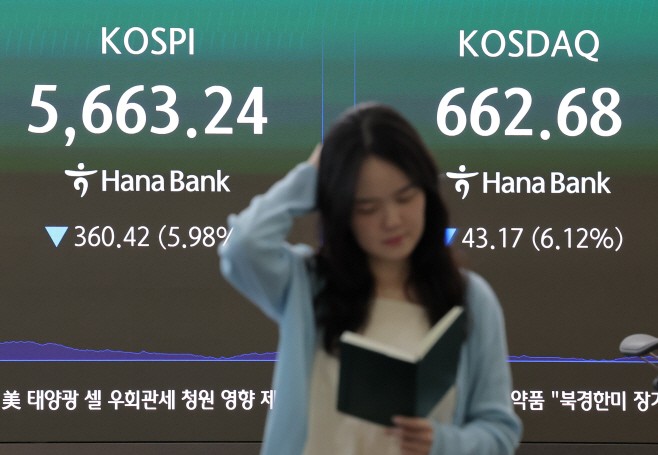 |
| Hana Bank dealing room on July 29 / Yonhap News |
On July 29, the KOSPI plunged into the 5,600 level once again due to negative external factors and worsening supply-demand dynamics. Following the activation of sell sidecars in both the KOSPI and KOSDAQ markets, trading was temporarily halted as circuit breakers were triggered simultaneously across both exchanges. Amid the ongoing steep market sell-off, the KOSPI's total market capitalization shrank by approximately 2,800 trillion won in just one month.
On this day, the KOSPI index opened at 6,089.11, up 65.45 points (1.09%) from the previous trading day, but closed at 5,663.24, down 360.42 points (5.98%). In the main board market, retail and foreign investors dragged down the index by net selling 1.9655 trillion won and 1.2300 trillion won, respectively. Conversely, institutional investors were sole net buyers, purchasing 3.1576 trillion won.
In particular, as both the KOSPI and KOSDAQ indices crashed over 8% during the session, circuit breakers were triggered across both markets for the second consecutive day. A circuit breaker suspends trading for 20 minutes when an index remains down by 8% or more compared to the previous day for a full minute. Alarmingly, on the preceding day, July 28, both the KOSPI and KOSDAQ markets had already plummeted by 10.84% and 7.72% respectively, simultaneously triggering circuit breakers. The dual-market circuit breaker activation was the first since the COVID-19 pandemic in March 2020, and its occurrence for two consecutive days marked an unprecedented first.
As the stock market crashed in a short span, total KOSPI market capitalization shrank to around 4,669 trillion won at the closing bell, evaporating nearly 2,800 trillion won from its peak of approximately 7,449 trillion won reached on June 22.
The direct catalysts behind the steep decline were excessively high market expectations for the semiconductor industry combined with negative news out of China. SK Hynix achieved record-high quarterly performance in the second quarter of this year, reporting revenue of 79.3187 trillion won and operating profit of 60.5426 trillion won. However, citing results that fell short of market consensus estimates, its shares closed at 1,401,000 won, down 9.61% from the previous session. Analysts noted that investor sentiment was further dampened by growing peak-out concerns for domestic semiconductor stocks following the blockbuster Shanghai IPO of China's ChangXin Memory Technologies (CXMT) and China's domestic development of deep ultraviolet (DUV) lithography equipment.
Market analysts diagnosed the current stock market environment not as a deterioration of fundamentals, but as a market driven by supply-demand imbalances and fear-induced panic selling. The KOSPI index, which stood at the 8,400 level a month ago, fell to as low as the 5,200 level intraday, marking a drop of nearly 40% in a single month. The KOSDAQ also tumbled around 35% over the same period. These decline rates significantly exceed those of major Asian peers such as Japan, Taiwan, and China (-10% to -17%), representing the largest drop globally.
As the fall in domestic equities widened, the government and financial authorities initiated a comprehensive review of the market structure. Kim Yong-beom, Presidential Chief of Staff for Policy, met with reporters in São Paulo, Brazil, on July 29 (local time) and stated, "The Financial Services Commission and the Financial Supervisory Service will examine the structural factors that make our market volatility particularly pronounced."
He elaborated, "The high volatility seen over the past two to three months was not unique to our market. However, when a shift of 10 occurs at the center of global fluctuations, it gets amplified to 20 or 30 in South Korea." He added, "While leveraged ETFs may make this phenomenon appear even more stark, that is not the sole reason. It is time to seriously look into our high proportion of derivative products and investor demographics."
Han Hye-seong
Most Read
-
1
Celltrion’s Omlyclo gains ground in major European..

-
2
Trump demands rates fall below 1% as Fed hikes for..

-
3
Hyundai Motor Group breaks ground on integrated st..

-
4
U.S. strikes 3 Iranian oil tankers, Iran vows reta..

-
5
Trump makes $1 trillion bet ahead of midterm elect..

-
6
Iran resumes ballistic missile production, assembl..

-
7
Samsung Electronics, Mistral AI to jointly develop..

PEOPLE






-
Address : In-Young Bldg., 34, Uisadang-daero 1-gil, Yeongdeungpo-gu, Seoul
Copyright by ASIATODAY CO., LTD. All rights resereved