



U.S. leaders, defense sector rally on Zelenskyy visit to press Putin
Jul 29, 2026, 01:07 pm


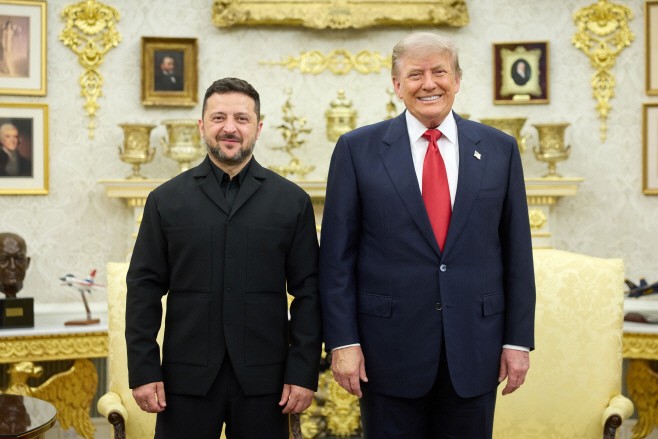 |
| Ukrainian President Volodymyr Zelenskyy (left) and U.S. President Donald Trump pose for a photo during a meeting in the Oval Office at the White House in Washington, D.C., U.S., on July 28 (local time). / Courtesy of the Presidential Office of Ukraine, UPI, Yonhap |
Ukrainian President Volodymyr Zelenskyy met with President Donald Trump at the White House in Washington, D.C., on July 28 (local time) to discuss licenses for producing Patriot interceptor missiles and ways to resume diplomacy to end the war.
Following Ukraine's attack on an Iranian vessel in the Caspian Sea on July 25, Iran warned of retaliation. Meanwhile, the U.S. Senate passed a cloture motion to proceed with consideration of a sanctions bill targeting buyers of Russian energy.
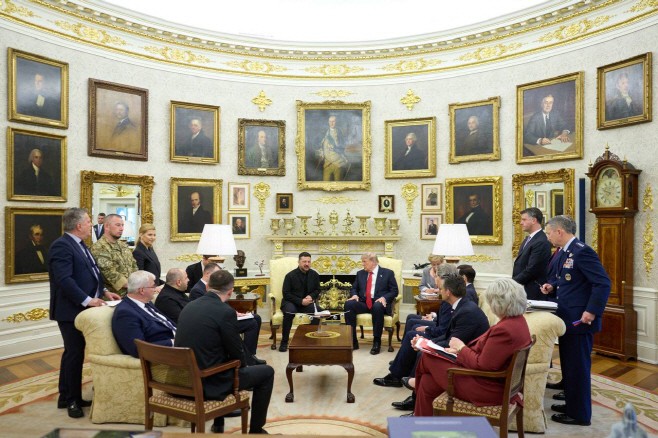 |
| Ukrainian President Volodymyr Zelenskyy (center-left) holds a meeting with President Donald Trump (right) in the Oval Office at the White House in Washington, D.C., U.S., on July 28 (local time). / Courtesy of the Presidential Office of Ukraine, AFP, Yonhap |
Zelenskyy, Trump discuss Patriot production licenses, resumption of diplomacy to end war; U.S. envoy and Trump's son-in-law seek Ukraine visit
Following the meeting, President Zelenskyy stated on social media that it was a "good meeting," sharing that they discussed licenses for producing Patriot interceptor missiles and additional support measures. He explained that both leaders agreed on the need to reinvigorate diplomacy to end the war, adding that working-level teams from both sides would coordinate the details of follow-up discussions.
The policy to resume diplomacy confirmed during the White House summit led to plans for a U.S. mediation team to visit Ukraine. Steve Witkoff, U.S. Special Envoy for the Middle East, and Jared Kushner, former senior advisor to the White House and son-in-law of President Trump, agreed to visit Ukraine for the first time to restart mediation with Russia, Reuters reported, citing multiple sources.
Alongside diplomatic discussions, President Zelenskyy also moved to expand Ukraine's air defense manufacturing base. After discussing joint production of Patriots with representatives from U.S. defense contractor Raytheon, he conferred with officials from Lockheed Martin on defense production and technological exchange. President Zelenskyy stated via X that working-level teams from both sides are devising concrete measures to expedite joint production.
U.S. right-wing activist Laura Loomer shifted to a pro-Ukraine stance following a visit to Ukraine, and President Trump shared Loomer's interview with President Zelenskyy on Truth Social, reported media outlets including the Financial Times (FT) and The Wall Street Journal (WSJ).
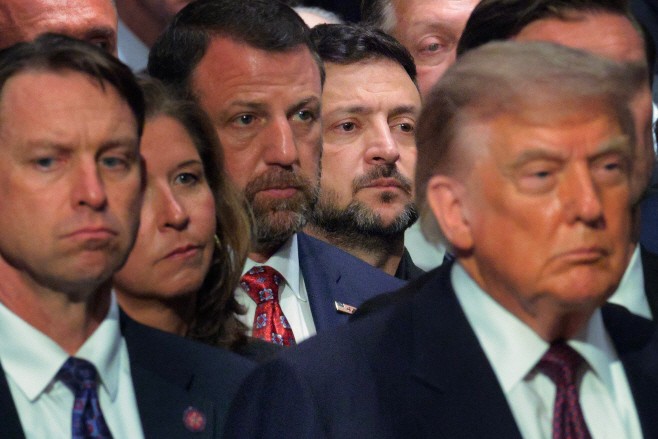 |
| Ukrainian President Volodymyr Zelenskyy (second from right) attends the funeral service for the late Republican Senator Lindsey Graham alongside leaders from various countries, including U.S. President Donald Trump (left), at the Washington National Cathedral in Washington, D.C., U.S., on July 28 (local time). The funeral service was attended by political leaders from various nations, including Israeli Prime Minister Benjamin Netanyahu, as well as the bereaved family, key ministers of the Trump administration, and members of the Senate and House of Representatives. Senator Graham, first elected to the Senate in 2002, passed away suddenly on July 11 from aortic dissection at the age of 71. / AFP, Yonhap |
Ukraine launches over 390 drones at Moscow; Putin's approval rating drops amid strikes on Russian oil refineries
Apart from discussions on restoring diplomatic channels, long-range strikes continued on the battlefield. Russian authorities stated that Ukraine launched over 390 drones toward Moscow overnight. The Russian military announced on the same day that it attacked a Ukrainian vessel near Mykolaiv along the Black Sea coast.
Ukraine also sustained long-range drone strikes targeting Russian oil refineries, military, and logistics facilities. The Washington Post (WP) reported that Ukraine's attacks on oil refineries intensified fuel shortages and price surges across Russia.
The strain of the prolonged war was also reflected in domestic public opinion and politics within Russia. According to WP, a state-run polling agency in Russia found that President Vladimir Putin's approval rating dropped 5 percentage points in a single week to 66%. WP cited the independent Russian news outlet Meduza as reporting that the projected vote share for the ruling United Russia party also fell from 55% to 45%.
Ahead of the September general election, Russian authorities restricted candidates with anti-war stances, including the liberal Yabloko party and anti-war politician Boris Nadezhdin, from running for office.
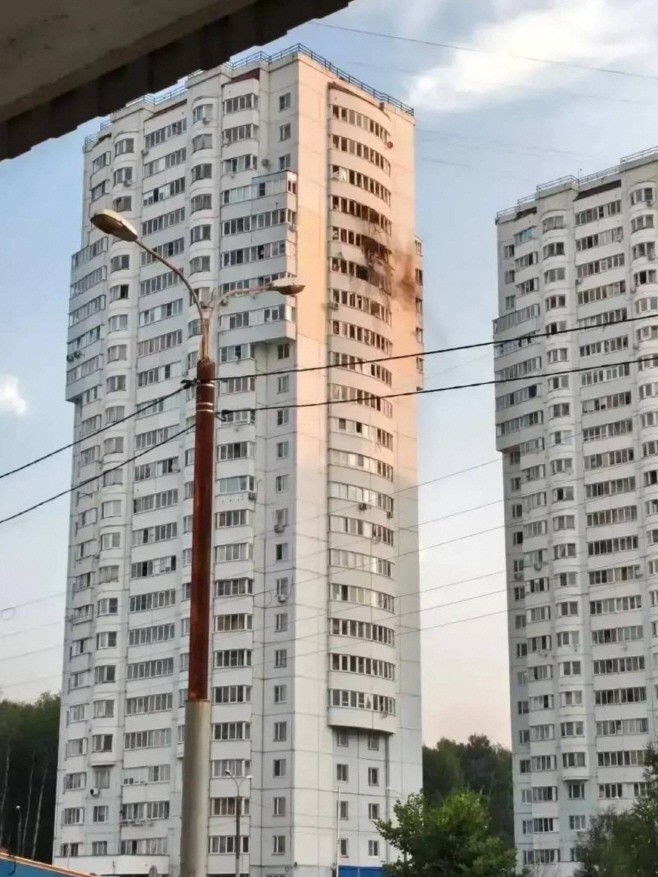 |
| An apartment building in Chekhov, Moscow Oblast, Russia, is damaged following an overnight Ukrainian drone attack on July 28 (local time). / Courtesy of Moscow Oblast Governor Andrei Vorobyov, Reuters, Yonhap |
Ukraine attacks Iranian vessel in Caspian Sea; Foreign ministers of both countries consult to restrain escalation and compensate for damages
War with Russia expanded into tension between Ukraine and Iran following an attack on an Iranian vessel. The New York Times (NYT), a U.S. daily newspaper, reported that Ukraine attacked an Iranian ship in the Caspian Sea on July 25 using long-range drones, claiming it had been used to transport military supplies between Russia and Iran.
Iranian authorities countered that the struck vessel was a civilian merchant ship and that one crew member was killed. Abbas Araghchi, Minister of Foreign Affairs of Iran, warned of retaliation on X, writing that this attack "cannot go unanswered." Andrii Sybiha, Minister of Foreign Affairs of Ukraine, stated via social media that Ukraine did not target civilian vessels or civilians.
The two sides subsequently activated diplomatic channels and confirmed their intentions to prevent escalation. Foreign Minister Araghchi and Foreign Minister Sybiha confirmed their positions to avoid escalation during a phone call, reported AP and NYT. Foreign Minister Araghchi stated that Iran also does not desire escalation, but added that attacks on its citizens and national interests cannot be tolerated, demanding compensation for damages.
Military cooperation between Russia and Iran also lies in the background of the confrontation between Ukraine and Iran. President Zelenskyy stated that Russia provided Iran with satellite surveillance information regarding Gulf states and U.S. military bases in the region. NYT reported that Iran supplied attack drones to Russia.Ukraine also dispatched over 200 military experts to the Middle East to support Gulf states in intercepting Iranian drones, and signed agreements on drone and missile response cooperation with Saudi Arabia, Qatar, and the United Arab Emirates (UAE), reported NYT, WSJ, and AP.
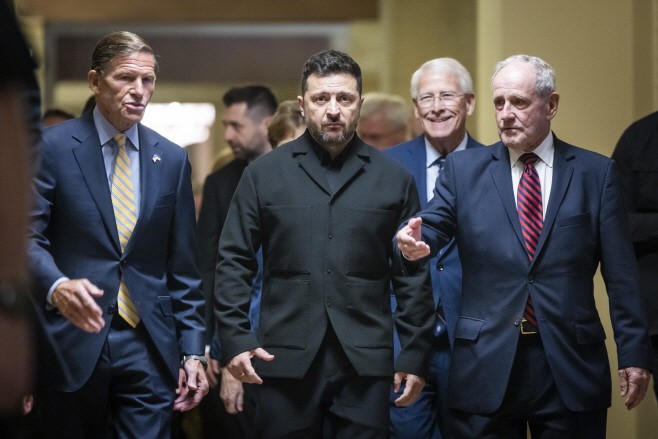 |
| Ukrainian President Volodymyr Zelenskyy (center) arrives at the U.S. Capitol in Washington, D.C., U.S., on July 28 (local time) and is guided by senators. / EPA, Yonhap |
U.S. Senate passes motion to begin consideration of Russia-Iran sanctions bill; EU considers sanctioning over 1,600 Russian companies
Along with military and diplomatic pressure, the United States and Europe also pushed to expand economic sanctions against Russia. Following his meeting at the White House, President Zelenskyy attended the funeral service for the late Republican Senator Lindsey Graham held at the Washington National Cathedral. Via social media, he extended his condolences to President Trump and honored Senator Graham as "a true friend of Ukraine."
On that day, the U.S. Senate passed a cloture motion on the "Lindsey O. Graham Russia and Iran Sanctions Act of 2026"—a legislative vehicle to begin consideration of the Russia sanctions bill—by a vote of 86 to 12. This was a procedural vote to proceed with consideration of the bill.
According to NYT, the sanctions bill mandates tariffs of up to 100% on U.S. imports from up to five top buyers of Russian oil and gas and the top five countries assisting Russia in evading petroleum sanctions. The bill includes exceptions for countries where Russian natural gas imports account for less than a specified threshold and are actively reducing those imports, while allowing the president to waive sanctions or tariffs based on U.S. national interests.
AP reported that the bill imposes tariffs on major buyers of Russian energy, including China and India, and sanctions President Putin, Russian financial institutions, and energy projects.
Bloomberg News reported that the European Union (EU) is also considering sanctioning over 1,600 additional companies deemed to be supporting Russia's war effort. Bloomberg noted that the companies under sanction review generate over $20 billion (29.096 trillion won) in annual revenue and employ more than 265,000 people.
Ha Man-joo
Most Read
-
1
Celltrion’s Omlyclo gains ground in major European..

-
2
Trump demands rates fall below 1% as Fed hikes for..

-
3
Trump makes $1 trillion bet ahead of midterm elect..

-
4
Iran resumes ballistic missile production, assembl..

-
5
Samsung Electronics, Mistral AI to jointly develop..

-
6
Trump warns countries not helping U.S. must pay re..

-
7
Apple launches first foldable, 1 million won prici..

PEOPLE






HEADLINE NEWS
- Trump to roll out ‘unprecedented welcome’ for Xi with B-2 bombers, F-22 fighters
- S. Korea, U.S., and Japan form united front on Taiwan and economic coercion..
- Trump administration moves to impose sweeping sanctions on International Cr..
- Xi to make state visit to U.S. Sept. 23-25, dispelling rumors over his heal..

-
Address : In-Young Bldg., 34, Uisadang-daero 1-gil, Yeongdeungpo-gu, Seoul
Copyright by ASIATODAY CO., LTD. All rights resereved