



China mobilizes full national power in AI showdown with U.S.
Jul 27, 2026, 03:20 pm


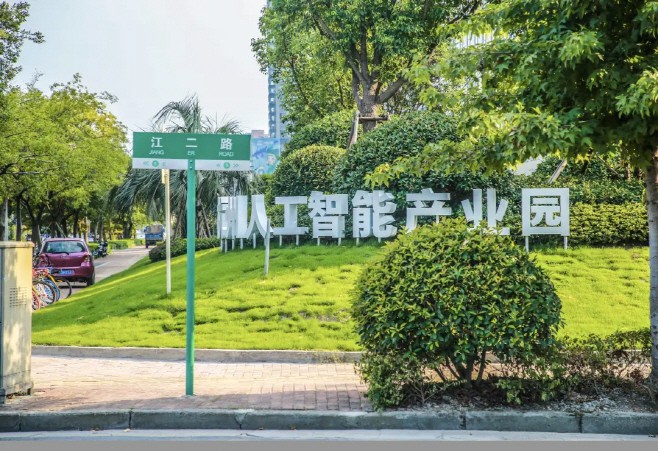 |
| The AI Industry Park in Hangzhou, Zhejiang Province, known as China's AI hub. There are estimated to be around 60 such parks across China. / Economic Daily |
China appears to be mobilizing its national strength to win the fierce artificial intelligence race against the U.S. There seems to be a acute sense of crisis that failing in this war would mean permanently settling as a G2 that can never overtake the U.S.
To see whether this is truly the case, one must examine the aggressive moves of both the industry and the government. Synthesizing recent reports from media outlets including the Economic Daily, the performance of the industry's so-called four AI titans—DeepSeek (Shendu Qiusuo), Moonshot AI (Yuezhi Anmian), Z.AI (Zhipu Huazhang), and MiniMax (Xiyu Keji)—is nothing short of extraordinary.
Among them, DeepSeek is famous for triggering the DeepSeek Shock by launching a low-cost, high-performance open-source AI model in January last year. From this perspective, it is hardly surprising that the company raised approximately 51 billion yuan (11.067 trillion won) in its first funding round last month, or that its valuation was recognized at over 50 billion dollars (73.1 trillion won).
Moonshot AI is one of the most highlighted cases recently. It is evaluated as having completely shaken the global AI industry with its large language model (LLM) Kimi K3. Having demonstrated performance comparable to leading U.S. models despite U.S. export controls on advanced semiconductors, such praise is well deserved.
Z.AI is building momentum after succeeding in developing an ultra-large AI model, a realm long considered the exclusive domain of U.S. Big Tech. With the unveiling of GLM-5.2 last month, it received reviews that it surpassed top-tier U.S. models. This allowed the company to comfortably join the low-cost, high-efficiency competition alongside DeepSeek.
MiniMax, founded by 37-year-old Yan Junjie who holds a doctorate from the Chinese Academy of Sciences, is widely known for putting forward MiniMax-M3, which targets coding and AI agent tasks. It is a multimodal model capable of processing not only text but also images and videos, supporting a context window of up to 1 million tokens.
In addition to these, considering the contributions of ICT giant ByteDance and the so-called Six Little Dragons and Five Little Phoenixes birthed in Hangzhou, Zhejiang Province, it would actually be strange if China's AI technology level did not surpass that of the U.S. Beijing-based ICT commentator Yang Xiaoqiang expressed confidence, stating, "I view the AI technology gap between China and the U.S. to be about six months. However, this gap is bound to narrow within two to three years at the latest," and there seems to be good reason for such confidence.
The Chinese government is also exerting every possible effort to secure victory in the AI war with the U.S. One need only look at the fact that General Secretary and President Xi Jinping demonstrated his resolve to actively engage in competition with the U.S. during his keynote speech at the 2026 World Artificial Intelligence Conference (WAIC) held in Shanghai on the 17th.
Going into details, it is safe to assert that China's efforts are truly formidable. First, one should examine the Implementation Opinions on the Innovative Development of Artificial Intelligence + Information and Communications (2026–2028) announced by the Ministry of Industry and Information Technology under the State Council in June this year. It stands out for presenting 17 tasks to develop the artificial intelligence industry to a level that completely surpasses the U.S.
It is also noteworthy that Shanghai has established two industrial clusters: the Zhangjiang and Beiyang AI Innovation Towns in the eastern and western parts of the city. It is currently estimated that these hubs have attracted around 300,000 AI talents. Sales from these two locations are expected to easily exceed 1 trillion yuan this year. The moves by neighboring Zhejiang Province, home to the Six Little Dragons and Five Little Phoenixes, are equally impressive. It recently finalized a plan to allocate a 100 billion yuan budget by next year to build an artificial intelligence model spanning the entire industrial chain, including semiconductors, servers, and large models.
Efforts poured into building AI data centers are evident in the East Data, West Computing project. This project covers more than 80% of the nation's AI resources, and a budget of 2 trillion yuan has reportedly already been secured for it. Such massive investments are being planned even though 306 national-level data centers and 60 AI industrial parks already exist across the country. There seems to be a clear reason why U.S. President Donald Trump recently made remarks suggesting that China is stealing U.S. AI technology.
Hong Soon-do
Most Read
-
1
Celltrion’s Omlyclo gains ground in major European..

-
2
Trump demands rates fall below 1% as Fed hikes for..

-
3
Trump makes $1 trillion bet ahead of midterm elect..

-
4
Iran resumes ballistic missile production, assembl..

-
5
Samsung Electronics, Mistral AI to jointly develop..

-
6
Trump warns countries not helping U.S. must pay re..

-
7
Apple launches first foldable, 1 million won prici..

PEOPLE





HEADLINE NEWS
- Trump to roll out ‘unprecedented welcome’ for Xi with B-2 bombers, F-22 fighters
- S. Korea, U.S., and Japan form united front on Taiwan and economic coercion..
- Trump administration moves to impose sweeping sanctions on International Cr..
- Xi to make state visit to U.S. Sept. 23-25, dispelling rumors over his heal..

-
Address : In-Young Bldg., 34, Uisadang-daero 1-gil, Yeongdeungpo-gu, Seoul
Copyright by ASIATODAY CO., LTD. All rights resereved