



China, Japan locked in dispute over diplomatic chief contact
Jul 27, 2026, 10:29 am


Positions are split between China and Japan over whether the foreign ministers of the two countries held a face-to-face meeting amid ongoing high-intensity diplomatic friction triggered by Japanese Prime Minister Sanae Takaichi's remark on intervention in a Taiwan contingency.
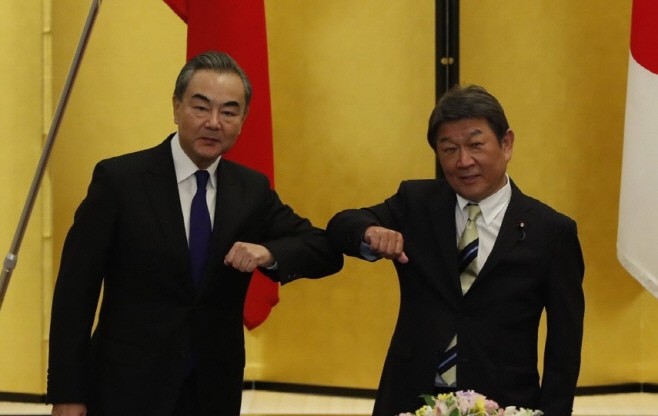 |
| Wang Yi, member of the Political Bureau of the CPC Central Committee and Foreign Minister of China, and Japanese Foreign Minister Toshimitsu Motegi, who previously met in Tokyo, Japan, in November 2020. The two countries are now engaged in a dispute over whether the two recently held a meeting. / Xinhua News Agency |
According to Beijing diplomatic sources familiar with bilateral relations on the 26th, Japanese Foreign Minister Toshimitsu Motegi reportedly bumped into Wang Yi, member of the Political Bureau of the CPC Central Committee and Foreign Minister of China (who also serves as Director of the Office of the Central Commission for Foreign Affairs), and had a brief conversation with him on the sidelines of the ASEAN Foreign Ministers' Meeting in Manila, Philippines, on the 22nd (local time).
Regarding the details of the conversation, Foreign Minister Motegi is reported to have only explained, "We discussed bilateral relations. Since it was a diplomatic exchange, I will refrain from mentioning anything beyond that." He added, "It was not a formal meeting. We had a chance to touch base as we crossed paths between meetings."
He is also reported to have reaffirmed Japan's stance, stating, "Japan has always maintained that it is open to dialogue at all levels. Japan and China play major roles in regional peace. Continuing dialogue is extremely important, and we will keep communicating moving forward."
According to the sources, their conversation was merely a greeting without an interpreter present, yet Japanese media attached significance to the fact that the first contact between the foreign affairs chiefs had taken place since Prime Minister Takaichi's remarks on intervention during a Taiwan emergency on November 6 last year.
However, China has countered that no such conversation took place at all. First, China's state-run CGTN refuted Japan's claim on the 26th through a one-line report stating, "It has been confirmed that Minister Wang did not hold any meetings or talks with the Japanese side during his visit to Manila, Philippines."
Foreign Ministry Spokesperson Lin Jian also refrained from confirming Japan's statement during a regular news briefing on the 23rd when asked a related question, saying, "As far as I know, Minister Wang had no plans to meet with the Japanese side."
Putting aside the encounter controversy, Foreign Minister Wang and Foreign Minister Motegi did not actually sit together once during the three-day ASEAN Foreign Ministers' Meeting. Foreign Minister Wang failed to appear at both the dinner on the 21st and the ASEAN Plus Three Foreign Ministers' Meeting on the 23rd, which Foreign Minister Motegi attended.
In fact, China likely believes this is not the right time to engage with Japan, as Japan has yet to apologize for the remarks. Nevertheless, some interpretations suggest that Foreign Minister Wang briefly met Foreign Minister Motegi with the U.S. in mind. Indeed, U.S. Secretary of State Marco Rubio noted in an NHK interview on the 22nd, "There is a view that China showed a degree of consideration because it wants to stabilize relations with the U.S."
Hong Soon-do
Most Read
-
1
Celltrion’s Omlyclo gains ground in major European..

-
2
Trump demands rates fall below 1% as Fed hikes for..

-
3
Trump makes $1 trillion bet ahead of midterm elect..

-
4
Iran resumes ballistic missile production, assembl..

-
5
Samsung Electronics, Mistral AI to jointly develop..

-
6
Trump warns countries not helping U.S. must pay re..

-
7
Apple launches first foldable, 1 million won prici..

PEOPLE






HEADLINE NEWS
- Trump to roll out ‘unprecedented welcome’ for Xi with B-2 bombers, F-22 fighters
- S. Korea, U.S., and Japan form united front on Taiwan and economic coercion..
- Trump administration moves to impose sweeping sanctions on International Cr..
- Xi to make state visit to U.S. Sept. 23-25, dispelling rumors over his heal..

-
Address : In-Young Bldg., 34, Uisadang-daero 1-gil, Yeongdeungpo-gu, Seoul
Copyright by ASIATODAY CO., LTD. All rights resereved