



Two-thirds of companies express intent to utilize mega special zones
Jul 27, 2026, 09:36 am


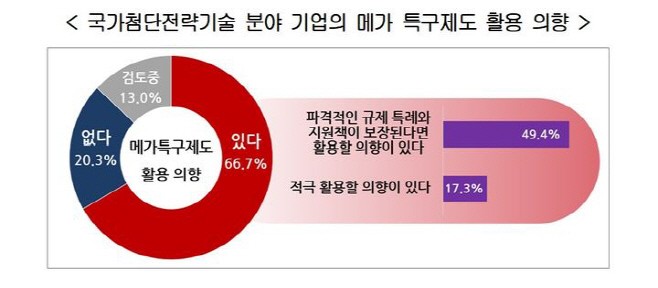 |
| Survey on corporate views regarding the Mega Special Zone System, conducted by the Korea Enterprises Federation among 468 companies with 50 or more employees in national advanced strategic technology sectors / Courtesy of Korea Enterprises Federation |
Over 60 percent of companies in national advanced strategic technology sectors show interest in participating in the government's Mega Special Zone System. Half of the respondents, or 50.6 percent, cite flexible working hours for R&D personnel as the most needed labor regulation exception in these zones, while the introduction of domestic production incentive tax credits ranks first among financial and tax support measures.
According to a survey on corporate views regarding the Mega Special Zone System released by the Korea Enterprises Federation on July 26, conducted among 468 companies with 50 or more employees in national advanced strategic technology sectors, 66.7 percent of responding firms express intent to utilize the system.
Specifically, 49.4 percent state they intend to participate if radical regulatory relief and support measures are guaranteed, marking the highest response, while 17.3 percent say they will actively participate. When asked about the most critical policy task for the success of the mega special zones, with multiple answers allowed, 42.9 percent select exemptions and deferrals of core regulations across labor, safety, and the environment.
Regarding required labor regulation exceptions within the zones, more than half of the companies, or 50.6 percent, point to flexible working hours for R&D personnel. Specific demands include exceptions to the 52-hour workweek system, the introduction of white-collar exemptions, and the extension of period limits for flexible and selective work hour systems.
Other desired exceptions include temporary deferrals of the Serious Accidents Punishment Act in demonstration zones for advanced industries such as robotics at 30.1 percent, allowing replacement labor during strikes and restricting the occupation of essential workplace facilities at 21.6 percent, relaxing restrictions on dispatch sectors and duration at 15.0 percent, and easing foreign labor regulations at 13.7 percent.
Respondents also highlight government-led timely construction of essential industrial infrastructure such as electricity and water at 36.5 percent, securing top talent and supporting residential conditions through industry-academia-research cooperation at 29.5 percent, and establishing an integrated control tower with strong policy execution at 27.8 percent. Furthermore, temporary deferrals of the Serious Accidents Punishment Act in demonstration zones for advanced industries at 30.1 percent, allowing replacement labor during strikes and restricting facility occupation at 21.6 percent, and easing dispatch regulations at 15.0 percent follow.
As for the ideal authority to oversee regulatory exceptions, licensing, and follow-up management in the mega special zones, 35.3 percent choose a public-private consultative body involving local governments and private enterprises. The central government follows at 30.8 percent, presidential committees at 18.8 percent, and regional governments at 14.5 percent. Regarding preferred future investment or location areas, the Greater Seoul area ranks highest at 45.7 percent, followed by the Chungcheong region at 26.3 percent, the Southeast region at 18.6 percent, the Honam region at 13.5 percent, and the Daegu-Gyeongbuk region at 10.0 percent.
The Mega Special Zone System provides a packaged set of regulatory exceptions, subsidies, and tax and financial support targeting core industries in specific, regional, or super-regional areas. When businesses and local governments jointly apply after consultation, the zones are designated and supported through government deliberation and decision-making.
Lee Dong-keun, full-time vice chairman of the KEF, says that for mega special zones to become a new growth solution, drastic regulatory reform and unprecedented support measures capable of offsetting the preference for the Greater Seoul area are required, adding that he hopes these zones will serve as the starting point for an innovative ecosystem that brings a fresh boost to the U.S. and global economic landscape.
Kim Bo-young
Most Read
-
1
Celltrion’s Omlyclo gains ground in major European..

-
2
Trump demands rates fall below 1% as Fed hikes for..

-
3
Hyundai Motor Group breaks ground on integrated st..

-
4
U.S. strikes 3 Iranian oil tankers, Iran vows reta..

-
5
Trump makes $1 trillion bet ahead of midterm elect..

-
6
Iran resumes ballistic missile production, assembl..

-
7
Samsung Electronics, Mistral AI to jointly develop..

PEOPLE







-
Address : In-Young Bldg., 34, Uisadang-daero 1-gil, Yeongdeungpo-gu, Seoul
Copyright by ASIATODAY CO., LTD. All rights resereved