



U.S. warns China over alleged AI tech theft
Jul 24, 2026, 10:23 am


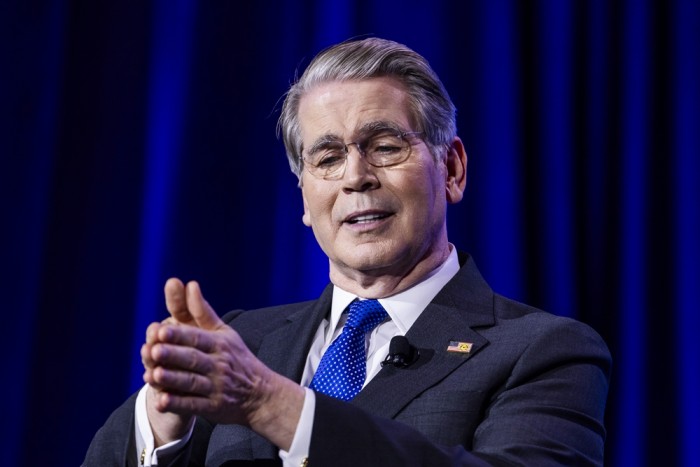 |
| U.S. Treasury Secretary Scott Bessent delivers a speech at the Faith and Freedom Coalition annual conference held in Washington, D.C. on June 26 (local time). / EPA Yonhap News |
The U.S. administration warned it would respond sternly—even considering export controls—to allegations that Chinese AI companies are illegally leveraging American AI technology.
U.S. Treasury Secretary Scott Bessent emphasized on social media on July 22 (local time), "We support open-source AI and the innovation it enables," but added, "Open source is not an open season on American intellectual property."
He went on to say, "If Chinese companies conduct covert, large-scale 'distillation' attacks that amount to IP infringement, the United States will consider sanctions and designations for export controls."
Distillation is a training technique used to transfer knowledge from one AI model to another. While it is a common development method within the AI industry, unauthorized use can give rise to issues such as IP infringement and technology leaks.
In an interview with Fox Business the previous day, Secretary Bessent disclosed that the administration is investigating whether open-source AI models developed by Chinese firms infringed upon the IP of American competitors.
He warned, "They use the technical term distillation in AI, but we call it theft," adding, "We will not tolerate companies building products based on stolen IP."
Leading AI companies such as OpenAI and Anthropic operate closed, commercial AI models and explicitly prohibit unauthorized distillation under their terms of service.
In February, OpenAI, Anthropic, and Google each released security threat detection reports stating they had caught Chinese AI companies—including DeepSeek, Moonshot AI, and MiniMax—executing large-scale distillation and model extraction, effectively stealing their AI research.
In particular, Moonshot AI's recently launched AI model, Kimi K3, is known to demonstrate performance close to top-tier models from OpenAI or Anthropic. Suspicions have consistently been raised in the U.S. AI industry that this performance boost resulted from unauthorized distillation.
Michael Kratsios, Director of the White House Office of Science and Technology Policy, revealed on social media on July 22, "We have obtained information that Moonshot AI distilled Anthropic's Fable to develop its K3 model."
Director Kratsios explained, "They built a sophisticated internal platform to perform large-scale distillation on American models and used techniques to rapidly rotate access points to evade detection."
He noted that Moonshot AI was found to have trained its AI model using servers equipped with Nvidia's Grace Blackwell-based GB300 AI supercomputers—which are banned from sale to China—obtained in Thailand.
He affirmed, "Legitimate AI distillation to make smaller, more efficient models plays an important role in an open innovation ecosystem," but added, "Covert, large-scale industrial distillation designed to siphon off American proprietary technology and undermine America's research base will not be tolerated."
Kim Hyun-min
Most Read
-
1
Celltrion’s Omlyclo gains ground in major European..

-
2
Trump demands rates fall below 1% as Fed hikes for..

-
3
Trump makes $1 trillion bet ahead of midterm elect..

-
4
Iran resumes ballistic missile production, assembl..

-
5
Samsung Electronics, Mistral AI to jointly develop..

-
6
Trump warns countries not helping U.S. must pay re..

-
7
Apple launches first foldable, 1 million won prici..

PEOPLE






HEADLINE NEWS
- Trump to roll out ‘unprecedented welcome’ for Xi with B-2 bombers, F-22 fighters
- S. Korea, U.S., and Japan form united front on Taiwan and economic coercion..
- Trump administration moves to impose sweeping sanctions on International Cr..
- Xi to make state visit to U.S. Sept. 23-25, dispelling rumors over his heal..

-
Address : In-Young Bldg., 34, Uisadang-daero 1-gil, Yeongdeungpo-gu, Seoul
Copyright by ASIATODAY CO., LTD. All rights resereved