



Fuel tax cut extended by 2 months amid renewed Middle East conflict
Jul 24, 2026, 10:00 am


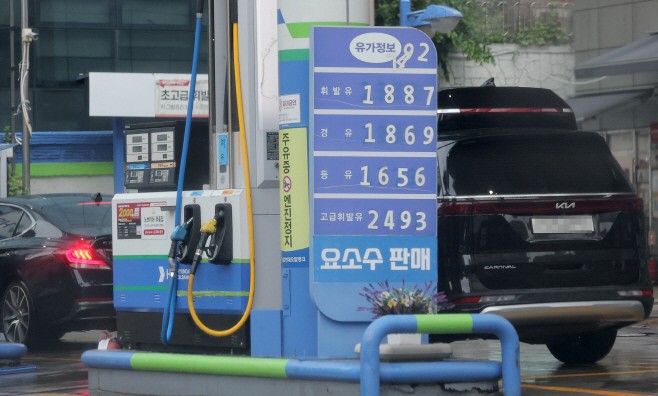 |
| Oil prices are displayed at a gas station in Seoul on July 21. / Photo courtesy of Yonhap News |
Amid heightened oil price volatility driven by reignited Middle East conflicts, the South Korean government will extend its fuel tax cut by two months. In addition, authorities plan to enact the 8th petroleum product price cap to counter rising oil prices while softening living costs through agricultural, livestock, and fisheries discount events.
Koo Yun-cheol, Deputy Prime Minister and Minister of Economy and Finance, presided over the Task Force for Special Management of Consumer Prices at the Government Complex Seoul on July 24, stating, "As recent tensions from the Middle East conflict flare up again, sparking sharp rises in international oil prices and potential hurdles in prices and supply chains, we will prepare thoroughly."
On July 23 (local time) on the ICE Futures Europe exchange, Brent crude futures for September delivery settled at 100.69 dollars per barrel, up 7.04 percent from the previous session. On the New York Mercantile Exchange, West Texas Intermediate (WTI) crude futures for September delivery also climbed 6.17 percent to settle at 92.19 dollars per barrel.
With oil prices exhibiting erratic movements once again, the government decided during the meeting to extend the fuel tax cuts, originally scheduled to expire at the end of this month, at their current levels for two additional months through the end of September. Consequently, the tax reductions implemented since March—15 percent for gasoline and 25 percent for diesel and butane—will remain in place for nearly half a year.
An official from the Ministry of Economy and Finance explained, "With Middle East geopolitical instability unresolved, maintaining flexibility in fuel tax adjustments is necessary to respond to potential future oil price volatility. In particular, we decided to preserve relatively higher reduction rates for diesel, essential to industry and logistics, and butane, utilized as fuel for low-income households and light trucks."
Alongside these measures, authorities will determine the 8th petroleum price caps taking into account market conditions including international oil prices, supply and demand trends, and public cost burdens, with implementation set for midnight on July 25. To compensate for refiners' losses arising from the price ceiling, the government will operate a maximum amount settlement committee to disburse compensation based on data submitted by individual refiners.
Furthermore, the government decided to extend its ban on hoarding urea and diesel exhaust fluid (DEF) for one more month. Officials plan to review additional extensions thereafter depending on developments in the Middle East conflict and DEF supply conditions.
To stabilize food prices and consumer living costs, the government is launching its largest-scale discount event covering all agricultural, livestock, and fisheries categories involving 90 online and offline retailers through July and August, while importing 200 million fresh eggs and 2,000 tons of mackerel. Directly imported quantities will be released into the domestic market at low prices alongside strengthened on-site inspections. Ahead of the Chuseok holiday at the end of September, authorities plan to formulate "Chuseok Measures for Public Livelihood Stability" within September, featuring additional steps to lower perceived consumer prices and ease household burdens.
With price volatility projected to persist and deepen into the second half of the year, measures to raise policy effectiveness are also being implemented. The government will pursue amendments to the Price Stabilization Act during the second half to strengthen sanctions against violations of price stabilization measures such as hoarding. Specifically, plans include establishing new non-compliance penalties for failing to carry out administrative orders and establishing legal grounds to liquidate seized items in urgent supply situations.
Meanwhile, regulations on medical supplies such as syringes and injection needles, which faced supply disruption concerns during the early stages of the Middle East conflict, will be partially eased. Assessing that supplies for these items have stabilized, the government expanded the excess inventory storage threshold from 150 percent to 200 percent while lifting sales volume restrictions.
A Ministry of Economy and Finance official explained, "Inventory surveys targeting hospitals show syringe supply conditions have recovered to pre-war levels and remain stable. Influenced by declining demand and substitution with imported goods, manufacturers' inventory levels have increased while production has decreased since late last month."
Seo Byung-joo
Most Read
-
1
Celltrion’s Omlyclo gains ground in major European..

-
2
Trump demands rates fall below 1% as Fed hikes for..

-
3
Hyundai Motor Group breaks ground on integrated st..

-
4
U.S. strikes 3 Iranian oil tankers, Iran vows reta..

-
5
Trump makes $1 trillion bet ahead of midterm elect..

-
6
Iran resumes ballistic missile production, assembl..

-
7
Samsung Electronics, Mistral AI to jointly develop..

PEOPLE






-
Address : In-Young Bldg., 34, Uisadang-daero 1-gil, Yeongdeungpo-gu, Seoul
Copyright by ASIATODAY CO., LTD. All rights resereved