



Q2 GDP posts 0.6% growth, strengthening case for August BOK rate hike
Jul 24, 2026, 09:56 am


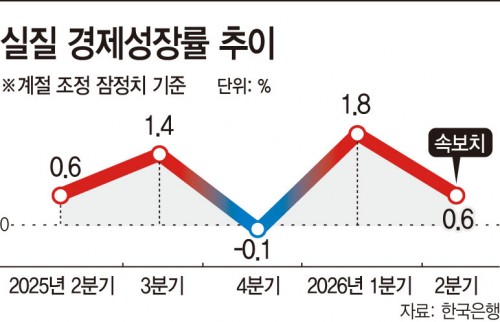 |
Driven by robust semiconductor exports and a recovery in private consumption, South Korea's economy grew 0.6 percent in the second quarter, delivering a surprise performance that far exceeded the Bank of Korea's forecast. Robust exports centered on semiconductors, backed by private consumption, drove the growth. With concerns over an economic slowdown easing significantly, observations are emerging that the Bank of Korea, which has shifted toward a tightening stance, could advance the timing of additional base rate hikes.
According to advance estimates of real gross domestic product (GDP) for the second quarter released by the Bank of Korea on July 23, real GDP expanded by 0.6 percent from the previous quarter. Compared to the same period last year, the figure represents a 3.7 percent increase. This sits 0.4 percentage points above the 0.2 percent growth forecast projected by the BOK back in May. The central bank explained that despite base effects following high growth in the first quarter and repercussions from the Middle East conflict, the ongoing semiconductor boom maintained strong growth momentum that offset downside risks.
In terms of growth contribution, domestic demand and net exports evenly supported economic expansion. Of the overall 0.6 percent growth rate, domestic demand and net exports contributed 0.3 percentage points each. Analyses indicate that alongside continued export growth driven by computers, electronic, and optical equipment including semiconductors, government policies such as Samsung Electronics' voucher reimbursement event and high oil price support funds, together with wealth effects from rising stock prices, bolstered private consumption.
With growth exceeding forecasts for two consecutive quarters following the first quarter, the likelihood of annual growth topping 3 percent has increased. The BOK previously revised its annual growth outlook upward from 2.0 percent earlier this year to 2.6 percent in May.
Real gross domestic income (GDI), which reflects the real purchasing power of domestic economic entities including households and corporations, also sustained a strong upward trajectory. Real GDI in the second quarter climbed 3.6 percent from the previous quarter and 15.6 percent year-on-year. On a year-on-year basis, this marks the highest growth rate in 38 years since the first quarter of 1988 (16.4 percent). Improved terms of trade contributed to this rise, as export prices, led by semiconductors, rose significantly faster than import prices. While sustained real GDI growth expands corporate investment capacity and household purchasing power to benefit domestic demand, it could also act as a factor raising inflationary pressure over time.
Consequently, speculation is rising that the BOK may enact additional rate hikes sooner than anticipated. This comes as concerns over an economic slowdown softened with growth beating expectations. Furthermore, consumer price inflation rising into the 3 percent range in the second quarter adds weight to a preemptive rate hike.
"With this growth rate release, concerns over an economic slowdown that constrained rate hikes have been largely resolved," said Yang Jun-seok, an economics professor at Catholic University of Korea. "If current inflation and stock market conditions persist, an August hike as well as an additional increase in the fourth quarter will likely be necessary."
Han Sang-wook
#GDP
Copyright by Asiatoday
Most Read
-
1
Celltrion’s Omlyclo gains ground in major European..

-
2
Trump demands rates fall below 1% as Fed hikes for..

-
3
Hyundai Motor Group breaks ground on integrated st..

-
4
U.S. strikes 3 Iranian oil tankers, Iran vows reta..

-
5
Trump makes $1 trillion bet ahead of midterm elect..

-
6
Iran resumes ballistic missile production, assembl..

-
7
Samsung Electronics, Mistral AI to jointly develop..

PEOPLE






-
Address : In-Young Bldg., 34, Uisadang-daero 1-gil, Yeongdeungpo-gu, Seoul
Copyright by ASIATODAY CO., LTD. All rights resereved