



U.S. keeps S. Korea on currency monitoring list
Jul 24, 2026, 10:17 am


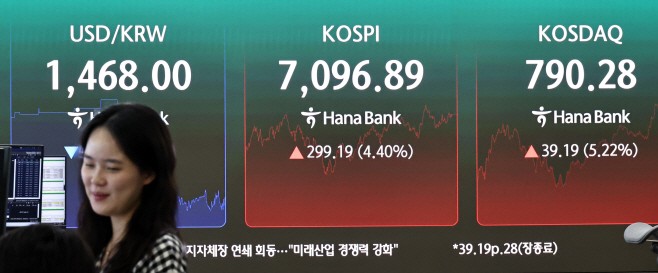 |
| The status board in the Hana Bank dealing room in Jung-gu, Seoul displays the KOSPI and other indices on July 23. / Photo courtesy of Yonhap News |
The U.S. Department of the Treasury has designated South Korea as a currency monitoring list country for four consecutive times, pointing out the continuous weakness of the Korean won that fails to reflect the fundamentals of the domestic economy.
According to the Ministry of Economy and Finance on July 24, the U.S. Treasury Department released its "Report to Congress on Macroeconomic and Foreign Exchange Policies of Major Trading Partners" on July 23 (local time) and classified South Korea on its currency monitoring list alongside nine other nations, including Japan and China. This marks the fourth consecutive designation since November 2024.
Under the current Trade Facilitation and Trade Enforcement Act, a country is designated for an in-depth currency analysis if it meets three criteria: a bilateral trade surplus with the U.S. of at least 15 billion dollars, a material current account surplus of at least 3 percent of GDP, and persistent net purchases of foreign currency amounting to at least 2 percent of GDP over at least eight months.
In the case of South Korea, while it met the first two criteria, its net dollar purchases remained at 1.5 percent of GDP, escaping designation for an in-depth analysis.
Through this exchange rate report, the U.S. Treasury Department evaluated that "Korea's exports buffered the growth slowdown last year, and its current account surplus expanded significantly, centered around semiconductors and tech-related products."
However, it explained that "the recent weakness of the won is inconsistent with Korea's strong economic fundamentals," adding that "despite a large external sector surplus, the won has faced persistent depreciation pressure." In particular, it cited foreign stock investments by households and corporations as an additional factor that intensified depreciation pressure on the won at the end of last year.
Regarding the capital and foreign exchange markets, it noted that "Korea is making progress in easing restrictions on foreign investors' participation in the onshore foreign exchange market," evaluating that "this will support liquidity and price discovery in the onshore market over the medium to long term."
In its evaluation of state-invested institutions, the report mentioned the National Pension Service's dollar purchases for overseas investments last year, showing interest in the National Pension Service's new framework and FX hedging policies.
The Korean government stated, "We will continue to communicate closely with the U.S. Treasury Department to expand mutual understanding and trust regarding the foreign exchange market," adding, "We plan to sustain cooperation to ensure foreign exchange market stability."
Seo Byung-joo
Most Read
-
1
Celltrion’s Omlyclo gains ground in major European..

-
2
Trump demands rates fall below 1% as Fed hikes for..

-
3
Hyundai Motor Group breaks ground on integrated st..

-
4
U.S. strikes 3 Iranian oil tankers, Iran vows reta..

-
5
Trump makes $1 trillion bet ahead of midterm elect..

-
6
Iran resumes ballistic missile production, assembl..

-
7
Samsung Electronics, Mistral AI to jointly develop..

PEOPLE







-
Address : In-Young Bldg., 34, Uisadang-daero 1-gil, Yeongdeungpo-gu, Seoul
Copyright by ASIATODAY CO., LTD. All rights resereved