



U.S. House passes bill banning lawmakers from buying stocks
Jul 23, 2026, 05:11 pm


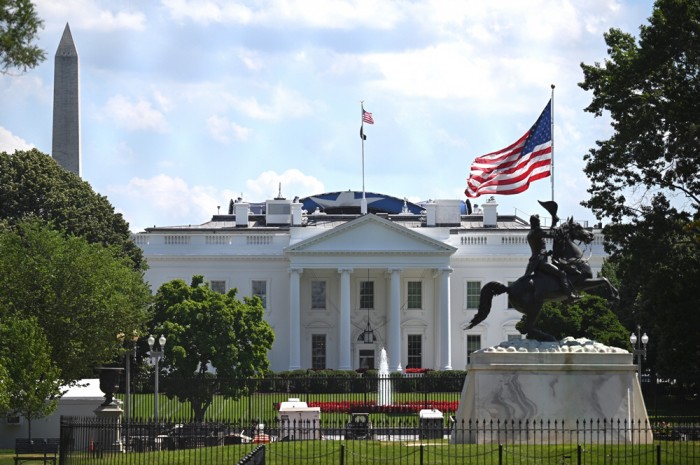 |
The exterior of the White House in Washington, D.C., on July 7 (local time). / Photo courtesy of Xinhua, Yonhap News Agency
The U.S. House of Representatives has passed the "Stop Insider Trading Act," a Republican-led bill banning lawmakers and their families from purchasing individual stocks, the Associated Press reported on July 22 (local time).
The House passed the bill in a 232 to 198 vote, with a portion of Democratic lawmakers voting in favor.
The passage marks a breakthrough for ethics reform proposals that had repeatedly stalled in the past, and is viewed as a legislative milestone for Republicans targeting voter distrust ahead of the midterm elections.
However, its passage through the Senate remains uncertain, as the bill excludes the president and vice president from the trading ban while incorporating mandatory voter ID requirements—a core provision of the Safeguard American Voter Eligibility (SAVE) America Act supported by U.S. President Donald Trump.
Mandatory voter ID regulations, which require voters to present photo identification when casting ballots, have repeatedly failed to clear the Senate in previous attempts.
The Stop Insider Trading Act prohibits lawmakers, their spouses, and dependent children from purchasing new individual stocks while in office. Existing stock holdings may be retained, but any sales must be disclosed at least seven days in advance.
However, broad-based investment funds and assets held in specified trusts are granted exceptions.
President Trump disclosed making over 3,600 stock transactions in the first quarter alone, which included companies directly tied to government policy.
Consequently, Democrats and civic watchdog groups are voicing strong opposition.
U.S. Representative Joe Morelle, a Democrat from New York, criticized the inclusion, calling it a "poison pill designed to kill the bill."
The Campaign Legal Center, a nonpartisan political and legal watchdog organization in the U.S., pointed out that allowing lawmakers to retain existing stock holdings "leaves substantial conflicts of interest intact," adding that it "fails to eliminate the potential for lawmakers to seek profits tied to their official duties."
Lawmakers' stock trading has emerged in recent years as a key campaign issue symbolizing voter distrust. Emphasizing the need for reform, U.S. Representative Mike Lawler, a Republican from New York, stated, "Public servants should serve only the people. They must not use power for personal gain."
Park Jin-sook |
Most Read
-
1
U.S. Treasury Secretary Bessent publicly warns ove..

-
2
Celltrion’s Omlyclo gains ground in major European..

-
3
U.S. strikes Iran after a month, hits IRGC rocket..

-
4
Hyundai Motor Group breaks ground on integrated st..

-
5
Russia faces warning signs over prolonged war econ..

-
6
Anti-Western solidarity strengthens amid Trump's e..

-
7
U.S. strikes 3 Iranian oil tankers, Iran vows reta..

PEOPLE






HEADLINE NEWS

-
Address : In-Young Bldg., 34, Uisadang-daero 1-gil, Yeongdeungpo-gu, Seoul
Copyright by ASIATODAY CO., LTD. All rights resereved