



China's single-person household economy gaining full momentum
Jul 23, 2026, 10:26 am


China's single-person household lifestyle and the resulting "solo economy" are gaining full momentum, demanding recognition as an undeniable reality. It is fair to say this trend has firmly established itself as a quintessential 21st-century new normal—a trajectory that is bound to accelerate even further in the future.
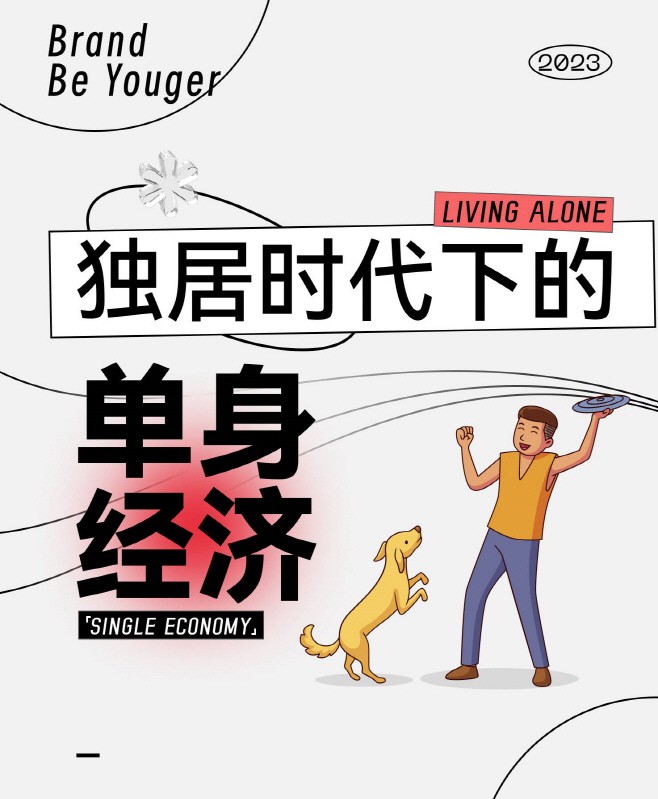 |
| A editorial cartoon from a media outlet depicting the reality that the single-person household economy has emerged as an undeniable social phenomenon in China / Photo courtesy of The Beijing News |
Comprehending media reports from outlets like The Beijing News, it becomes clear that the current residential living conditions of China's 1.4 billion people have dramatically changed compared to the previous century. Until about 30 years ago, the phrase sishi tongtang (four generations under one roof) was widely used, but today, such households are virtually nowhere to be seen, even in the most remote mountain villages across China.
Conversely, the number of people living alone has exploded, surging from under 100 million at the end of the last century to a staggering 240 million. The causes are varied. Chief among them are divorces, which have become far more frequent this century; extreme longevity that inevitably comes with the loss of a life partner; and non-marriage, where individuals even refuse to live with their parents. Rapid shifts in social structure, heightened individualism, and changing perceptions of marriage and family relations also rank among the primary drivers.
It would be strange if a "solo economy"—where individuals earn and spend alone—did not emerge as a fresh phenomenon under these circumstances. As of the end of last year, the market size was estimated at a minimum of 5 trillion yuan (around 1,095 trillion won) to a maximum of 13 trillion yuan. Calculating that this economic scale accounts for nearly 10 percent of gross domestic product (GDP) naturally follows, as do projections that it will reach up to around 20 percent by 2030.
Given this reality, related markets are expanding rapidly. This is evident when considering recent trends such as the rise of single-diner seating in restaurants and the extreme miniaturization of home appliances. The popularity of solo travel ensuring complete privacy and the expansion of the pet industry are also noteworthy—the latter projected to reach 300 billion yuan this year alone.
In addition, AI spouses, cyber partners, and micro-housing are becoming realities that must be accepted. In short, the world has evolved to make living alone completely convenient. A single woman in her late 30s in Beijing, surnamed Sui, remarked, "Living alone costs much more money than living together with a large family—statistics show it costs up to 23% more. However, there is no inconvenience in daily life, and I am satisfied with my current lifestyle," underscoring how rapidly society is adapting to serve the solo economy.
While the solo economy is an inevitable phenomenon, it carries numerous negative side effects. Concerns are highest regarding the mental health of solo dwellers, solitary deaths, and the rampant rise of social individualism. Nevertheless, it is safe to assert that reversing this tide has become virtually impossible. Chinese society has little choice but to adapt to this reality, and its industrial structure is certain to be swept rapidly into this wave of major transformation.
Hong Soon-do
Most Read
-
1
Celltrion’s Omlyclo gains ground in major European..

-
2
Trump demands rates fall below 1% as Fed hikes for..

-
3
Trump makes $1 trillion bet ahead of midterm elect..

-
4
Iran resumes ballistic missile production, assembl..

-
5
Samsung Electronics, Mistral AI to jointly develop..

-
6
Trump warns countries not helping U.S. must pay re..

-
7
Seoul faces triple squeeze over troop deployment t..

PEOPLE






-
Address : In-Young Bldg., 34, Uisadang-daero 1-gil, Yeongdeungpo-gu, Seoul
Copyright by ASIATODAY CO., LTD. All rights resereved