



GDP growth rate beats expectations: Up 0.6 percent in Q2 on strong chip exports
Jul 23, 2026, 10:22 am


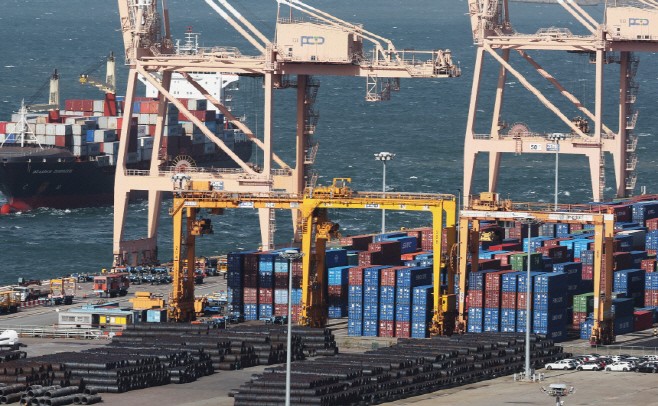 |
| Containers stacked at Pyeongtaek Port in Gyeonggi Province / Photo courtesy of Yonhap News |
Korea's gross domestic product grew by 0.6 percent quarter-on-quarter in the second quarter of this year. Although the growth rate slowed from 1.8 percent in the first quarter, it significantly exceeded the Bank of Korea's initial expectations. The economy maintained positive growth supported by an increase in exports led by semiconductors, alongside improvements in private consumption and the services sector.
According to advance estimates for second-quarter real GDP released by the Bank of Korea on the 23rd, real GDP grew 0.6 percent from the previous quarter and 3.7 percent from the same period last year. This figure is 0.4 percentage points higher than the Bank of Korea's forecast of 0.2 percent projected in May.
While market observers initially anticipated that growth would remain subdued due to the full-blown impact of the Middle East conflict and rising oil prices, the sustained boom in semiconductor exports throughout the second quarter reportedly provided upward pressure on growth.
By expenditure component, private consumption expanded 0.4 percent from the previous quarter. Consumption of goods such as home appliances and services including dining out and accommodation both registered gains. Government consumption increased 0.2 percent, driven primarily by health insurance benefit expenditures. Facility investment rose 0.2 percent as investments in semiconductor manufacturing equipment increased, while intellectual property investment, including R&D and software, jumped 3.3 percent.
In contrast, construction investment contracted 0.2 percent due to a decline in civil engineering construction. On a year-on-year basis, it fell 1.3 percent, pointing to a prolonged slump in the construction sector.
Exports rose 1.4 percent, led by semiconductors, machinery, and equipment. Imports grew 0.8 percent, driven by increases in automobiles, machinery, and equipment. Year-on-year growth stood at 9.0 percent for exports and 6.3 percent for imports.
Domestic demand and net exports contributed 0.3 percentage points each to second-quarter growth. Final consumption expenditure contributed 0.2 percentage points, and gross fixed capital formation added 0.2 percentage points, whereas inventory drawdowns reduced growth by 0.2 percentage points.
By economic activity, manufacturing expanded 1.2 percent quarter-on-quarter, boosted by production gains in computers, electronics, optical equipment, machinery, and equipment. The services sector grew 1.1 percent, led by wholesale and retail trade, accommodation and food services, finance and insurance, and information and communication. Conversely, construction shrank 1.9 percent due to the drop in civil engineering construction, and agriculture, forestry, and fisheries plummeted 7.1 percent, driven down by crop production and fishing.
Real gross domestic income rose 3.6 percent from the previous quarter and 15.6 percent from a year earlier. The year-on-year growth rate hit its highest level in 38 years and 3 months, since the first quarter of 1988 (16.4 percent). Real GDI reflects the actual purchasing power of income earned through production activities; the sharp rise was largely driven by improved terms of trade as prices for export items such as semiconductors increased.
Han Sang-wook
Most Read
-
1
Celltrion’s Omlyclo gains ground in major European..

-
2
Trump demands rates fall below 1% as Fed hikes for..

-
3
Hyundai Motor Group breaks ground on integrated st..

-
4
U.S. strikes 3 Iranian oil tankers, Iran vows reta..

-
5
Trump makes $1 trillion bet ahead of midterm elect..

-
6
Iran resumes ballistic missile production, assembl..

-
7
Samsung Electronics, Mistral AI to jointly develop..

PEOPLE






-
Address : In-Young Bldg., 34, Uisadang-daero 1-gil, Yeongdeungpo-gu, Seoul
Copyright by ASIATODAY CO., LTD. All rights resereved