



Sri Lanka deploys Air Force drones amid worst dengue outbreak in decade
Jul 22, 2026, 10:47 am


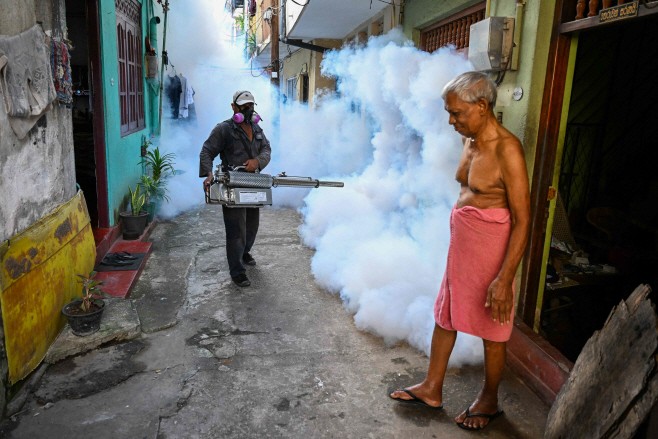 |
| Workers perform vector control spraying to prevent dengue fever in Colombo, Sri Lanka, on June 24 / Photo by AFP via Yonhap News Agency |
Facing its worst dengue fever outbreak in a decade, Sri Lanka is deploying Air Force drones and joint military-police enforcement operations.
According to Reuters on July 22 (local time), 76,044 people in Sri Lanka have contracted dengue fever since January this year, with 53 deaths recorded. As the highly virulent DENV-2 strain spreads rapidly, total infections are approaching the levels of the 2017 outbreak, when cases surpassed 100,000.
The government is flying Air Force drones to detect mosquito breeding grounds, such as rooftops with pooled monsoon rainwater. Soldiers and police officers have launched joint inspections across private homes, construction sites, and schools to drain standing water. Sri Lanka's Ministry of Health stated that about 11,000 mosquito breeding sites were cleared this month, and fines were issued to more than 4,000 locations for maintaining conditions favorable to breeding.
Hospitals are also overwhelmed by the surge in patients. More than 18,000 new cases were recorded in the first two weeks of July alone, while cases in June reached 21,537, more than double the May total. A physician at Negombo General Hospital, located in one of the hardest-hit areas, said, "We have treated around 1,800 patients in less than two months since June," adding, "Patients are surging compared to last year's total of 1,050."
To handle the influx, hospitals are converting general wards to add beds and extending shifts for healthcare workers. To relieve pressure on inpatient facilities, light cases are being advised to recover at home.
While dengue cases mount, Sri Lanka's health infrastructure has been further weakened by the destruction left by Cyclone Ditwah last November. Recorded as the worst natural disaster in Sri Lanka's history, Ditwah destroyed critical infrastructure and medical facilities, with the World Bank estimating damages at $1.4 billion (approximately 2.1 trillion won).
Although Sri Lanka maintains 4 hospital beds per 1,000 people—above the global average of under 3—the combined impact of the cyclone's aftermath and the patient surge is rapidly draining available capacity.
Kapila Kannangara, acting director of the National Dengue Control Unit, noted, "Patient numbers are high, and severity is elevated," explaining that about 75 percent of infections are linked to the virulent DENV-2 strain.
Authorities are considering introducing a dengue vaccine, though experts express concern that its effectiveness may be limited due to multiple circulating strains.
While experts and authorities expect dengue cases to peak in August before declining, they acknowledge that predicting the exact timeline is difficult because the virus's transmission pattern has diverged from previous years. Concerns are also rising that the arrival of the second monsoon in November could spark another wave of infections.
Jeong Ri-na
Most Read
-
1
Celltrion’s Omlyclo gains ground in major European..

-
2
Trump demands rates fall below 1% as Fed hikes for..

-
3
Trump makes $1 trillion bet ahead of midterm elect..

-
4
Iran resumes ballistic missile production, assembl..

-
5
Samsung Electronics, Mistral AI to jointly develop..

-
6
Trump warns countries not helping U.S. must pay re..

-
7
Apple launches first foldable, 1 million won prici..

PEOPLE






HEADLINE NEWS
- Trump to roll out ‘unprecedented welcome’ for Xi with B-2 bombers, F-22 fighters
- S. Korea, U.S., and Japan form united front on Taiwan and economic coercion..
- Trump administration moves to impose sweeping sanctions on International Cr..
- Xi to make state visit to U.S. Sept. 23-25, dispelling rumors over his heal..

-
Address : In-Young Bldg., 34, Uisadang-daero 1-gil, Yeongdeungpo-gu, Seoul
Copyright by ASIATODAY CO., LTD. All rights resereved