



Retail investors pivot: Targeting dividends and semiconductor dip-buying
Jul 21, 2026, 09:53 am


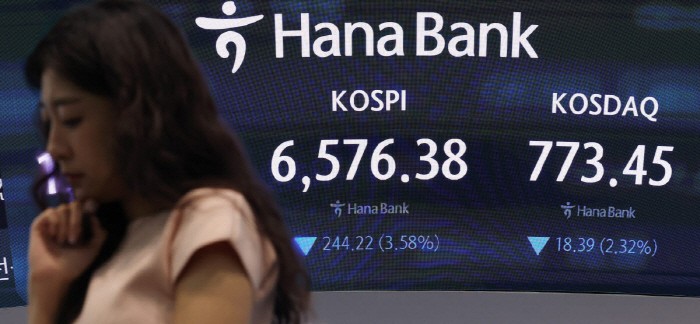 |
| Electronic displays show the KOSPI and KOSDAQ stock indices at Hana Bank's dealing room in Jung-gu, Seoul, on July 20. / Courtesy of Yonhap News |
As KOSPI volatility expands, retail investors are rapidly shifting their exchange-traded fund (ETF) purchasing strategies. During the initial plunge, capital flowed heavily into covered call products aimed at distributions and downside protection; however, as market drops deepened, bargain-hunting demand concentrated in semiconductor ETFs holding tech giants such as Samsung Electronics and SK Hynix. Meanwhile, a portion of capital moved into money market and certificate of deposit (CD) rate-linked ETFs to await further buying opportunities.
According to the Korea Exchange on July 20, among the top 20 ETFs net purchased by retail investors over the past week, net inflows into covered call products dropped 33% from 167.95 billion won to 112.09 billion won. Conversely, net purchases of non-covered call semiconductor ETFs jumped 119% from 48.86 billion won to 107.09 billion won over the same period.
When the KOSPI plummeted 9% on July 13, retail investors heavily bought covered call products. They net purchased 99.41 billion won of KODEX 200 Target Weekly Covered Call, while channeling 23.54 billion won and 23.32 billion won into TIGER Dividend Covered Call Active and TIGER Semiconductor TOP10 Covered Call Active, respectively. RISE Korea Value-Up Weekly Fixed Covered Call also attracted 21.67 billion won in net inflows.
Defensive demand against volatility and scheduled distribution payouts drove the covered call buying wave. Both KODEX 200 Target Weekly Covered Call and RISE Korea Value-Up Weekly Fixed Covered Call set the 15th of each month as their distribution record date. Under South Korea's T+2 settlement system, July 13 marked the final day to purchase shares to qualify for the distribution payout. Consequently, demand to secure distribution income overlapped with buying opportunity during the steep market decline.
However, as the KOSPI sank another 6.4% on July 16, retail buying shifted toward semiconductor ETFs. On that day alone, TIGER Semiconductor TOP10 recorded 31.74 billion won in net inflows, while KODEX AI Semiconductor TOP2 Plus and SOL AI Semiconductor TOP2 Plus registered net purchases of 27.1 billion won and 24.84 billion won, respectively. KODEX Semiconductor also drew 14.96 billion won. Notably, the two products heavily weighted toward Samsung Electronics and SK Hynix—KODEX AI Semiconductor TOP2 Plus and SOL AI Semiconductor TOP2 Plus—attracted a combined 51.94 billion won.
This inflow of bargain-hunting capital reflected rebound expectations as Samsung Electronics and SK Hynix plunged 8.8% and 11.5%, respectively, on the day. Market analysts note that rather than a newly improved outlook for the semiconductor sector, the surge reflected retail demand to dollar-cost average into leading stocks following sharp pullbacks.
Capital hesitant to deploy immediately during the market sell-off also migrated to cash-equivalent ETFs. On July 16, TIGER Money Market Active and KODEX CD Rate Active attracted 21.64 billion won and 11.25 billion won, respectively. This trend reflected demand to park capital while earning short-term interest, amid heightened market volatility and following the Bank of Korea's benchmark interest rate hike from 2.50% to 2.75% on the same day.
An industry insider noted, "Retail capital is altering its target assets across different phases of the sell-off," adding, "With market volatility likely to persist for the time being, we expect to see a dual movement of funds dollar-cost averaging into beaten-down semiconductor stocks while waiting in cash-equivalent products for further buying entry points. However, betting on corporate fundamentals rather than short-term price fluctuations will yield better results."
Kim So-ra
Most Read
-
1
Celltrion’s Omlyclo gains ground in major European..

-
2
Trump demands rates fall below 1% as Fed hikes for..

-
3
Hyundai Motor Group breaks ground on integrated st..

-
4
U.S. strikes 3 Iranian oil tankers, Iran vows reta..

-
5
Trump makes $1 trillion bet ahead of midterm elect..

-
6
Iran resumes ballistic missile production, assembl..

-
7
Samsung Electronics, Mistral AI to jointly develop..

PEOPLE






-
Address : In-Young Bldg., 34, Uisadang-daero 1-gil, Yeongdeungpo-gu, Seoul
Copyright by ASIATODAY CO., LTD. All rights resereved