



Khamenei's funeral highlights dilemmas of Indonesia's 'non-aligned diplomacy'
Jul 20, 2026, 11:00 am


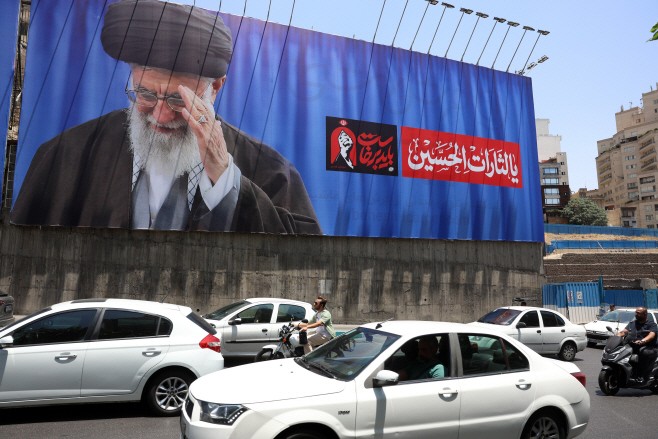 |
| A large portrait of the late Supreme Leader Ayatollah Ali Khamenei hangs along a highway in Tehran, Iran. / Courtesy of EPA, Yonhap News |
Indonesia, the country with the world's largest Muslim population, initially dispatched only its ambassador to the funeral of Iran's Supreme Leader Ali Khamenei, but later scrambled to send its foreign minister and even promised a visit by President Prabowo as controversy mounted.
According to the South China Morning Post (SCMP) on July 20 (local time), a debate is brewing both inside and outside Indonesia over whether the nation—which has long championed a non-aligned, independent foreign policy—snubbed Iran out of deference to the United States.
Khamenei was assassinated in a U.S. and Israeli airstrike on Iran on February 28. The Iranian government held a six-day state funeral from July 3 to 9, roughly four months after his death.
At the time, Indonesia's representative at the state funeral was its ambassador to Iran. While the ambassador attended the enshrinement ceremony and funeral prayers held at the Grand Mosalla in Tehran on July 3, reports indicate he was denied entry to the area reserved exclusively for high-ranking dignitaries. The fact that the delegation was led only by an ambassador-level official instantly sparked controversy.
Dino Patti Djalal, former Indonesian Ambassador to the United States, wrote on his social media account on July 6 that "the Iranian government consistently tried to invite the Indonesian government but received no response," slamming the move as "an insult to Iran." He questioned, "They have their pride. They won't beg for our attendance. Does this mean our 'independent and active' foreign policy is beginning to crumble because Indonesia fears or defers to the United States?"
On the same day, Foreign Minister Sugiono explained to reporters that schedules overlapped with preparations for other state visits, adding that "several key figures were also too busy to attend."
However, just days later, Minister Sugiono flew to Iran alongside Ahmad Muzani, Speaker of the People's Consultative Assembly (MPR), as well as leaders from Nahdlatul Ulama (NU) and Muhammadiyah. Although late for the funeral, they became the first foreign delegation to personally pay their respects at Khamenei's tomb in Mashhad on July 10. Following this, on July 15, the Indonesian Ministry of Foreign Affairs confirmed that, at Iran's request, Indonesian President Prabowo Subianto would also visit Iran "at a mutually convenient time."
Minister Sugiono also met with Iranian Foreign Minister Abbas Araghchi. While the Indonesian Foreign Ministry announced that both sides reaffirmed their commitment to "resolving various conflicts through dialogue, diplomacy, respect for sovereignty, and international law," Iran issued a separate statement defining the war initiated by the U.S. and Israel in February as "an unprecedented violation of the UN Charter and international law" and called for "Islamic unity against the Zionist regime's expansionism, genocide, and colonial apartheid." The contrasting tones of their respective statements highlight the palpable distance between the two nations.
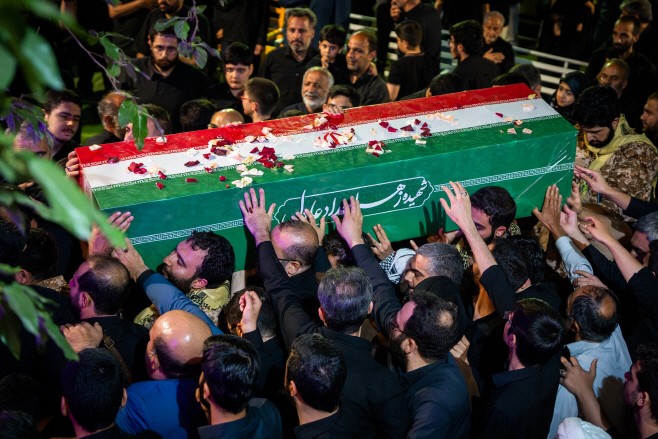 |
| Mourners carry the coffin of Zahra Hadad-Adel, wife of Iran's Supreme Leader Mojtaba Khamenei, in Tehran, Iran, on July 2 (local time). Hadad-Adel, daughter of former Parliament Speaker Gholam-Ali Haddad-Adel, was killed alongside her father-in-law, the late Supreme Leader Ayatollah Ali Khamenei, in a U.S. and Israeli airstrike on February 28. / Courtesy of AFP, Yonhap News |
Experts believe that Indonesia's participation in U.S. President Donald Trump's peace committee serves as the background to this controversy.
President Prabowo signed onto the peace committee in Davos this past January, attended its first meeting in Washington in February, and pledged to deploy up to 8,000 peacekeepers to the Gaza Strip. This decision triggered a fierce backlash from domestic Islamic groups, forcing President Prabowo to defuse the situation by stating, "We will withdraw if it does not benefit Palestine."
Agung Nurwijoyo, an international relations lecturer at the University of Indonesia, analyzed that Indonesia "may have been concerned that attending the funeral of a high-ranking official could be interpreted as taking a specific side in a situation where distrust between the U.S. and Iran runs extremely high." He pointed out, "Relationships with the U.S. are inevitable due to strategic interests such as trade and investment," adding, "However, problems arise when a double standard is applied—raising one's voice in one conflict while remaining silent in another."
Iran's perspective may be even colder. Political scientist Ade Marup Wirasenjaya viewed that Iran used the funeral as a sort of "sorting process" to "filter out who remains a partner and who has distanced themselves." From that benchmark, he noted that Indonesia may have appeared "no longer neutral" in Iran's eyes because it failed to strongly condemn the actions of the U.S. and Israel.
Nur Rachmat Yuliantoro, a professor of international relations at Gadjah Mada University, evaluated that the trust Indonesia has built in the Islamic world—as a legacy of a foreign policy rooted in anti-colonialism, support for the Palestinian cause, and independence—was not made overnight. He emphasized, "Even now, with democracy under threat and the economy in turmoil, Indonesia's normative influence among Muslim nations remains alive."
He stressed, "What matters in relations with the Islamic world is not whether Indonesia is close to the U.S. or China, but how firm it stands in respecting international law and supporting the Palestinian cause," adding, "This is what Indonesia must protect to maintain its credibility in the world."
Jeong Ri-na
Most Read
-
1
Celltrion’s Omlyclo gains ground in major European..

-
2
Trump demands rates fall below 1% as Fed hikes for..

-
3
Trump makes $1 trillion bet ahead of midterm elect..

-
4
Iran resumes ballistic missile production, assembl..

-
5
Samsung Electronics, Mistral AI to jointly develop..

-
6
Trump warns countries not helping U.S. must pay re..

-
7
Apple launches first foldable, 1 million won prici..

PEOPLE






HEADLINE NEWS
- Trump to roll out ‘unprecedented welcome’ for Xi with B-2 bombers, F-22 fighters
- S. Korea, U.S., and Japan form united front on Taiwan and economic coercion..
- Trump administration moves to impose sweeping sanctions on International Cr..
- Xi to make state visit to U.S. Sept. 23-25, dispelling rumors over his heal..

-
Address : In-Young Bldg., 34, Uisadang-daero 1-gil, Yeongdeungpo-gu, Seoul
Copyright by ASIATODAY CO., LTD. All rights resereved