



Hyundai Motor union intensifies strike action as pre-vacation deal faces final showdown this week
Jul 20, 2026, 10:20 am


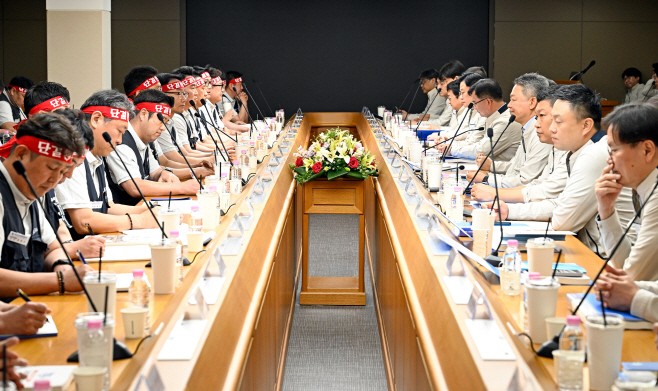 |
| Hyundai Motor management and union officials held an introductory meeting for the 2026 wage negotiations at the Donghaeng Room of the main building in the Ulsan plant on July 6. The bargaining representatives from both sides are seen sitting across from each other. / Courtesy of Yonhap News |
This week marks a critical turning point for the wage negotiations between Hyundai Motor management and its labor union. With the union escalating its industrial action and announcing a four-hour partial strike for three consecutive days starting July 20, failure to find a breakthrough this week will likely drag the negotiations past the summer holidays.
According to industry sources on July 19, the Hyundai Motor branch of the Korean Metal Workers' Union plans to hold an eight-hour partial strike daily (four hours each for the day and night shifts) from July 20 to 22. The union finalized these strike guidelines during its third central dispute committee meeting held on July 16.
Previously, the union staged a partial strike for three days starting July 13, walking out for two hours per shift, totaling four hours a day relative to the production line (12 hours in total). Industry analysts estimate this earlier action resulted in a production setback of about 5,000 vehicles and a revenue loss of approximately KRW 200 billion.
The damage is projected to snowball as the upcoming strikes double in duration.
Combining the strikes from last week and the ones scheduled for this week, production losses are arithmetically estimated to reach around 15,000 vehicles, with revenue losses hitting between KRW 600 billion and KRW 700 billion. This is more than double the production setbacks caused by all of last year's partial strikes.
Furthermore, with the union refusing weekend overtime and component suppliers facing their own strikes, observers predict the actual damage could be even more severe.
The union plans to reconvene the central dispute committee on July 23 after the partial strikes to discuss the next steps in their struggle.
Against this backdrop, it remains uncertain whether the two sides can dramatically find common ground, as a wide gap persists over core issues. The biggest sticking points in the current negotiations are the union's separate demands, which include the reinstatement of dismissed workers and the extension of the retirement age.
During the 15th round of talks on July 8, management countered with its third proposal, which offered an increase of KRW 89,000 in base pay, a performance bonus of 350 percent plus KRW 10 million, and 15 shares of company stock. However, the union rejected it, stating, "It is not a level that our union members can accept."
Management maintains that since this year's talks are strictly wage negotiations, the scope of the bargaining is expanding excessively by bringing separate issues like the retirement age extension and the reinstatement of dismissed workers into the mix.
In a statement issued on July 16, Hyundai Motor CEO Choi Young-il pointed out, "What remains at the end of a strike is only accumulated production losses, lost wages, and external criticism," adding, "Employees are being pushed into a strike, blocked by agendas that are not subject to wage negotiations, such as the reinstatement of dismissed workers, retirement age extensions, and bonus increases."
Conversely, the union argues that these demands must be addressed concurrently to ensure future job security and improve working conditions, making a compromise difficult to achieve.
Given the deadlock, sources forecast that a settlement before the plants' early August summer break will be out of reach unless a tentative agreement is struck this week. Even after a tentative deal is reached, subsequent procedures—such as finalizing the contract language and conducting a member vote—take time, meaning that missing this week's window makes a pre-holiday resolution nearly impossible.
An industry insider remarked, "While Hyundai Motor management and labor have a track record of dramatic last-minute agreements, neither side currently shows signs of backing down on key issues," emphasizing, "The outcome of this week's negotiations will be the ultimate watershed moment."
Kim Jeong-gyu
Most Read
-
1
Celltrion’s Omlyclo gains ground in major European..

-
2
Trump demands rates fall below 1% as Fed hikes for..

-
3
Hyundai Motor Group breaks ground on integrated st..

-
4
U.S. strikes 3 Iranian oil tankers, Iran vows reta..

-
5
Trump makes $1 trillion bet ahead of midterm elect..

-
6
Iran resumes ballistic missile production, assembl..

-
7
Samsung Electronics, Mistral AI to jointly develop..

PEOPLE





-
Address : In-Young Bldg., 34, Uisadang-daero 1-gil, Yeongdeungpo-gu, Seoul
Copyright by ASIATODAY CO., LTD. All rights resereved