



Tired of fluctuating K-stock market, retail investors' U.S. stock net purchases surge 207% this month
Jul 20, 2026, 10:17 am


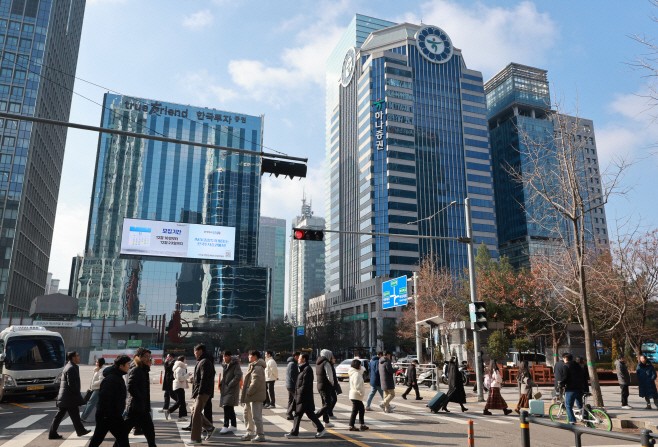 |
| A view of the Yeouido financial district in Seoul. / Yonhap News |
Retail investors are escaping the domestic stock market. The daily average stock transaction value for retail investors dropped by more than 31 percent in a single month, and investor deposits left in brokerage accounts for stock purchases also plummeted by nearly KRW 30 trillion in just two months. As the KOSPI market recently exhibited extreme volatility, with its volatility index surpassing levels seen during the global financial crisis and 44 market stabilization measures triggered this year alone, weary investors are heading overseas. While retail investors' net purchases of US stocks surged by over 200 percent this month compared to the previous month, stock market analysts suggest that resolving uncertainties in leading industries and improving foreign capital inflows must come first to bring retail funds back.
According to the Korea Exchange on July 19, the daily average transaction value for retail investors in the domestic stock market so far this month stood at KRW 34.0388 trillion, plunging 31.7 percent compared to the same period last month (KRW 49.8178 trillion). Monthly daily average transaction value for retail investors has continued its downward trend for two consecutive months after peaking at over KRW 60 trillion in May.
Investor deposits, a metric for potential sideline capital in the market, are also showing a sharp contraction. According to the Korea Financial Investment Association, investor deposits, which reached an all-time high of approximately KRW 139.7 trillion on June 4, were tallied at around KRW 111.03 trillion as of July 14. More than KRW 28 trillion in capital was drained in just two months.
The extreme volatility that has surpassed global financial crisis levels is cited as the primary reason behind retail investors leaving the domestic market. On June 29, the KOSPI 200 Volatility Index (VKOSPI) skyrocketed to 96.94, rewriting its all-time high. In particular, a total of 44 market stabilization measures were triggered in the KOSPI market this year alone, including 37 buy/sell sidecars (program trading curbs) and seven circuit breakers. Analysts evaluate that as a panic market exceeding healthy gains and adjustments persists, the phenomenon of weary retail investors deserting the domestic bourse and escaping overseas is accelerating.
Fleeing the weakened supply-and-demand environment of the domestic market, retail capital has flowed in droves into the US stock market, which shows a relatively robust trend. According to the Korea Securities Depository, domestic retail investors were net sellers of US stocks in April and May, but turned to net buyers of USD 632.96 million in June when the KOSPI began its correction, followed by net purchases of USD 1.94768 billion this month (July 1 to 17). In just 17 days, the figure surpassed three times the entire net purchase volume of last month, representing a 207.7 percent surge compared to the previous month's total.
Stock market analysts diagnose that for retail investor funds to return to the domestic market, concerns over leading domestic industries must be resolved and foreign capital inflows must improve first.
The NH Investment & Securities Research Center analyzed in its report titled "Holding Onto Mental Strength Amid Peak-Out Fears" that "After the current price correction, a process of reconfirming the industry's direction through big tech earnings and the continuity of AI investment is necessary. Once uncertainty mitigates through this, the stock market can rebound again." The report added, "The rebalancing by foreigners and the National Pension Service in the domestic stock market may enter a lull as the index level drops, and foreign ownership in semiconductors is currently down to historically low levels, meaning that further selling pressure will gradually ease."
Han Hye-sung
Most Read
-
1
Celltrion’s Omlyclo gains ground in major European..

-
2
Trump demands rates fall below 1% as Fed hikes for..

-
3
Hyundai Motor Group breaks ground on integrated st..

-
4
U.S. strikes 3 Iranian oil tankers, Iran vows reta..

-
5
Trump makes $1 trillion bet ahead of midterm elect..

-
6
Iran resumes ballistic missile production, assembl..

-
7
Samsung Electronics, Mistral AI to jointly develop..

PEOPLE







-
Address : In-Young Bldg., 34, Uisadang-daero 1-gil, Yeongdeungpo-gu, Seoul
Copyright by ASIATODAY CO., LTD. All rights resereved