



Gov't contains fallout from single-stock leverage, but effectiveness remains questionable
Jul 20, 2026, 10:14 am


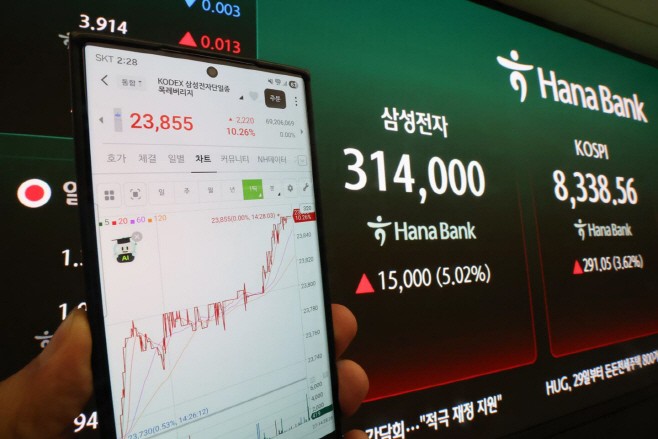 |
| A screen displaying the trading of a Samsung Electronics single-stock leverage product on its listing day on May 27. / Yonhap News |
Although the government has moved to tighten regulations on single-stock leverage ETFs (Exchange Traded Funds), the asset management industry views the measures as having limited effectiveness. On July 16, the government announced a package of countermeasures, including a suspension on new listings of single-stock products, raising the basic deposit requirement from KRW 10 million to KRW 30 million, strengthening pre-investment education, and tightening discrepancy rate management. While the industry believes that immediately implementable measures, such as the increased basic deposit and enhanced pre-education, may have a calming effect on the market, it sees limits to their ability to mitigate volatility. The prevailing opinion is that it will be difficult to lower volatility because a substantial number of investors already hold investments exceeding KRW 50 million in leverage products, and no restrictions exist on the daily average turnover rate. Furthermore, critics pointed out that the intended effects of launching single-stock leverage products—such as stabilizing the exchange rate or drawing back capital deployed in overseas products—have been negligible.
According to the financial sector on July 19, the government announced measures for single-stock leverage ETFs centered on tightening investor requirements. Starting August 5, the basic deposit required when purchasing single-stock leverage ETFs will be raised to KRW 30 million, and starting November, the minimum trading unit will expand from the current 1 share to 20 shares. For example, under the current rules, purchasing one share of "KODEX SK Hynix Single-Stock Leverage" requires paying only the single-share price (KRW 14,584), but moving forward, investors must pay KRW 291,680 even when purchasing just 1 share. The tightened deposit criteria will apply not only to domestic listings but also to overseas-listed single-stock leverage products.
The government anticipated that raising the transaction value in this manner would elevate the entry barrier for general investors. The combined market capitalization of single-stock leverage products, which currently stands at approximately KRW 12 trillion, is expected to shrink to between KRW 4 trillion and KRW 5 trillion.
In addition, the pre-investment education requirement will be extended from two hours to three hours, and advertisement of leverage products by asset management firms, as well as new listings of leverage products, will be completely banned. The mandatory closing-price discrepancy rate management standard for brokerage firms acting as ETF liquidity providers (LPs) will also be tightened from 3 percent to 2 percent. The discrepancy rate is an indicator showing the difference between an ETF's net asset value (NAV) and its market trading price; a higher discrepancy rate means that investors purchased the product at a premium relative to its NAV. Financial authorities plan to review restrictions on new ETF listings if brokerages fail to meet their discrepancy rate management obligations due to intent or gross negligence.
Previously, the rationale behind launching leverage products originated from exchange rate stabilization. At the time, arguments were raised that capital flowing into SK Hynix 2x leverage products listed on the Hong Kong market needed to be drawn back into the domestic market. The expectation was that bringing capital that had gone overseas back home would lead to exchange rate stability. However, according to the Korea Securities Depository, as of May 26 (prior to the listing date of domestic single-stock leverage products), the held amounts for the SK Hynix 2x leverage product (XL2CSOPHYNIX) and the Samsung Electronics 2x leverage product (XL2CSOPSMSN) stood at USD 258.73 million (approx. KRW 385.5 billion) and USD 126.58 million (approx. KRW 188.6 billion), respectively. As of July 16, the held amounts for the two products fell to USD 71.91 million (approx. KRW 107.1 billion) and USD 37.24 million (approx. KRW 55.5 billion). In effect, only about KRW 300 billion in capital was repatriated.
Meanwhile, the market capitalization of the 16 leverage stocks listed on the domestic market surged from KRW 4.4 trillion on May 27 to KRW 11.9 trillion on July 15. Transaction value also jumped during the same period from KRW 10.4 trillion to KRW 13 trillion. This transaction value accounts for roughly 38.2 percent of all ETFs, with the turnover rate exceeding 100 percent. The investor breakdown for single-stock products stands at 42.3 percent foreign investors, 36.9 percent retail investors, and 18.3 percent institutional investors.
An official from an asset management company criticized the situation, stating, "It is a classic case of burning down the house to roast the pig," adding, "The effect on exchange rate stabilization was virtually negligible." The official pointed out that in an effort to capture Hong Kong leverage capital, which amounted to a mere KRW 200 billion to KRW 300 billion in retail investor money, the launch of domestic leverage products ended up attracting trillions of won in general investor capital. The official also predicted that raising the deposit requirement to KRW 30 million would be insufficient to reduce market volatility.
Some quarters also express concern that the emergence of excessive regulations will push the Korean stock market one step further away from inclusion in developed market indices. An industry insider stated, "If there are excessive regulations such as lowering the leverage multiple, it alters the very strategies of investors, which inevitably damages global credibility."
Yoon Seo-young
Most Read
-
1
Celltrion’s Omlyclo gains ground in major European..

-
2
Trump demands rates fall below 1% as Fed hikes for..

-
3
Hyundai Motor Group breaks ground on integrated st..

-
4
U.S. strikes 3 Iranian oil tankers, Iran vows reta..

-
5
Trump makes $1 trillion bet ahead of midterm elect..

-
6
Iran resumes ballistic missile production, assembl..

-
7
Samsung Electronics, Mistral AI to jointly develop..

PEOPLE







-
Address : In-Young Bldg., 34, Uisadang-daero 1-gil, Yeongdeungpo-gu, Seoul
Copyright by ASIATODAY CO., LTD. All rights resereved