



Coupang to seek dismissal of class-action lawsuit in U.S.
Jul 20, 2026, 10:08 am


 |
A USD 5 million (approximately KRW 7.3 billion) class-action lawsuit filed in the United States regarding the Coupang data breach incident has entered its first legal battle ahead of full-scale hearings. As the incident occurred at the South Korean entity (Coupang Corp), the Coupang side signaled its intent to file a motion to dismiss the lawsuit, arguing that it is inappropriate to name the U.S. parent company (Coupang Inc) and Coupang Inc Board Chairman Kim Bom-suk as defendants. The plaintiffs countered that it is contradictory for Coupang to introduce the South Korean entity to investors as its core operating subsidiary while claiming it is a separate corporation in court.
According to a comprehensive coverage by Asia Today on July 19, Kirkland & Ellis, representing Coupang, submitted a letter of intent to file a motion to dismiss to the U.S. District Court for the Eastern District of New York on July 6. SJKP and Napoli Shkolnik, the U.S. partner law firms of Law Firm Daeryun representing over 7,800 plaintiffs, submitted a rebuttal letter responding to Coupang's position on July 14.
Through these submissions, both sides specified their positions on the core issues of the case for the first time. The court plans to set a schedule for the discovery process after reviewing these documents. The discovery process, a core procedure in class-action lawsuits, requires the litigating parties to disclose relevant information to each other upon request prior to the formal trial.
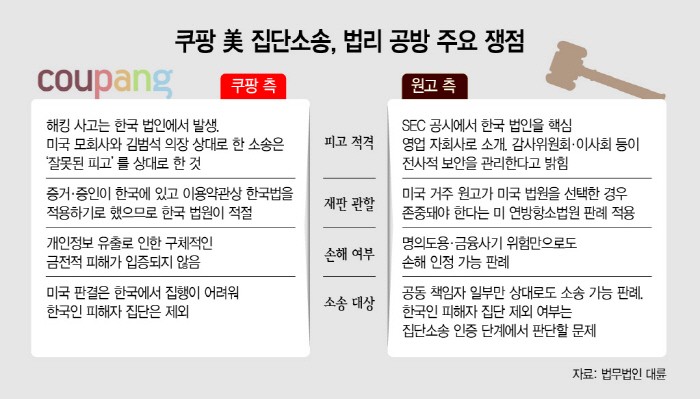
Coupang presented four main arguments in its letter. First, it asserted that it is a lawsuit against the wrong defendants, arguing that the plaintiffs filed the lawsuit against the U.S. parent company and Chairman Kim even though the incident occurred at the South Korean entity. It also raised the principle of forum non conveniens, claiming that the case should be tried in a South Korean court since the evidence and witnesses are located in South Korea and users agreed to the application of South Korean law through the terms of service. Forum non conveniens is a legal doctrine under which a court dismisses a case if another court is deemed more appropriate to hear the matter despite having jurisdiction.
Coupang further argued that the plaintiffs failed to prove specific financial damages resulting from the data leak and that the U.S. judgment would be difficult to take effect in South Korea, meaning that at least the subclass of South Korean victims should be excluded from the lawsuit.
The plaintiffs pointed out that although Coupang claims the South Korean entity and the U.S. parent company are separate corporations, it has introduced the South Korean entity as its core operating subsidiary in its U.S. Securities and Exchange Commission (SEC) filings and stated that it operates a cybersecurity framework at the parent company level. They also cited the fact that the chief legal officer of the U.S. parent company took over as the interim CEO of the South Korean entity immediately after the incident as evidence demonstrating the parent company's involvement.
The plaintiffs presented a federal court of appeals precedent stating that a U.S.-resident plaintiff's choice of their home court must be respected unless there are exceptional circumstances, emphasizing that a New York resident is included among the lead plaintiffs. They also asserted that the lawsuit should not be dismissed at an early stage because exposure to the risk of identity theft or financial fraud due to a personal data breach can be recognized as damage. They argued that whether to exclude the subclass of South Korean victims is a matter to be determined during the subsequent class certification process.
Son Dong-hoo, a U.S. attorney representing the plaintiffs, stated, "This battle is a procedural dispute at the early stage of the lawsuit, not a judgment on the merits," adding, "The court will determine the extent to which the U.S. parent company and its management controlled the data security of the subsidiary after internal documents are disclosed through discovery."
Jeong Min-hoon
#Coupang #Data leakage #US
Copyright by Asiatoday
Most Read
-
1
Celltrion’s Omlyclo gains ground in major European..

-
2
Trump demands rates fall below 1% as Fed hikes for..

-
3
Hyundai Motor Group breaks ground on integrated st..

-
4
U.S. strikes 3 Iranian oil tankers, Iran vows reta..

-
5
Trump makes $1 trillion bet ahead of midterm elect..

-
6
Iran resumes ballistic missile production, assembl..

-
7
Samsung Electronics, Mistral AI to jointly develop..

PEOPLE







-
Address : In-Young Bldg., 34, Uisadang-daero 1-gil, Yeongdeungpo-gu, Seoul
Copyright by ASIATODAY CO., LTD. All rights resereved