



Trump orders naval blockade of Iran and additional airstrikes
Jul 16, 2026, 10:26 am


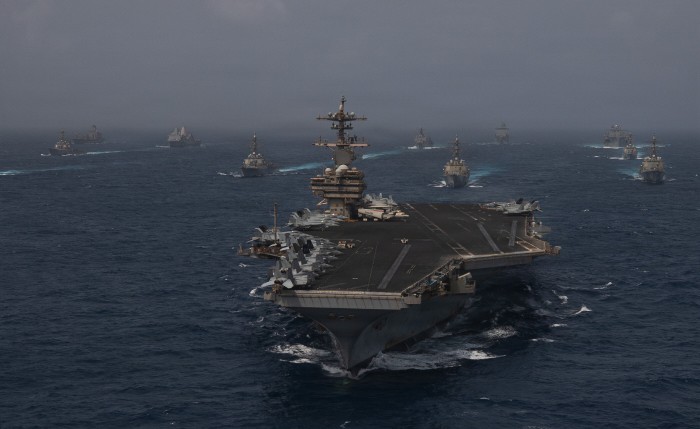 |
| U.S. military vessels on the move for operations as the U.S. reimposes a naval blockade on Iran on July 14 (local time). U.S. Central Command (CENTCOM) announced that more than 20 U.S. Navy warships and hundreds of military aircraft have been deployed. / Captured from the U.S. Central Command website. |
The U.S. administration under Donald Trump escalated its military pressure on Iran on July 14 (local time), resuming its naval blockade and launching additional airstrikes. However, the administration withdrew its plan to impose a 20% security fee on cargo transiting the Strait of Hormuz just one day after its announcement, moving instead to coordinate with its Gulf allies.
U.S. Central Command (CENTCOM) announced that it resumed the naval blockade on vessels traveling to and from Iranian ports and coasts, starting at 4:00 PM on the same day (5:00 AM on July 15, KST). CENTCOM stated through social media that more than 20 U.S. Navy warships and hundreds of military aircraft are currently operating across the Middle East, preparing for further military action. Prior to resuming the blockade, the U.S. military also conducted additional airstrikes to degrade Iran's maritime attack capabilities. Iranian authorities reported that attacks hit four locations in Bushehr, as well as Bandar Abbas, Qeshm Island, Sirik, Abadan, and Mahshahr.
President Trump withdrew the plan to impose the 20% transit fee. He announced on social media that the 20% security fee, which was to be charged on cargo passing through the Strait of Hormuz, will be replaced by trade and investment agreements with Gulf nations. While maintaining military pressure, President Trump also kept the door open for negotiations. In an interview, he warned, "We're hitting them very hard," adding that if they do not come to the negotiating table, the U.S. will target all infrastructure, including power plants and bridges.
In response to the U.S. naval blockade, Iran's Islamic Revolutionary Guard Corps (IRGC) warned that it could block oil and gas transport routes used by the U.S. and its allies. In a statement released through state media on July 15, the Revolutionary Guard warned that since the enemy has blocked global oil and gas export routes through acts of piracy, they must prepare for other oil and gas transport routes beneficial to the U.S. and its allies to be cut off as well.
Ha Man-joo
Most Read
-
1
Celltrion’s Omlyclo gains ground in major European..

-
2
Trump demands rates fall below 1% as Fed hikes for..

-
3
Trump makes $1 trillion bet ahead of midterm elect..

-
4
Iran resumes ballistic missile production, assembl..

-
5
Samsung Electronics, Mistral AI to jointly develop..

-
6
Trump warns countries not helping U.S. must pay re..

-
7
Apple launches first foldable, 1 million won prici..

PEOPLE






HEADLINE NEWS
- Trump to roll out ‘unprecedented welcome’ for Xi with B-2 bombers, F-22 fighters
- S. Korea, U.S., and Japan form united front on Taiwan and economic coercion..
- Trump administration moves to impose sweeping sanctions on International Cr..
- Xi to make state visit to U.S. Sept. 23-25, dispelling rumors over his heal..

-
Address : In-Young Bldg., 34, Uisadang-daero 1-gil, Yeongdeungpo-gu, Seoul
Copyright by ASIATODAY CO., LTD. All rights resereved