



India digs in heels over trade pact with U.S., prioritizing national interest over speed
Jul 14, 2026, 10:08 am


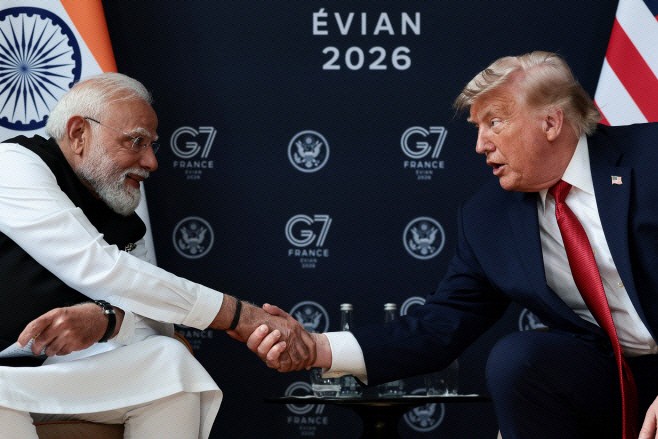 |
| U.S. President Donald Trump and Indian Prime Minister Narendra Modi shake hands during a bilateral meeting on the sidelines of the G7 summit in Evian-les-Bains, France, last month. / Photo courtesy of Reuters, Yonhap News |
India digs in heels over trade pact with the U.S., prioritizing national interest over speed
India has made it clear that it will not rush into a trade agreement with the United States. New Delhi maintains that it will not sign any deal unless it secures tariff advantages over its competitors.
Reuters reported on July 14 (local time) that India and the U.S. failed to reach a consensus despite months of trade negotiations. The talks collapsed even though U.S. Trade Representative Jamieson Greer visited New Delhi last month to finalize a tentative trade pact, raising expectations on both sides for a limited agreement.
"The deal fell through because the U.S. failed to guarantee a tariff advantage for India over competitors like China, nor did it promise to refrain from imposing additional tariffs post-agreement," an Indian government official privy to the negotiations said. The official added, "We have no intention of rushing into a deal under unfavorable conditions, and we will strictly defend our red line regarding concessions in the agricultural sector."
Piyush Goyal, India's Minister of Commerce and Industry, stated the previous day that both nations remain "committed to a balanced agreement." Commerce Secretary Rajesh Agrawal also noted that "the framework agreement is ready and will be signed at an appropriate time," but firmly underscored that "the core of the agreement is comparative advantage," emphasizing the necessity of securing an edge over rival nations.
While Washington also hopes for a breakthrough, a clear divergence in positions remains. A U.S. source familiar with the matter conveyed that Washington expects India to make its own concessions if it wishes to obtain the tariff preferences it desires. Another U.S. official hinted that a swift agreement is unlikely, characterizing India's negotiating stance as "at times slow, bureaucratic, and difficult."
"The Trump administration is engaging productively with the Indian side to finalize a historic trade deal that puts Americans and America first," White House spokesperson Khush Desai said.
In February, the two countries agreed on a framework where India would lower trade barriers and increase purchases of American goods in exchange for a temporary waiver on an 18% tariff on Indian commodities. However, the landscape shifted later that month when the U.S. Supreme Court struck down the Trump administration's tariffs based on the International Emergency Economic Powers Act (IEEPA).
To replace the invalidated measures, the Trump administration temporarily imposed a 10% tariff under Section 122 of the Trade Act, which is set to expire on July 24. Ahead of the expiration, the U.S. is seeking to introduce new tariffs through Section 301 investigations targeting overcapacity and forced labor. Under the forced labor probe, Washington has proposed additional tariffs of up to 12.5% on dozens of countries, including India. New Delhi has denied accusations regarding overcapacity.
India's economic confidence underpins its refusal to rush negotiations. Its merchandise exports from April to June surged by approximately 15% year-on-year. Exports to the Gulf region, which had been severely disrupted by the war involving Iran, recovered to pre-war levels—jumping from $2.62 billion in March to $5.3 billion in May—thanks to the securing of alternative shipping routes. Exports to the U.S. also ticked up slightly, reaching $17.29 billion during the April-May period.
Furthermore, the India-UK Free Trade Agreement (FTA) is set to take effect on July 15, while the FTA signed with the European Union in January is slated for implementation early next year.
"Indian negotiators have gained significant leverage in these talks, backed by a resilient economy, diversification with other global partners, and their rising international strategic status," said Wendy Cutler, Vice President of the Asia Society Policy Institute.
Political calculations are also at play. New Delhi anticipates that some of Washington's trade measures could face legal and political roadblocks, much like how 22 U.S. state attorneys general from the Democratic Party have already challenged the forced labor-related tariffs.
Moreover, Prime Minister Narendra Modi's recent victories in state assembly elections have expanded his political room to maneuver, allowing him to resist a rushed pact. Leadership within the ruling Bharatiya Janata Party (BJP) has publicly insisted that any trade agreement must safeguard domestic farmers and small businesses.
"India is realizing that delaying or walking away from a rushed agreement might be wiser than binding itself to obligations that could outweigh the benefits of temporary tariff relief," said Ajay Srivastava, a former trade negotiator and founder of the Global Trade Research Initiative (GTRI).
Jeong Ri-na
Most Read
-
1
Celltrion’s Omlyclo gains ground in major European..

-
2
Trump demands rates fall below 1% as Fed hikes for..

-
3
Trump makes $1 trillion bet ahead of midterm elect..

-
4
Iran resumes ballistic missile production, assembl..

-
5
Samsung Electronics, Mistral AI to jointly develop..

-
6
Trump warns countries not helping U.S. must pay re..

-
7
Apple launches first foldable, 1 million won prici..

PEOPLE






HEADLINE NEWS
- Trump to roll out ‘unprecedented welcome’ for Xi with B-2 bombers, F-22 fighters
- S. Korea, U.S., and Japan form united front on Taiwan and economic coercion..
- Trump administration moves to impose sweeping sanctions on International Cr..
- Xi to make state visit to U.S. Sept. 23-25, dispelling rumors over his heal..

-
Address : In-Young Bldg., 34, Uisadang-daero 1-gil, Yeongdeungpo-gu, Seoul
Copyright by ASIATODAY CO., LTD. All rights resereved