



Samyang Group drives enterprise-wide expansion of generative AI
Jul 14, 2026, 09:55 am


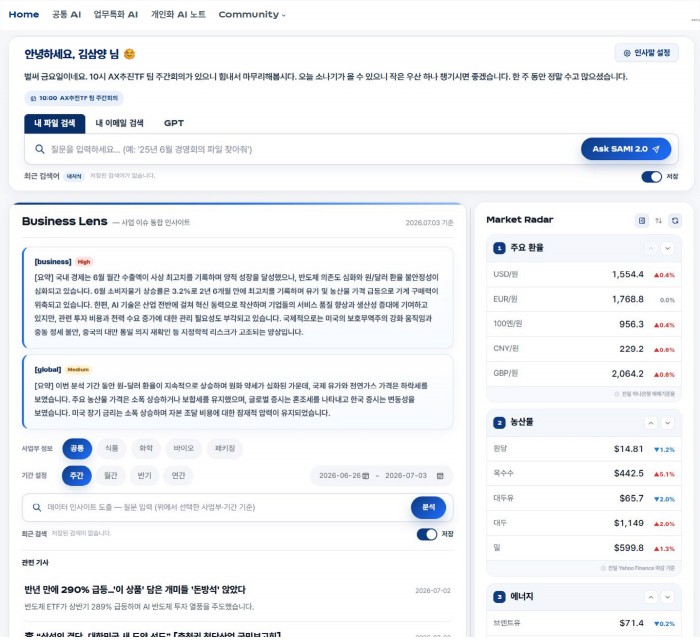 |
| Samyang Group's generative AI platform 'SAMI 2.0' home screen. / Photo courtesy of Samyang Group |
Samyang Group drives enterprise-wide expansion of generative AI
Samyang Group is accelerating business innovation utilizing generative artificial intelligence (AI). The group has embarked on establishing a group-wide AI transformation framework by introducing an in-house platform that allows executives and employees to directly build customized AI assistants based on their own operational data.
Samyang Group announced on July 13 that it has officially launched "SAMI 2.0," an AI portal dedicated to its workforce. This platform is an advanced version of "SAMI 1.0," the generative AI service unveiled last year, and is engineered to enable employees across all domestic and overseas business sites to link and utilize data necessary for their daily tasks in tandem with AI.
The most prominent feature of SAMI 2.0 is its capability to build tailored AI models suited to individual work environments. Employees can register their own operational files and materials into the internal AI database, allowing the AI to learn the relevant contents. This mechanism streamlines repetitive tasks such as document retrieval and report writing, while ensuring that data security issues are strictly managed within the corporate intranet environment.
During the development phase of the platform, Samyang Group focused heavily on maximizing utility on the front lines. Through "100 Days of Challenge"—an in-house AI competition participated in by around 80 employees—the group identified tasks with high repetitive frequencies and strong job-specific utilization, subsequently building 13 specialized AI business modules based on these findings.
SAMI 2.0 has also expanded its general business support functions. From personal schedules and email management to internal document searches, business unit data verification, and customized news summaries, the platform delivers these features on a single dashboard. Furthermore, by linking internal data such as market conditions, raw material prices, financial performance, inventory levels, and utility costs, the system can be utilized for analyzing past business outcomes and forecasting future market environments.
Moving forward, Samyang Group plans to expand the scope of AI applications from simple text-based task support to diverse domains, including image generation and comprehensive report creation. The company intends to progressively elevate the level of business automation by interconnecting internal core systems with AI. In the long term, the group aims to establish an AI-driven work environment by 2030, where multiple AI agents organically connect to provide context-aware analyses and strategic proposals.
"We will accelerate the group-wide AI transformation by concurrently running AI training programs and discovering department-specific tasks," said Oh Seung-hoon, CEO of Samyang Data Systems.
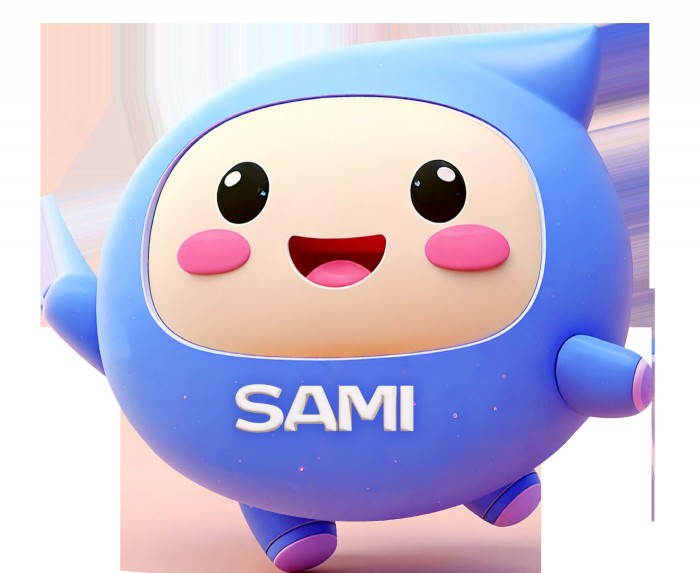 |
| Samyang Group's 'SAMI' icon. / Photo courtesy of Samyang Group |
Lee Chang-yeon
Most Read
-
1
Kia Sportage outperforms Mazda CX-5 in German auto..

-
2
Houthis launch successive attacks on Saudi airport..

-
3
Saudi Arabia, Iran hold first diplomatic talks to..

-
4
U.S. deploys carrier, 10,000 more troops to Middle..

-
5
Saudi airport in Riyadh struck again, leaving at l..

-
6
Japan tracks Ukraine fiber-optic drones, bolsters..

-
7
Putin's ally visits China on the 8th ahead of APEC..

PEOPLE





HEADLINE NEWS

-
Address : In-Young Bldg., 34, Uisadang-daero 1-gil, Yeongdeungpo-gu, Seoul
Copyright by ASIATODAY CO., LTD. All rights resereved