



Services shore up employment insurance, but youth and manufacturing jobs face deep freeze
Jul 14, 2026, 09:23 am


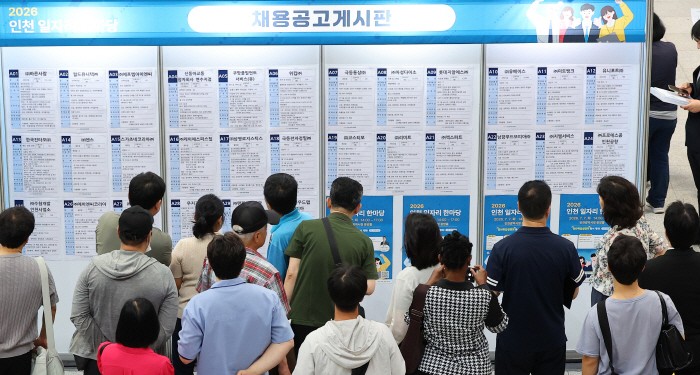 |
| Job seekers examine job advertisements at the '2026 Incheon Job Fair' held in the central hall of Incheon City Hall in Namdong District, Incheon, on July 7. / Photo courtesy of Yonhap News Agency. |
Although the number of employment insurance subscribers maintained its growth streak in the 200,000s for the sixth consecutive month, the increase was heavily concentrated in service sectors such as health and social welfare, as well as accommodation and food services. Meanwhile, the manufacturing sector saw a decline for the 13th consecutive month, and the number of subscribers aged 29 and under fell for the 46th consecutive month, highlighting a persistent disparity across different industries and age groups.
According to the "Labor Market Trends Based on June 2026 Employment Administrative Statistics" released by the Ministry of Employment and Labor on July 13, the number of permanent subscribers to employment insurance stood at 15,855,000 at the end of last month, marking an increase of 264,000 (1.7%) compared to the same month last year. The expansion in subscription numbers remained in the upper 200,000s following gains of 259,000 in February, 270,000 in March, 271,000 in April, and 270,000 in May.
The overall growth was driven by the service sector, where the number of subscribers increased by 279,000 year-on-year. Health and social welfare services recorded the largest gain with an increase of 112,000, followed by accommodation and food services (55,000), business services (26,000), professional, scientific, and technical services (22,000), and educational services (20,000). Notably, accommodation and food services maintained a growth streak in the 50,000s for five consecutive months, led by restaurants and specialty coffee shops.
"Employment in the service industry is expanding, primarily driven by health and social welfare, as well as the accommodation and food sectors," said Chun Kyung-gi, director of the Future Employment Analysis Division at the Labor Ministry. "The recovery of the domestic service sector, spurred by an influx of foreign tourists, also appears to have had an impact."
Conversely, manufacturing subscribers fell by 9,000, marking the 13th consecutive month of decline. Furthermore, the scale of this reduction has progressively widened from 2,200 in February to 3,900 in March, 6,600 in April, 8,400 in May, and 9,000 in June.
While growth slowed in the food products and electronic/telecommunication sectors, the decline deepened in chemical products, electrical equipment, and automobiles. The number of domestic subscribers within manufacturing fell by 22,000, contracting for the 33rd consecutive month. In contrast to a decline of 2,100 subscribers in automobile manufacturing, the "other transport equipment" manufacturing sector, which includes shipbuilding, added 5,500 subscribers. Machinery and equipment manufacturing also shifted back to growth for the first time in 17 months.
Subscribers in the construction sector dropped by 8,100, centered on general construction, marking the 35th consecutive month of decline. However, the margin of decrease narrowed slightly from the 10,600 drop recorded in February.
By age demographic, a stark contrast emerged between younger and older generations. Subscribers aged 29 and under decreased by 63,000 year-on-year, continuing a downward trajectory for 46 consecutive months since September 2022. The contraction was observed across manufacturing, information and communications, health and social welfare, and wholesale/retail trade. Although the drop among youth has eased from its peak of 113,000 in September 2024 to the current 60,000 range, the declining trend remains unbroken. Subscribers in their 40s also edged down by 2,000. Conversely, those aged 60 and older increased by 206,000, driving the overall growth. Subscribers in their 30s and 50s rose by 82,000 and 41,000, respectively.
"The decline in youth subscribers has eased significantly from 113,000 in September 2024 to the low 60,000s at present," Director Chun noted. "However, when looking at the entire employment pool, the drop in less stable employment, such as temporary positions for youth, is more pronounced, meaning the actual situation felt on the ground may be more challenging."
The number of first-time applicants for jobseeker benefits reached 90,000, up by 4,000 (4.5%) from the same month last year, reversing back to an increase after four consecutive months of decline. The total number of benefit recipients fell by 20,000 to 635,000, but the total payout amount rose by 23.1 billion won to 1.0747 trillion won.
New job openings registered through the online employment portal Employment24 surged by 21.4% to 183,000, while new job seekers dipped by 0.8% to 384,000. Consequently, the job opening-to-application ratio, which indicates the number of available jobs per seeker, rose from 0.39 in June last year to 0.48 in June this year.
Kim Nam-hyung
Most Read
-
1
Celltrion nears additional contract with major U.S..

-
2
Putin proposes trilateral U.S.-China-Russia summit..

-
3
U.S. weighs dropping MOAB, world's most powerful n..

-
4
"Aren't those foreigners on welfare?": M..

-
5
Attention centers on APEC for possible Trump-Xi-Pu..

-
6
Saudi Arabia, Iran hold first diplomatic talks to..

-
7
China tightens grip on boosting domestic demand an..

PEOPLE







-
Address : In-Young Bldg., 34, Uisadang-daero 1-gil, Yeongdeungpo-gu, Seoul
Copyright by ASIATODAY CO., LTD. All rights resereved