



Surging power demand from AI data centers and chips to leave Honam 2.3 GW short by 2030
Jul 13, 2026, 10:03 am


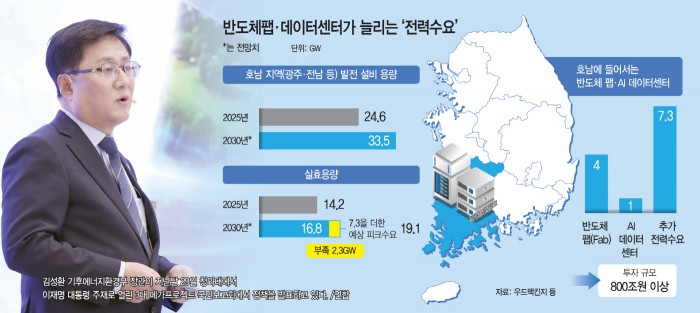 |
While the government has unveiled blueprints to develop the southwestern Honam region into South Korea's second semiconductor manufacturing hub by establishing semiconductor factories and artificial intelligence (AI) data centers, securing the power infrastructure to back these projects has emerged as the most critical hurdle. If investments proceed as planned and electricity demand spikes in Honam, the region is projected to face a power deficit of 2.3 gigawatts (GW) by 2030. Consequently, experts stress that a reliable baseload power solution must be established to resolve the looming electricity shortage four years from now.
According to energy industry sources on July 12, if the planned semiconductor production facilities and AI data centers are built as scheduled, Honam's peak power demand is projected to surge from the current 11.8 GW to 19.1 GW. The estimate is a simple aggregation of the power capacities required for four semiconductor fabs from Samsung Electronics and SK Hynix alongside one AI data center.
The core dilemma centers on the volume of electricity that can actually be supplied. A recent South Korean power grid analysis report by global energy consultancy Wood Mackenzie revealed that while Honam's total installed power capacity stands at 24.6 GW, its effective capacity—the reliable supply capacity available during peak load periods—is limited to approximately 14.2 GW. Although solar power installations in Honam total 11.5 GW, outstripping other energy sources, their effective capacity sits at a mere 1.6 GW due to the inherent intermittency of renewable energy. Effective capacity refers to the valid supply capability that factors in the availability and output characteristics of each specific power source.
Even assuming that the rollouts of solar power, battery energy storage systems (BESS), and wind power continue at their current paces through 2030, Honam’s effective power capacity is expected to reach only 16.8 GW, falling short of the newly generated peak demand.
"Currently, the connection of new renewable energy to the grid in Honam is heavily bottlenecked by transmission grid constraints and system acceptance issues," said Jung Yoon-shik, Principal Research Analyst at Wood Mackenzie. He assessed, "If this trend persists, the renewable energy added between now and 2030 will highly likely struggle to fully cover the new power demand generated by AI data centers and high-tech industries."
Furthermore, experts point out that the projected effective capacity of 16.8 GW assumes a 100% operational rate for thermal and nuclear power plants, meaning the actual available capacity could turn out even lower. For instance, the Hanbit Nuclear Power Site (Units 1 to 6) operated by Korea Hydro & Nuclear Power (KHNP) in Yeonggwang, South Jeolla Province, possesses a total installed capacity of 5.9 GW, yet its annual capacity utilization rate hovers below 80%. The lower utilization stems from shutdowns triggered by the Korea Power Exchange's output curtailment and routine maintenance schedules.
"While nuclear power can be maintained as a reliable source of effective capacity, this depends on conditions being met: the continued operation of Hanbit Units 1 and 2 must proceed as scheduled, and the capacity limits on dry storage facilities must be lifted under the Special Act on High-Level Radioactive Waste," analyzed Jung Bum-jin, a professor of nuclear engineering at Kyung Hee University.
Experts emphasize that to supply stable power to high-tech industries such as semiconductor fabs, the expansion of BESS must be paired with the securing of solid baseload power sources. Against this backdrop, idle land within the Hanbit Nuclear Power Site is being floated as a candidate location for new reactors. KHNP has been using this specific plot to operate a solar power facility (21.363 megawatts) since 2007, but industry analysts believe the site could accommodate two additional new nuclear reactors.
Bae Seok-won
#AI data center
Copyright by Asiatoday
Most Read
-
1
Celltrion’s Omlyclo gains ground in major European..

-
2
Trump demands rates fall below 1% as Fed hikes for..

-
3
Hyundai Motor Group breaks ground on integrated st..

-
4
U.S. strikes 3 Iranian oil tankers, Iran vows reta..

-
5
Trump makes $1 trillion bet ahead of midterm elect..

-
6
Iran resumes ballistic missile production, assembl..

-
7
Samsung Electronics, Mistral AI to jointly develop..

PEOPLE






-
Address : In-Young Bldg., 34, Uisadang-daero 1-gil, Yeongdeungpo-gu, Seoul
Copyright by ASIATODAY CO., LTD. All rights resereved