



Surging legal risks from Commercial Act revision prompt companies to delay investments and M&As
Jul 13, 2026, 10:01 am


 |
One year has passed since the implementation of the revised Commercial Act, which expanded the scope of directors' duty of loyalty from the "company" to the "company and its shareholders." On the corporate front, heightened legal risks are materializing into reality, putting the brakes on pivotal management activities including new business investments and mergers and acquisitions (M&As).
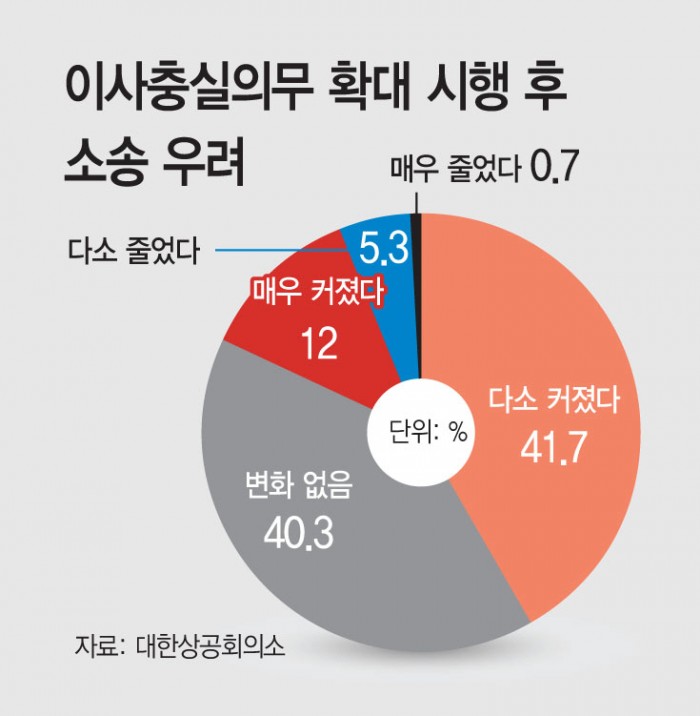
According to a survey on the "Impact of the Commercial Act Revision on the Business Environment After One Year," released by the Korea Chamber of Commerce and Industry (KCCI) on July 12 following a poll of 300 listed firms, 53.7% of responding companies stated that the possibility of legal disputes, such as shareholder derivative suits, has increased compared to the period before the revision.
This fear of litigation is directly prompting changes in corporate management strategies. Two out of ten surveyed firms (21.7%) revealed that they have experienced cases where new investments or M&As were delayed, suspended, or entirely canceled due to increasingly stringent legal review processes following the revision.
Breaking down the affected activities, new investments—including entry into new businesses and M&As—accounted for the highest share at 30.8%. This was followed by capital raising (18.5%), executive appointments (16.9%), and asset acquisition/disposition as well as affiliate restructuring (15.4% each).
"While we agree with the intent of reviewing board agenda items from diverse perspectives, directors need the business judgment rule to be clearly codified into law so they can manage with confidence when swift investment decisions are critical," an official from Company A, a mid-sized automotive components manufacturer, pointed out.
In fact, the recent regulatory shift did not stop at a one-off amendment but was enacted in three consecutive waves over the past year, exerting comprehensive pressure on businesses. Following the expansion of the directors' duty of loyalty that went into effect last July, the mandatory upward adjustment of the independent director ratio is slated for this July, alongside the expansion of separate election systems for audit committee members and the introduction of cumulative voting set for September. Compounded by the mandatory retirement of treasury shares enforced last March, enterprises have faced the daunting task of reshaping their overall corporate governance within a short timeframe.
As legal liabilities intensified, companies dramatically overhauled their board operations. A staggering 84.3% of all responding firms replied that they revamped their board protocols following the revision. Companies introduced measures such as establishing preliminary review processes by legal teams (47%), expanding consultations with external experts (45.7%), and reinforcing board minutes documentation by recording the individual votes and opinions of each director (43.7%).
Regarding these changes in operational methods, 39.6% of respondents highlighted positive aspects, such as enhanced accountability and improved governance transparency. Conversely, 22.4% lamented management burdens, including increased compliance costs and slowed decision-making processes.
Meanwhile, preparations for the mandatory implementation of electronic shareholder meetings and the expansion of the independent director ratio—both set to take effect sequentially next year—have yet to gain speed on the ground. Only 16.0% of the target firms have completed building electronic shareholder meeting systems, and numerous companies are reportedly struggling to source eligible independent director candidates.
To facilitate the stable landing of the new legal framework, businesses urged the government to provide sophisticated policy support. The top policy priority cited by firms was the specification of clear guidelines for the duty of loyalty (37.3%), followed by the codification of the business judgment rule (20.3%).
"Over the past year, companies have poured significant efforts into restructuring their board operations," said Choi Eun-rak, Head of the KCCI Research Division. He emphasized, "For the system to take root firmly in the corporate ecosystem, it is essential to establish concrete operational guidelines alongside on-site policy support that alleviates practical administrative burdens."
Son Kang-hoon
Most Read
-
1
Celltrion’s Omlyclo gains ground in major European..

-
2
Trump demands rates fall below 1% as Fed hikes for..

-
3
Hyundai Motor Group breaks ground on integrated st..

-
4
U.S. strikes 3 Iranian oil tankers, Iran vows reta..

-
5
Trump makes $1 trillion bet ahead of midterm elect..

-
6
Iran resumes ballistic missile production, assembl..

-
7
Samsung Electronics, Mistral AI to jointly develop..

PEOPLE







-
Address : In-Young Bldg., 34, Uisadang-daero 1-gil, Yeongdeungpo-gu, Seoul
Copyright by ASIATODAY CO., LTD. All rights resereved