



Share of rising Seoul apartment deals hits 57.1% in June, up 9.4%p MoM
Jul 13, 2026, 09:47 am


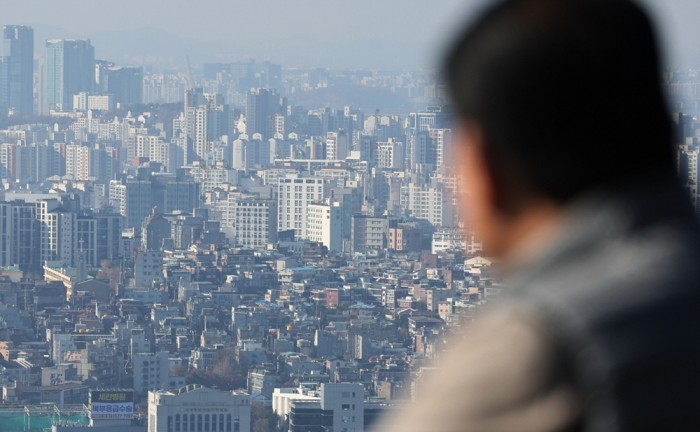 |
| A panoramic view of a densely populated apartment complex area in Seoul. / Yonhap News |
The proportion of "appreciating transactions"—where apartments are sold at higher prices than their previous deals—approached 60% in the Seoul apartment market, expanding significantly within a single month.
According to an analysis of the Ministry of Land, Infrastructure and Transport’s actual apartment transaction data released by real estate platform Zigbang on July 13, the share of rising transactions in Seoul reached 57.1% last month, marking a 9.4 percentage point (p) increase from the previous month.
In May, only five autonomous districts in Seoul recorded a share of appreciating deals above 50%. However, this figure expanded to 23 districts in June, with the sole exceptions of Gangnam-gu and Gwangjin-gu.
By district, Yongsan-gu registered the largest growth at 17.7%p, followed by Mapo-gu (15.8%p), Jungnang-gu (15.5%p), Seocho-gu (14.6%p), Gwanak-gu (13.3%p), Yeongdeungpo-gu (13.0%p), Geumcheon-gu (12.4%p), and Seongdong-gu (12.2%p).
Notably, the share of rising transactions grew visibly even in areas dense with relatively affordable apartments, such as Jungnang, Gwanak, Yeongdeungpo, and Geumcheon. The upward trend spread to regions that had previously seen limited price growth, signaling that the buoyant transaction mood is expanding across the entire capital.
Reflecting this trend, the share of appreciating deals across the broader Seoul metropolitan area climbed to 50.1%, up 3.5%p from the previous month's 46.6%. The nationwide figure also nudged up by 1.6%p, rising from 45.7% to 47.3%.
However, overall transaction volume remains sluggish. The number of reported apartment sales in Seoul dropped from 7,681 in May to 3,105 in June. Because the reporting window for June transactions is still open and additional volumes could be registered, analysts note that the rise in appreciating deals should be interpreted alongside final transaction volumes and shifts in transaction composition.
Gyeonggi Province also saw an expansion in its share of rising deals. The figure reached 49.4% in June, up 3.0%p from 46.4% in the previous month.
Gwacheon posted the highest growth rate at 22.7%p, followed by Sujeong-gu in Seongnam (20.1%p), Gwangmyeong (13.7%p), Bundang-gu in Seongnam (10.7%p), Yeongtong-gu in Suwon (8.8%p), and Dongtan-gu in Hwaseong (8.6%p).
Yet, matching the trend seen in Seoul, most of these Gyeonggi regions saw their transaction volumes plunge by 30% to 70% month-on-month, meaning only the proportion of higher-priced deals increased, with Dongtan being the sole exception. Analysts attribute the resilience in Seongnam, Gwacheon, and Gwangmyeong—despite being regulated areas—to a mix of proximity to Seoul, preferences for newly built complexes, and expectations surrounding redevelopment projects and transportation network upgrades.
Dongtan set itself apart by logging simultaneous increases in both transaction volume and the share of appreciating deals. Its transaction volume in June surged by 41% compared to the previous month, fueled by expanding investments in the semiconductor industry and anticipated infrastructure improvements following the opening of the GTX-A line.
In contrast, Incheon’s share of rising deals stood at 44.1% in June, hovering flat compared to May's 44.2%. While no district in Incheon surpassed the 50% threshold, Yeongjong-gu jumped 9.7%p month-on-month to hit 48.2%. Other districts like Yeonsu-gu (1.9%p), Seo-gu (1.7%p), and Bupyeong-gu (0.7%p) recorded only marginal gains.
The provinces diverged sharply from the metropolitan area, showing mixed trends across different regions. The overall share of appreciating deals in provincial areas ticked down by 0.2%p from the previous month to 44.3%.
Increases were seen in Gangwon (46.6%, up 3.5%p), Chungnam (44.4%, up 3.3%p), Ulsan (46.1%, up 2.7%p), and Gyeongbuk (46.4%, up 1.6%p), while Sejong (39.6%) and Daejeon (42.4%) remained virtually unchanged.
Conversely, slight declines were recorded in Gwangju and Jeonnam (44.7%, down 0.2%p), Chungbuk (45.3%, down 0.4%p), Gyeongnam (44.4%, down 0.6%p), and Busan (44.1%, down 0.8%p). Daegu dropped by 3.3%p, while Jeonbuk (down 4.6%p) and Jeju (down 5.6%p) experienced relatively sharper contractions.
Zigbang analyzed that regional polarization was highly pronounced across the nationwide real estate market last month. While Seoul spearheaded the growing share of appreciating deals within the capital region, Zigbang stressed that further data must be monitored to confirm actual market directions since transaction filings are still underway.
Additionally, a key variable is that June's transactions reflect the market state prior to the government's recent tightening of regulations. In July, the government designated Dongtan in Hwaseong, Giheung in Yongin, and Guri as additional speculative vigilance zones and adjusted regulated areas. Follow-up policy debates, including tax reform bills and public real estate forums, are slated to continue.
Consequently, how these tightened regulations and tax changes reshape regional transaction flows is viewed as the pivotal variable for the housing market in the second half of the year. Experts forecast that rather than moving in unison, the market will continue to witness highly fragmented trends depending on the specific region, price tier, and target demand group.
Jeon Won-jun
Most Read
-
1
Celltrion’s Omlyclo gains ground in major European..

-
2
Trump demands rates fall below 1% as Fed hikes for..

-
3
Hyundai Motor Group breaks ground on integrated st..

-
4
U.S. strikes 3 Iranian oil tankers, Iran vows reta..

-
5
Trump makes $1 trillion bet ahead of midterm elect..

-
6
Iran resumes ballistic missile production, assembl..

-
7
Samsung Electronics, Mistral AI to jointly develop..

PEOPLE







-
Address : In-Young Bldg., 34, Uisadang-daero 1-gil, Yeongdeungpo-gu, Seoul
Copyright by ASIATODAY CO., LTD. All rights resereved