



S. Korea eyes $15T European defense market and secures Mongolian mineral supply chain
Jul 13, 2026, 09:37 am


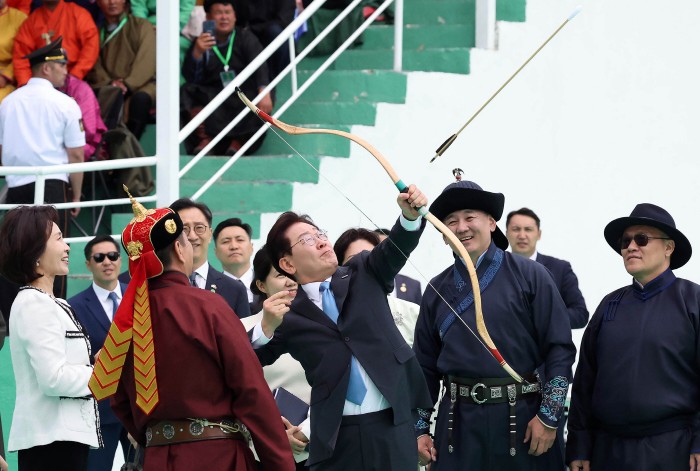 |
| President Lee Jae-myung, currently on a state visit to Mongolia, shoots a traditional bow at the Naadam festival grounds in Ulaanbaatar on July 11 (local time) as First Lady Kim Hye-kyung, Mongolian President Ukhnaa Khurelsukh, and First Lady Luvsandorj Bolortsetseg look on. / Photo by Yonhap News |
President Lee Jae-myung’s recent visits to Turkey and Mongolia from July 7 to 11 focused squarely on economic security sales.
At the NATO Summit, President Lee concentrated on opening doors for the South Korean defense industry to enter the joint procurement market and threw his weight behind the Korea-U.S. shipbuilding cooperation initiative dubbed "MASGA." During his state visit to Mongolia, his agenda prioritized the Korea-Mongolia Comprehensive Economic Partnership Agreement (CEPA) and cooperation on strengthening supply chains for critical minerals, including rare earth elements.
K-Defense aims at NATO procurement alongside rising Korea-U.S. shipbuilding cooperation
According to the presidential office on July 12, President Lee laid out a blueprint during his NATO itinerary to enter the alliance's joint procurement market, which is estimated at roughly 15 trillion won ($11 billion) annually.
Delivering a keynote speech at a defense forum, Lee proposed the "Defense Industry Partnership 2.0"—a framework centered on joint research, production, and operations—while expressing a strong commitment to expanding technological cooperation for future warfare, including drones, artificial intelligence (AI), and space technologies.
The presidential office explained that opportunities for South Korean defense exports to Europe are set to expand significantly, as NATO allies have agreed to boost their defense spending to around 5% of their gross domestic product (GDP) by 2035.
Shipbuilding cooperation between Seoul and Washington also emerged as a major agenda item under the MASGA framework. President Lee met with U.S. President Donald Trump in Ankara, Turkey, on July 7 to discuss the construction of military vessels.
While the presidential office noted that the possibility of constructing vessels within South Korea remains open, legal constraints mean that cooperation is more likely to materialize first in the sectors of combat logistics support ships and maintenance, repair, and overhaul (MRO) services. President Lee also held a bilateral meeting with Ukrainian President Volodymyr Zelenskyy to discuss a comprehensive support package worth $100 million. However, the presidential office drew a clear line regarding the provision of lethal weapons, maintaining its stance on offering non-lethal and humanitarian aid.
Securing critical minerals in Mongolia as consumer goods cooperation expands
During the state visit to Mongolia, cooperation on critical mineral supply chains took center stage. President Lee held a summit with Mongolian President Ukhnaa Khurelsukh on July 9, where the two leaders adopted a joint declaration to usher in a "golden age of Korea-Mongolia relations." Anchored by an agreement in principle on the CEPA and partnership on critical minerals, the two nations agreed to push for a bilateral trade volume of $1 billion by 2030. Once the pact takes effect, tariffs on Mongolian copper, molybdenum, and rare earth elements will be eliminated, which is expected to ease the raw material procurement burden on South Korean companies.
However, given that the share of Mongolian minerals in South Korea's total imports remains minuscule for now, analysts view the agreement primarily as a meaningful step toward diversifying supply chains.
At a Korea-Mongolia business forum, retail models operating in Ulaanbaatar—often nicknamed "Mongtan" due to the high concentration of Korean businesses—were also highlighted. Highlighting these operations as mutually beneficial examples that combine the technology and experience of Korean retail firms with investments from Mongolian enterprises, President Lee unveiled plans to expand cooperation into food, cosmetics, finance, healthcare, education, and AI.
Additionally, peace initiatives on the Korean Peninsula were addressed during the trip. As a nation that has maintained long-standing diplomatic ties with North Korea, Mongolia is recognized as holding an established communication channel regarding Peninsula issues. Moving forward, the ultimate success of the tour will depend on whether the framework established for defense, shipbuilding, critical minerals, and consumer goods cooperation can translate into actual contracts, investments, and secured supply chains.
Park Young-hoon
Most Read
-
1
Celltrion nears additional contract with major U.S..

-
2
Putin proposes trilateral U.S.-China-Russia summit..

-
3
U.S. weighs dropping MOAB, world's most powerful n..

-
4
"Aren't those foreigners on welfare?": M..

-
5
Attention centers on APEC for possible Trump-Xi-Pu..

-
6
Saudi Arabia, Iran hold first diplomatic talks to..

-
7
China tightens grip on boosting domestic demand an..

PEOPLE







-
Address : In-Young Bldg., 34, Uisadang-daero 1-gil, Yeongdeungpo-gu, Seoul
Copyright by ASIATODAY CO., LTD. All rights resereved