



Samsung mass-produces enterprise SSD 'PM1763' optimized for AI infrastructure
Jul 09, 2026, 09:56 am


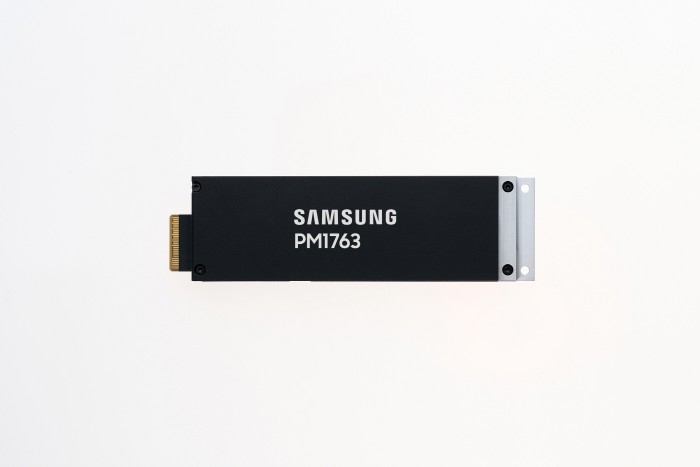 |
| A product image of Samsung Electronics' PM1763, an enterprise SSD optimized for AI infrastructure. / Courtesy of Samsung Electronics |
Samsung Electronics has commenced mass production of its new PCIe 6.0-based enterprise solid-state drive (eSSD), the PM1763, which is engineered specifically for artificial intelligence (AI) infrastructure.
The company announced on July 8 that the PM1763 integrates its ninth-generation V-NAND alongside a newly developed 4-nanometer controller, yielding major advancements in both performance and power efficiency. Samsung officials highlighted that the drive’s high-throughput data processing capabilities will position it as a foundational storage solution for next-generation AI platforms.
The eSSD will be offered in three storage capacities: 4 terabytes (TB), 8TB, and 16TB, with the 16TB model delivering industry-leading performance metrics. The 16TB drive achieves sequential read speeds of up to 28,400 megabytes per second (MB/s) and sequential write speeds of up to 21,900 MB/s, representing roughly a twofold increase compared to its predecessor, the PM1753.
This level of performance enables the transfer of a large language model (LLM) sized at 40 gigabytes (GB) in approximately 1.4 seconds. By minimizing data latency between accelerators and processors, the drive dramatically improves overall AI workload processing efficiency.
Samsung also emphasized that the product is uniquely optimized for the liquid-cooled environments increasingly utilized in next-generation AI servers. It relies on a Direct-to-Chip (D2C) liquid-cooling layout that fixes a cold plate directly onto the internal hardware components, allowing the drive to sustain peak operational speeds over extended periods without thermal throttling, even under heavy processing loads.
Furthermore, the PM1763 enhances data center cost-effectiveness by improving power efficiency by more than 1.8 times compared to previous models, which helps lower overall server energy costs.
Security features have been heavily reinforced to protect critical corporate information in the AI era. The drive introduces a Post-Quantum Cryptography (PQC) encryption algorithm designed to defend against future quantum computing-based hacking techniques. Additionally, it implements TEE Device Interface Security Protocol (TDISP) technology to securely shield data pathways within virtualized IT environments.
"The PM1763 has successfully completed product qualification by satisfying the rigorous next-generation AI platform demands of our global customers," said Choi Jang-seok, senior vice president of the Product Planning Team within Samsung Electronics' Memory Business. "It will serve as a vital solution that expands memory capacity and enables clients to run their complex AI models with maximum efficiency."
Choi In-kyu
Most Read
-
1
Kia Sportage outperforms Mazda CX-5 in German auto..

-
2
Houthis launch successive attacks on Saudi airport..

-
3
Saudi Arabia, Iran hold first diplomatic talks to..

-
4
U.S. deploys carrier, 10,000 more troops to Middle..

-
5
Saudi airport in Riyadh struck again, leaving at l..

-
6
Japan tracks Ukraine fiber-optic drones, bolsters..

-
7
Putin's ally visits China on the 8th ahead of APEC..

PEOPLE






HEADLINE NEWS

-
Address : In-Young Bldg., 34, Uisadang-daero 1-gil, Yeongdeungpo-gu, Seoul
Copyright by ASIATODAY CO., LTD. All rights resereved