



Cross-strait crisis hits worst point as risks of localized conflict surge
Jul 06, 2026, 10:34 am


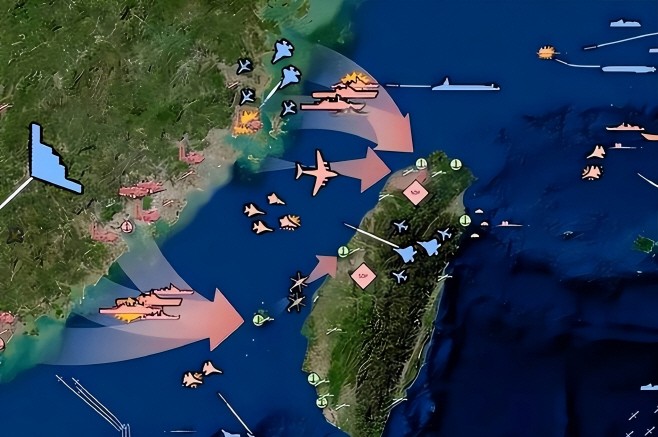 |
| An artistic rendering of a cross-strait war. In the event that even a localized conflict breaks out, Taiwan is highly likely to be overwhelmed, which in turn leaves little choice but to increase the likelihood of U.S. military intervention. / Courtesy of The Beijing News |
Taiwan, which often gives the impression of confronting China with a swagger backed by the United States, is well known not only for its explosive economic growth driven by a booming semiconductor industry but also for having endured the world’s longest period of martial law. For 38 years, from 1949—when the Kuomintang was defeated by the Chinese Communist Party and fled the mainland—until 1987, everything in Taiwan, including its politics and economy, had to operate under martial law.
Naturally, Taiwan did not experience uninterrupted peace during the four decades following the lift of martial law. In particular, whenever the current ruling Democratic Progressive Party (DPP), which advocates for "Taiwan independence," took power in this century, cross-strait relations between China and Taiwan became so perilous that they rivaled the martial law era. Describing it as a state of quasi-war would not be an exaggeration, especially during presidential elections when the "One China" principle and the slogan of "Taiwan independence" clashed fiercely.
As a journalist who frequently stayed in Taiwan for work, I personally experienced these hair-raising situations countless times. Right before the historic first direct presidential election in March 1996, amid a quasi-war footing, I traveled to Matsu Island—an island sitting right under China’s nose—for coverage and barely managed to evacuate aboard a warship provided by the Taiwanese Navy. Furthermore, around the time of the presidential election on January 13, 2024, while reporting from Taipei and other areas, I clearly witnessed how China’s military muscle-flexing could trigger a localized conflict at any given moment.
Since the DPP candidate Lai Ching-te won that election by an overwhelming margin, the current atmosphere remains incredibly chilling. Given the total freeze on all dialogue and exchanges, alongside China's blatant military provocations and hardline stance toward Taiwan, it is safe to say that the region is facing its worst crisis in history. Some diplomatic sources in Beijing hit the nail on the head when they emphasized the severity of the situation, stating, "The current standoff across the strait is truly critical. It can be seen as a worse crisis than the martial law era around the 1980s."
A closer look at the current standoff, where neither side is willing to back down an inch, clearly underscores this reality. Last month, China made its intentions clear by deploying its aircraft carrier, the Fujian, along with official vessels to the eastern waters of the Taiwan Strait to resume its military show of force. Following this, on July 2, Beijing openly tested reactions by dispatching 30 military aircraft, 7 warships, and 5 official vessels into the airspace and waters surrounding Taiwan.
Beijing is also sending messages that border on outright intimidation. General Secretary and President Xi Jinping, along with Wang Yi—who serves as a member of the Political Bureau of the CPC Central Committee, Minister of National Defense, and Director of the Office of the Central Foreign Affairs Commission—voiced a seemingly coordinated stance to mark the CPC's 105th anniversary on July 1. They declared they would "resolutely strike down and punish" separatist forces like the DPP that bring up "Taiwan independence," making it explicitly clear that words and actions opposing the "One China" principle are directly linked to death.
Taiwan is fighting back just as fiercely. President Lai’s recent moves speak volumes; whenever he senses that China’s military displays and pressure are becoming unusual, he responds immediately, making his stance clear that he will resolutely confront any threats. When combining this with Taiwan's aggressive push to expand its drone fleet—leveraging capabilities proven effective in the war in Ukraine to bolster its otherwise outmatched military strength—Taiwan’s momentum is formidable. It is safe to assert that the extreme standoff between the two sides has reached a level capable of sparking a localized war.
Should a localized conflict break out, the scenario becomes highly complex. First and foremost, the United States would have no choice but to intervene militarily based on the Taiwan Relations Act, which it hastily enacted when establishing diplomatic ties with China after severing them with Taiwan in 1979. Failing to act despite a clause dictating military intervention in the event of a "Taiwan contingency" would be unthinkable.
Japan would also find it difficult to sit idly by, given that Prime Minister Sanae Takaichi delivered a parliamentary speech on November 6 last year explicitly stating that Japan "must intervene in a Taiwan contingency." In one way or another, Japan would have to side with the United States. South Korea, which maintains a special relationship with the U.S. that is as vital as Japan's, could find itself in a highly awkward position.
Ultimately, however, South Korea would have to turn China into an adversary. This is why Leng Youcheng, a Taiwanese businessman operating in Beijing, analyzed that a cross-strait localized war would leave South Korea cornered with a single option: "South Korea has no other choice. If the clouds of a localized war darken across the strait, South Korea must offer full-scale support to the United States on a level akin to entering the war, even if it stops short of deploying troops. Otherwise, the alliance between the two nations becomes meaningless."
There is no denying that the current cross-strait crisis is partly being fueled by the United States to check China, which is bound to eventually become the next G1 superpower surpassing America. In that light, China's firm response is only natural. Concerns over the potential outbreak of a localized war across the strait are clearly not unwarranted. The conclusion that South Korea must stay fully alert and prepare for the worst-case scenario across the Taiwan Strait follows naturally.
Hong Soon-do
Most Read
-
1
Celltrion’s Omlyclo gains ground in major European..

-
2
Trump demands rates fall below 1% as Fed hikes for..

-
3
Trump makes $1 trillion bet ahead of midterm elect..

-
4
Iran resumes ballistic missile production, assembl..

-
5
Samsung Electronics, Mistral AI to jointly develop..

-
6
Trump warns countries not helping U.S. must pay re..

-
7
Seoul faces triple squeeze over troop deployment t..

PEOPLE







-
Address : In-Young Bldg., 34, Uisadang-daero 1-gil, Yeongdeungpo-gu, Seoul
Copyright by ASIATODAY CO., LTD. All rights resereved