



Top 5 banks funnel loans to conglomerates
Jul 03, 2026, 09:34 am


 |
| This image was generated by AI. |
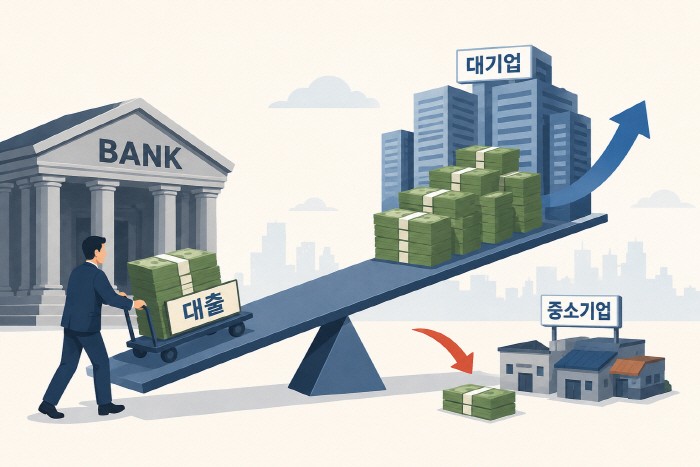
Despite the government's call to expand "productive finance," the banking sector saw a much larger surge in loans to large conglomerates than to small and medium-sized enterprises (SMEs) in the first half of this year. This trend is driven by continued large-scale projects and investments in high-tech sectors like artificial intelligence (AI) spearheaded by conglomerates, coupled with a widening credit gap between large and smaller firms amid a prolonged high-interest-rate environment.
According to the financial sector on July 2, the outstanding balance of SME loans at the top five banks (KB Kookmin, Shinhan, Hana, Woori, and NH Nonghyup) stood at 682.7204 trillion won as of the end of June, up 8.2942 trillion won during the first half of the year. During the same period, the balance of corporate loans to large enterprises reached 190.3641 trillion won, increasing by 20.0649 trillion won. Notably, corporate loans to large firms jumped by 4.9285 trillion won last month alone—a 2.66% increase month-on-month—marking the largest monthly gain in a year since May last year. Conversely, the outstanding balance of SME loans shrank by 1.7368 trillion won, down 0.25% from the previous month.
The growth gap between large corporate loans and SME loans has widened significantly this year. In the first half of this year, the difference in their growth amounts reached 11.7707 trillion won, more than doubling the gap of 5.4002 trillion won recorded in the first half of last year. Last year, large corporate loans grew by 7.2580 trillion won while SME loans increased by 1.8578 trillion won. In the first half of 2024, the growth discrepancy between the two types of loans was a mere 873.1 billion won.
This divergence is largely attributed to the widening credit gap between companies as the high-interest-rate environment drags on. Higher rates inevitably raise the borrowing threshold for SMEs and increase the interest burden on existing borrowers, worsening their financing conditions. Furthermore, with a rising number of marginal status firms suffering from low profitability, banks are operating their SME lending portfolios conservatively to manage asset quality.
In fact, the average delinquency rate on SME loans at the top five banks hit 0.73% as of the end of May, reaching its highest level since January 2020, when combined bank data first became available. According to the Federation of Korean Industries (FKI), the ratio of marginal companies in the KOSDAQ market stood at 32.6% at the end of last year, nearly double the 16.7% seen in the KOSPI market. The contraction in SME lending indicates growing default risks concentrated among smaller firms.
"When interest rates stay high and the economy slows down, the credit spread between large conglomerates and SMEs widens sharply," explained Son Jae-sung, a professor of accounting at Soongsil University. "Consequently, a growing number of SMEs are left unable to secure financing or struggle to handle interest payments."
The recent concentration of domestic funds into large enterprises has also played a major role. Spurred by the semiconductor cycle, conglomerates have expanded investments in AI and large-scale facilities, driving up their demand for capital. A banking insider noted, "Under the banner of productive finance—which aims to divert capital away from real estate and into corporations and capital markets—the current environment naturally drives a concentration of funds into large enterprises."
The lending gap between large conglomerates and SMEs is expected to widen further in the second half of the year, as conglomerates begin executing their investment plans in earnest. Experts also note that interest rates and inflation are projected to remain upward for the time being, further stretching the credit gap.
"With inflation and interest rates likely to rise in tandem during the second half of the year, credit spreads are expected to widen even further," Professor Son added.
Chae Jong-il
Most Read
-
1
U.S. Treasury Secretary Bessent publicly warns ove..

-
2
Celltrion’s Omlyclo gains ground in major European..

-
3
U.S. strikes Iran after a month, hits IRGC rocket..

-
4
Hyundai Motor Group breaks ground on integrated st..

-
5
Russia faces warning signs over prolonged war econ..

-
6
Anti-Western solidarity strengthens amid Trump's e..

-
7
U.S. strikes 3 Iranian oil tankers, Iran vows reta..

PEOPLE






HEADLINE NEWS

-
Address : In-Young Bldg., 34, Uisadang-daero 1-gil, Yeongdeungpo-gu, Seoul
Copyright by ASIATODAY CO., LTD. All rights resereved