



Samsung Bioepis bets big on clinical pipeline ahead of Keytruda patent cliff
Jul 01, 2026, 09:45 am


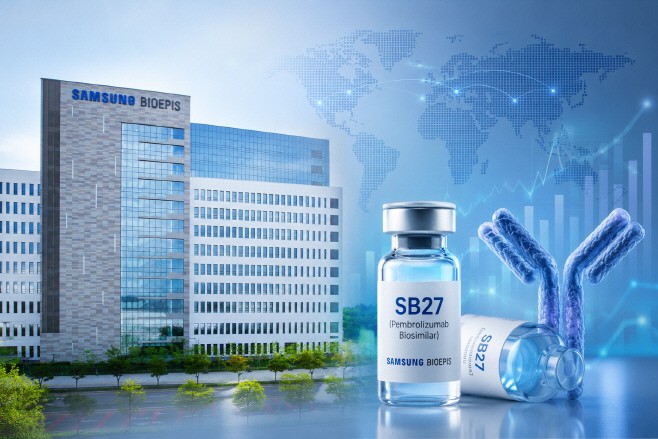 |
| This image was generated by AI. |
Samsung Bioepis is strengthening its position to secure an early foothold in the market by disclosing the Phase 3 clinical trial results for its biosimilar targeting the blockbuster immunotherapy drug Keytruda. Ahead of Keytruda’s patent expiration in 2028, global pharmaceutical companies are racing to develop biosimilars, and Samsung Bioepis has become the first among its competitors to unveil clinical data. Despite recent regulatory easing by the US Food and Drug Administration (FDA) that has prompted some companies to modify their clinical strategies—such as downscaling or halting Phase 3 trials—Samsung Bioepis has maintained its original roadmap, choosing a head-on approach.
On the 29th, Samsung Bioepis released the analysis results from the global Phase 1 and Phase 3 clinical trials for its Keytruda biosimilar candidate, SB27. The findings demonstrated equivalence between SB27 and the originator drug, Keytruda, across the primary endpoints of both studies. Notably, in the Phase 3 trial, SB27 confirmed equivalence in the objective response rate (ORR)—the percentage of patients whose tumor size decreased beyond a specific threshold after 24 weeks of treatment—while safety and immunogenicity profiles were also found to be highly comparable.
Developed by multinational pharmaceutical company MSD, Keytruda is an immune checkpoint inhibitor and the world's largest blockbuster drug, racking up approximately $31.7 billion (around 46 trillion won) in sales last year. It is indicated for a wide range of oncology diseases, including non-small cell lung cancer (NSCLC), melanoma, and head and neck cancer. Evaluated as a standard of care across multiple cancer types, the drug possesses a resilient demand base driven by its continuously expanding indications.
Consequently, global drugmakers are aggressively pushing biosimilar development to enter the market the moment Keytruda's patent expires. Alongside Samsung Bioepis, major players such as Celltrion and Amgen are currently conducting global Phase 3 clinical trials. Among them, Samsung Bioepis is evaluated to be leading its peers in terms of both clinical trial scale and the timeline of disclosed data.
While the FDA's recent push toward biosimilar regulatory easing has sparked discussions on streamlining or exempting Phase 3 trials, the agency has only released draft guidance, meaning actual implementation will likely take time. In response to this shifting landscape, some companies have chosen to prematurely terminate or downsize their Phase 3 programs. Conversely, Samsung Bioepis is pressing ahead with its Phase 3 trial involving 555 patients across 14 countries. This currently stands as the largest clinical trial footprint among all Keytruda biosimilar pipelines disclosed to date.
Biotech industry experts note that under unconfirmed regulatory guidelines, securing full Phase 3 data can significantly mitigate uncertainties during the regulatory approval process. Such data is also expected to prove invaluable in building trust among medical professionals post-launch. Because oncology is a therapeutic area where clinicians exhibit high prescription conservatism, robust clinical data serves as a decisive competitive edge during prescription switching, insurance coverage listings, and hospital procurement bidding negotiations.
The ultimate variable rests on how rapidly SB27 can secure final marketing authorization and launch relative to its competitors. In the biosimilar industry, capitalizing on the immediate post-patent window is a critical factor that dictates long-term market share. This first-mover advantage is backed by empirical research; a study presented at the International Society for Pharmacoeconomics and Outcomes Research (ISPOR) in 2024 revealed that first-to-market biosimilars maintain an average market share 27% higher over the long term compared to late entrants.
Meanwhile, competitors such as Sandoz and Formycon have recently halted their Phase 3 trials in light of the discussions surrounding clinical exemptions, aiming instead for regulatory approval based primarily on Phase 1 analytical data. How much these shifting regulatory winds will accelerate the approval timelines for these companies remains a pivotal factor. To counter this, Samsung Bioepis has been utilizing an overlapping strategy since 2024—running Phase 1 and Phase 3 trials concurrently—to expedite the development timeline of SB27, with both trials targeted for completion by the end of this year.
"We are proceeding with our Phase 3 trial as scheduled based on the strategic determination that securing large-scale clinical data will serve as a distinct qualitative advantage," a Samsung Bioepis official stated. "Particularly in the field of oncology, we believe that an abundant pool of clinical data will become a vital competitive asset in driving prescription expansion during commercialization."
Bae Da-hyun
Most Read
-
1
Kia Sportage outperforms Mazda CX-5 in German auto..

-
2
Houthis launch successive attacks on Saudi airport..

-
3
Saudi Arabia, Iran hold first diplomatic talks to..

-
4
U.S. deploys carrier, 10,000 more troops to Middle..

-
5
Saudi airport in Riyadh struck again, leaving at l..

-
6
Putin's ally visits China on the 8th ahead of APEC..

-
7
Chinese military support and training center opens..

PEOPLE






HEADLINE NEWS

-
Address : In-Young Bldg., 34, Uisadang-daero 1-gil, Yeongdeungpo-gu, Seoul
Copyright by ASIATODAY CO., LTD. All rights resereved