



Only two Korean vessels remain stranded in Strait of Hormuz
Jul 01, 2026, 09:57 am


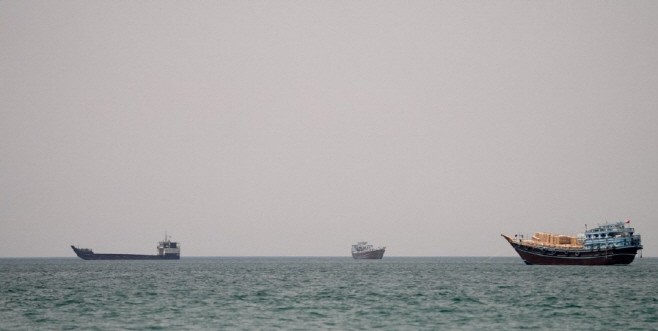 |
| The Strait of Hormuz/Reuters, Yonhap |
The South Korean government officially stated on the 1st that only two domestic vessels remain within the Strait of Hormuz, effectively confirming that all ships intending to exit the strategic waterway have done so. Moving forward, managing the safety of Korean sailors stationed aboard foreign-flagged vessels has emerged as the next critical challenge.
Nam Jae-heon, Vice Minister of Oceans and Fisheries, announced during a briefing at the Government Complex Seoul that as of 9 a.m., two Korean-flagged vessels housing seven Korean crew members remained inside the strait. When factoring in 28 Korean sailors serving on foreign-flagged ships, a total of 35 Korean nationals remain in the area.
The HMM Namu, which had been struck by an Iranian attack, is currently undergoing hull repairs at the Port of Dubai in the United Arab Emirates (UAE) and is expected to clear the strait after mid-month. The remaining domestic vessel is scheduled to resume transit once its cargo loading timeline is finalized.
With all Korean ships that expressed an intent to leave having successfully evacuated, the government's focus is shifting to safety management and monitoring for citizens working on foreign vessels, many of which are currently operating within the Persian Gulf.
"While we cannot directly command foreign-owned ships carrying Korean crew members, we have established communication networks through shipping lines and maritime associations to verify safety and facilitate crew rotations," Vice Minister Nam stated. "We will continue to closely monitor and manage the status and security of our sailors aboard these foreign vessels."
Up to this point, a pan-governmental task force comprising the Ministry of Oceans and Fisheries, the Ministry of Foreign Affairs, the National Security Office, the Ministry of National Defense, the National Intelligence Service, and the Korea Coast Guard has worked as a unified team to ensure the safe passage of domestic vessels out of the strait.
The Ministry of Oceans and Fisheries provided real-time tracking from the moment transits began until the vessels reached secure waters. Operating a constant link with shipping operators, the ministry conducted daily checks on essential provisions—including food, drinking water, and fuel reserves—alongside monitoring crew transitions.
Concurrently, the Ministry of Foreign Affairs cooperated with local diplomatic missions to facilitate the delivery of critical supplies and handle embarkation and disembarkation logistics. To support families, an emergency 24-hour counseling hotline has been in operation since March.
To mitigate supply uncertainties triggered by the conflict in the Middle East, the government has also been aggressively securing alternative oil transport routes. Since April 17, it has supported crude oil shipments via the Port of Yanbu in Saudi Arabia, located within the Red Sea. Thanks to these diversion measures, 10 crude oil tankers have successfully loaded and transported approximately 20 million barrels of oil, with 7 of those vessels having already docked at domestic ports.
"As the 60-day detailed peace negotiations are still underway, we will maintain a vigilant watch over transit conditions in the strait and further solidify our inter-agency response framework with the Ministry of Foreign Affairs and other related bodies," Nam added.
Mok Yong-jae
Most Read
-
1
Trump shares map on social media labeling Strait o..

-
2
Kia Sportage outperforms Mazda CX-5 in German auto..

-
3
Houthis launch successive attacks on Saudi airport..

-
4
U.S. deploys carrier, 10,000 more troops to Middle..

-
5
Trump rejects Iran's offer to open Strait of Hormu..

-
6
N. Korea conducts first swarm attack drill with dr..

-
7
U.S.-China summit falls short on substance as Trum..

PEOPLE






HEADLINE NEWS
- Seoul dismisses Ukraine's claim of 'S. Korean support for Russia' as "inaccurate and inappropriate"
- S. Korea, Japan race to develop nuclear-powered submarines
- Henri Kagan, Kenso Soai win Nobel Prize in Chemistry for uncovering how mol..
- Vance says Alaska LNG cooperation will move forward with Seoul's current or..

-
Address : In-Young Bldg., 34, Uisadang-daero 1-gil, Yeongdeungpo-gu, Seoul
Copyright by ASIATODAY CO., LTD. All rights resereved