



'Separate yet cool': 'Personal cooling' disrupts the sleep market
Jun 30, 2026, 09:27 am


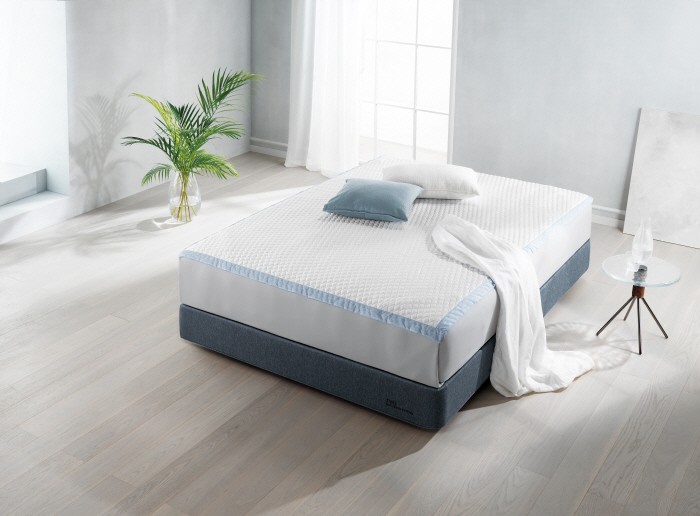 |
| An image of Ace Bed's 'Microcare Cooling Pad'. / Courtesy of Ace Bed |
Ahead of the full-scale summer tropical nights, demand for cooling bedding is increasing. In the sleep industry, rather than family members or married couples sharing a single bedroom temperature, the trend of selecting bedding to match individual perceived temperatures and sleep habits is viewed as 'personal cooling' consumption.
According to sales data analyzed by Ace Bed on the 29th, the total sales volume of cooling products this past May increased by 46% compared to the previous month. The sales volume from June 1st to 7th also grew by 37.8% from the previous week. This is interpreted as the effect of expanding demand for summer bedding that directly touches the skin—such as cooling pads and body pillows—along with the temperature rise.
By size, the proportion of single products was high. In the case of Ace Bed's cooling bedding 'Microcare Cooling Pad,' the Super Single (SS) size occupied 44.4% of the total sales volume based on last year's sales data.
This is interpreted as aligning with the trend of increasing use of 'twin beds'—where married couples arrange two single beds side by side to adjust individual sleep environments—along with the rise of single-person households. The analysis indicates that even when sleeping in the same space, since perceived temperatures and preferred bedding thicknesses are different, demand to use cooling products on an individual unit is expanding, rather than cooling the entire bedroom.
The competition for cooling bedding is expanding to other bedding companies as well. Major companies such as Eve자리 are putting summer cooling bedding at the forefront, and some brands are presenting the contact cooling coefficient 'Q-max' as a standard for product differentiation. Q-max is an index that numericalizes how quickly heat moves the moment skin touches the fabric, used as a primary standard to explain functionality in the summer bedding market.
Applied to the Ace Bed cooling product lineup is 'FORPE'—a contact cooling yarn developed by Kolon Industries. FORPE is a material utilizing high-density polyethylene (HDPE), which realizes coolness through a method of rapidly absorbing and dispersing heat upon skin contact.
The cooling bedding market is moving from the stage of simply emphasizing a "cold touch" toward a direction of considering material, durability after washing, hygiene, and breathability together. The industry views that as high temperature phenomena are forecasted for this summer, seasonal demand will continue, centering on cooling bedding and personal sleep assistance products.
Oh Se-eun
Most Read
-
1
Kia Sportage outperforms Mazda CX-5 in German auto..

-
2
Houthis launch successive attacks on Saudi airport..

-
3
Saudi Arabia, Iran hold first diplomatic talks to..

-
4
U.S. deploys carrier, 10,000 more troops to Middle..

-
5
Saudi airport in Riyadh struck again, leaving at l..

-
6
Putin's ally visits China on the 8th ahead of APEC..

-
7
Chinese military support and training center opens..

PEOPLE






HEADLINE NEWS

-
Address : In-Young Bldg., 34, Uisadang-daero 1-gil, Yeongdeungpo-gu, Seoul
Copyright by ASIATODAY CO., LTD. All rights resereved