



Korea’s top 3 tiremakers speed up shift to AI-powered development systems
Jun 24, 2026, 05:16 pm


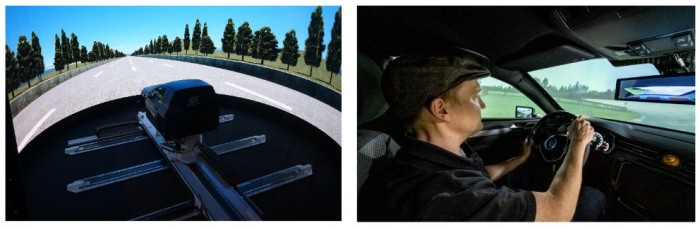 |
| Nexen Tire's driving simulator. / Courtesy of Nexen Tire |
The tire industry is rapidly leveraging Artificial Intelligence (AI) to accelerate product development. Moving away from the traditional method of building and testing physical prototypes, manufacturers are increasingly adopting "Virtual Tire" development systems. By designing tires and predicting their performance in virtual environments, companies aim to simultaneously slash development timelines and cut costs.
According to industry sources on the 24th, automakers have recently begun demanding virtual tire data from suppliers to compress vehicle development schedules. In the past, tire manufacturers had to produce physical prototypes, gather performance data through testing equipment, and use those insights to develop final models.
Recently, however, the paradigm has shifted toward designing tires and predicting performance in a virtual space, minimizing the need for physical verification.
With the rapid rise of electric vehicles (EVs) and Software-Defined Vehicles (SDVs), vehicle development cycles are shrinking, forcing tire manufacturers to accelerate their own timelines. Consequently, digital development capabilities fueled by AI and simulation technologies have emerged as a critical competitive edge.
Hankook Tire utilizes its proprietary "Virtual Compound Design System" to analyze over 50 performance metrics, including wear resistance, fuel efficiency, and noise levels. The system's AI suggests the optimal compound mix, which researchers then use to develop the actual product.
The company also deploys a virtual manufacturing system to predict potential defects during production. This predictive modeling has reportedly reduced defect rates by 20% to 30% in certain manufacturing processes.
Kumho Tire has similarly built an AI-based virtual tire modeling and performance prediction system. By replicating real-world road conditions and driving environments in a virtual space, the company focuses on verifying performance right from the design phase to maximize development efficiency.
Nexen Tire is strengthening its digital development capabilities through an advanced driving simulator. This cutting-edge setup integrates high-performance hardware and software to replicate realistic driving environments indoors.
Engineered with vision systems, sound systems, and motion platforms that recreate real-time driving conditions, the simulator captures data under near-actual road environments. The company explained that this allows for a more sophisticated analysis of vehicle-tire interactions while significantly shortening development cycles.
The industry consensus is that virtual tire technology will become the defining capability determining future competitiveness, far transcending a mere speed upgrade.
Digitizing the entire pipeline—from design and verification to production—enables companies to enhance quality while lowering expenses.
"AI adoption is expanding rapidly to improve the accuracy of tire performance predictions," an industry insider noted. "Ultimately, the goal is to develop models faster while efficiently upgrading core performance metrics like handling, ride comfort, and durability."
Kim So-young
Most Read
-
1
Kia Sportage outperforms Mazda CX-5 in German auto..

-
2
Houthis launch successive attacks on Saudi airport..

-
3
Saudi Arabia, Iran hold first diplomatic talks to..

-
4
U.S. deploys carrier, 10,000 more troops to Middle..

-
5
Saudi airport in Riyadh struck again, leaving at l..

-
6
Putin's ally visits China on the 8th ahead of APEC..

-
7
Chinese military support and training center opens..

PEOPLE






HEADLINE NEWS

-
Address : In-Young Bldg., 34, Uisadang-daero 1-gil, Yeongdeungpo-gu, Seoul
Copyright by ASIATODAY CO., LTD. All rights resereved