



Seoul apartment rentals unstable amid fears of 2021 Jeonse crisis repeat
Jun 21, 2026, 09:15 am


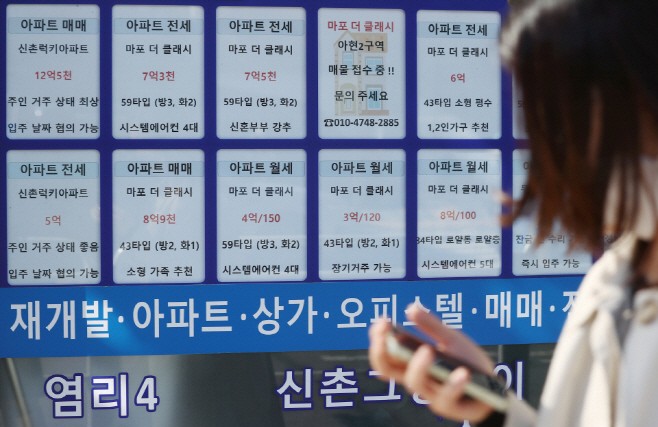 |
| An image shows real estate listings posted at an agency in Mapo-gu, Seoul. / Yonhap News |
The supply and demand imbalance in the Seoul apartment rental market is intensifying. This is interpreted as the combined result of a decrease in supply due to sluggish housing starts and a reduction in listings driven by sales from multi-homeowners.
According to the Korea Real Estate Board on the 21st, the Jeonse supply and demand index for Seoul apartments recorded 122.5 in the second week of June (as of the 15th). This is the highest level since the third week of February 2021 (122.8). The index measures the balance between supply and demand based on a baseline of 100, where a higher figure indicates that rental demand outstrips supply.
The Seoul Jeonse supply and demand index has risen steadily since hitting 103.2 in the first week of March this year. The market views the current rental supply and demand situation as approaching a level similar to late 2020 through early 2021, a period when the shortage of Jeonse listings became prominent following the implementation of the two major tenant protection laws.
The situation is similar in the Wolse (monthly rent) market. The monthly Wolse supply and demand index for Seoul stood at 114.8 in May, up 5.1 points from the previous month. Considering that the monthly increases this year mostly hovered around 1 point, this jump is unusually large.
Industry experts point to the decrease in move-in volume as the background behind the recent instability in the rental market. Analysts say that sluggish housing starts between 2022 and 2023 have led to reduced supply with a time lag, and multi-homeowners rushing to sell before the expiration of the capital gains tax heaviest taxation exemption have further reduced rental properties.
In fact, according to the Korea Real Estate Board and Real Estate R114, the estimated number of multi-family housing units scheduled for move-in in Seoul this year is 27,058. Next year, it is projected to decrease to 17,197 units.
As Jeonse and Wolse listings dry up, an increasing number of tenants are staying in their current residences. According to data from the Ministry of Land, Infrastructure and Transport's actual transaction price disclosure system, out of 23,180 Jeonse and Wolse transactions for Seoul apartments from the 1st of last month to the 19th of this month, contract renewals accounted for 11,366 cases, or 49% of the total. This is a 12 percentage point increase compared to the renewal rate of 37% during the same period last year.
The situation remains similar on a cumulative basis for this year. Out of 105,302 Seoul apartment Jeonse and Wolse transactions, contract renewals reached 47,792, recording 45.4%. This is a 9.2 percentage point increase from 36.2% during the same period last year.
Price growth is also steep. According to a survey by the Korea Real Estate Board, Jeonse prices for Seoul apartments rose 3.58% from January to May this year, which is about six times the growth rate of 0.60% recorded during the same period last year. The growth rate of Wolse prices during the same period was also 3.37%, significantly higher than last year's 0.78%.
Some forecast that the burden on the rental market could grow even heavier once the relocation demand from urban redevelopment projects begins in earnest. This is because union members flow into the rental markets of neighboring areas when existing houses are demolished during the reconstruction and redevelopment process.
Jeon Won-jun
Most Read
-
1
Kia Sportage outperforms Mazda CX-5 in German auto..

-
2
Houthis launch successive attacks on Saudi airport..

-
3
Saudi Arabia, Iran hold first diplomatic talks to..

-
4
U.S. deploys carrier, 10,000 more troops to Middle..

-
5
Saudi airport in Riyadh struck again, leaving at l..

-
6
Putin's ally visits China on the 8th ahead of APEC..

-
7
Chinese military support and training center opens..

PEOPLE





HEADLINE NEWS

-
Address : In-Young Bldg., 34, Uisadang-daero 1-gil, Yeongdeungpo-gu, Seoul
Copyright by ASIATODAY CO., LTD. All rights resereved