



EU tech firms pledge ₩250B in Korea, digital trade deal signed
Jun 11, 2026, 10:14 am


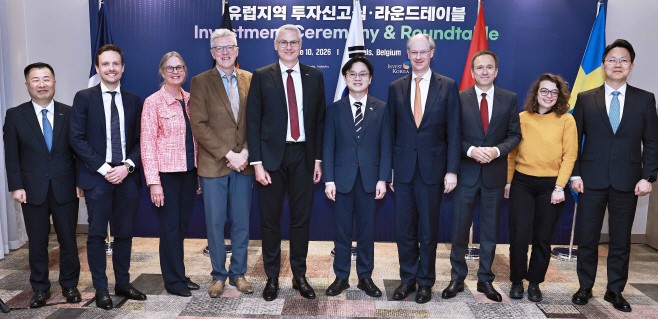 |
| South Korea’s Ministry of Trade, Industry and Energy held an investment declaration ceremony and a roundtable meeting with European investors in Belgium on the 10th (local time), on the occasion of President Lee Jae-myung’s visit to the European Union. / Ministry of Trade, Industry and Energy. |
Four European advanced technology companies have decided to make new investments in Korea totaling $165 million (about ₩250 billion). Korea and the European Union (EU) also officially signed a Digital Trade Agreement (DTA), strengthening cooperation in trade, investment, and digital sectors.
The Ministry of Trade, Industry and Energy announced on June 10 (local time) that, during President Lee Jae‑myung’s visit to the EU, an investment signing ceremony and European investors’ roundtable were held in Brussels, Belgium.
At the event, four companies from Germany, France, the Netherlands, and Sweden reported foreign direct investment (FDI) worth $165 million.
Germany’s advanced materials firm ORAFOL will expand production facilities of a Korean reflective film company it acquired last year, aiming to develop Korea as an export hub for Asia‑Pacific demand.
French quantum computing company Quandela will expand R&D and manufacturing capacity in Korea, positioning the country as a base for quantum technology development and production while strengthening cooperation with academia and industry.
Dutch firm Prodrive Technologies will establish a Korean subsidiary for semiconductor and advanced industry equipment modules, with plans to consider building production and R&D centers depending on business performance.
Sweden’s Micronic will foster Korea as an R&D hub for its laser equipment used in display and semiconductor photomask manufacturing.
These firms view Korea as a key investment base in future industries such as semiconductors, displays, advanced materials, and quantum computing.
Minister Kim Jung‑kwan stated: “Korea’s competitive advanced industry supply chains and AI ecosystem will continue to provide new opportunities for European companies. We will expand FDI incentives, improve regulatory conditions, and actively support foreign firms by addressing challenges in the investment process.”
On the same day, Korea and the EU signed the DTA in the presence of both leaders. This is Korea’s second bilateral digital trade agreement and the EU’s first in the digital trade field.
Under the agreement, Korean companies will be able to process data collected in the EU on domestic servers. Except for public policy purposes, data localization and mandatory local data center construction are prohibited, significantly reducing costs for digital service providers.
The pact also restricts demands for source code transfer to protect core technologies, recognizes the legal validity of electronic signatures and certifications, and simplifies digital trade procedures. Standardization of e‑invoices and e‑payments, as well as expanded e‑customs, are expected to lower transaction costs.
The ministry expects the agreement to boost e‑commerce and digital content exports, while facilitating EU market entry for Korean SMEs and startups.
Meanwhile, Korea and the EU agreed to launch a “Korea‑EU Competitiveness Partnership” covering trade, investment, supply chains, and advanced technology cooperation. They will also establish a high‑level economic dialogue channel to expand collaboration in supply chains, critical minerals, and economic security.
Kim Jung‑gyu
Most Read
-
1
Kia Sportage outperforms Mazda CX-5 in German auto..

-
2
Houthis launch successive attacks on Saudi airport..

-
3
Saudi Arabia, Iran hold first diplomatic talks to..

-
4
U.S. deploys carrier, 10,000 more troops to Middle..

-
5
Saudi airport in Riyadh struck again, leaving at l..

-
6
Putin's ally visits China on the 8th ahead of APEC..

-
7
Chinese military support and training center opens..

PEOPLE






HEADLINE NEWS

-
Address : In-Young Bldg., 34, Uisadang-daero 1-gil, Yeongdeungpo-gu, Seoul
Copyright by ASIATODAY CO., LTD. All rights resereved