



Japan becomes first overseas partner in US “Genesis Mission,” dubbed the AI Manhattan Project
Jun 05, 2026, 01:37 pm


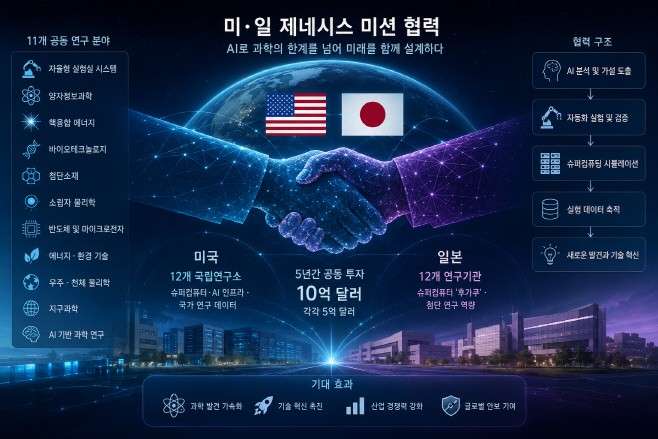 |
| An AI‑generated image depicting the U.S.–Japan partnership in the “Genesis Mission,” combining AI and supercomputing for joint research. / Created with ChatGPT |
The United States has brought Japan in as its first international partner for a national project aimed at accelerating scientific discovery and technological innovation through artificial intelligence (AI).
Yomiuri Shimbun reported on June 5 that Japan will join the U.S. “Genesis Mission” as its first international partner, with the two countries conducting joint research in 11 fields. Amid intensifying U.S.–China competition for technological supremacy, Japan is formally joining a U.S.-led AI science alliance that spans semiconductors, quantum, nuclear fusion, biotechnology, and advanced materials.
On June 4, the U.S. Department of Energy and Japan’s Ministry of Education, Culture, Sports, Science and Technology (MEXT) and Ministry of Economy, Trade and Industry (METI) signed a letter of intent at the DOE headquarters in Washington. Yasuyoshi Kakita of MEXT and Takehiko Matsuo of METI signed on behalf of Japan, while Dario Gil, DOE Under Secretary for Science and head of the Genesis Mission, signed for the U.S.
The Genesis Mission, launched by President Trump in November 2025, aims to integrate the U.S. government’s vast scientific data, supercomputers, AI systems, and experimental facilities into a single platform, with the goal of doubling research productivity within ten years. Washington has described it as a mobilization of science and technology comparable to the Manhattan Project during World War II.
The core of the U.S.–Japan cooperation is to use AI not merely as an automation tool but as a foundational technology to transform scientific research itself. The two countries will form joint teams in 11 fields, including autonomous laboratory systems, quantum information science, nuclear fusion, biotechnology, advanced materials, and particle physics. AI will analyze massive experimental and computational data to generate new hypotheses, robots and automated equipment will conduct experiments, and supercomputers will handle calculations and verification.
Japan’s RIKEN, the University of Tokyo, and the National Institute for Materials Science will collaborate with U.S. national laboratories under the DOE. Japan’s “Fugaku” supercomputer and DOE’s high-performance computing resources will also be used in joint research. According to DOE, 12 U.S. national labs and 12 Japanese research institutions will participate, with both countries investing $500 million each over the next five years, for a total of $1 billion.
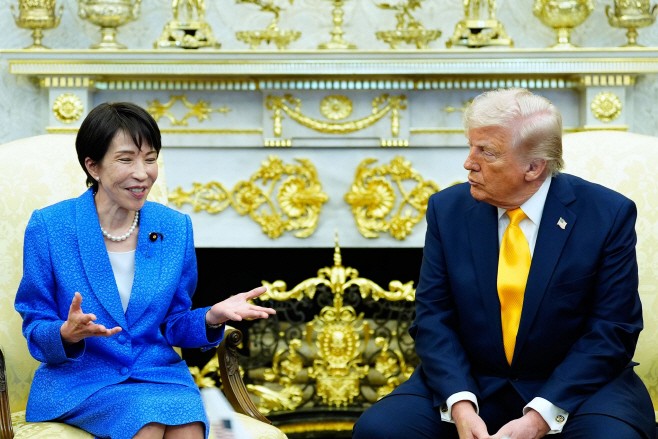 |
| Japan–U.S. Summit / Yonhap News |
For the United States, the effect is to draw Japan’s strengths in basic science, materials, quantum, and semiconductors into its own AI science platform. For Japan, the benefit is the opportunity to boost stagnant research productivity by linking with U.S. national laboratories, supercomputing infrastructure, and the AI corporate ecosystem. Japan’s Ministry of Education, Culture, Sports, Science and Technology explained that this cooperation connects with Japan’s “AI for Science” strategy, while the Ministry of Economy, Trade and Industry’s new participation strengthens integration with semiconductor and digital industry strategies.
Although China is not explicitly mentioned, the background of this cooperation reflects the strategic interests of both the U.S. and Japan in countering China’s pursuit in advanced technology fields. AI, quantum, nuclear fusion, biotechnology, and advanced materials are all directly tied to military, industrial, and energy security. The race now centers on who can integrate scientific data and computing resources faster, and who can industrialize more research outcomes.
Chief Cabinet Secretary Minoru Kihara stated at a press conference on June 5 that “cooperation will expand and strengthen across diverse advanced science and technology fields such as quantum and nuclear fusion.” He also said regarding AI-driven scientific research, “We will comprehensively promote international collaboration, including U.S.–Japan cooperation, and various initiatives.”
The implications for South Korea are significant. Semiconductor manufacturing capacity alone is not enough to compete in AI science and technology. A system is needed that integrates national research institutions’ scientific data, supercomputing resources, AI models, and the research capabilities of universities and companies into a single platform. The U.S. is reshaping the landscape of science and technology competition through the Genesis Mission, and Japan has secured the position as its first international partner. South Korea likewise needs a strategic approach that treats AI not merely as a tool of industrial policy but as core infrastructure for science and technology security.
Choi Young‑jae
Most Read
-
1
Celltrion’s Omlyclo gains ground in major European..

-
2
Trump demands rates fall below 1% as Fed hikes for..

-
3
Trump makes $1 trillion bet ahead of midterm elect..

-
4
Iran resumes ballistic missile production, assembl..

-
5
Samsung Electronics, Mistral AI to jointly develop..

-
6
Trump warns countries not helping U.S. must pay re..

-
7
Apple launches first foldable, 1 million won prici..

PEOPLE






HEADLINE NEWS
- Trump to roll out ‘unprecedented welcome’ for Xi with B-2 bombers, F-22 fighters
- S. Korea, U.S., and Japan form united front on Taiwan and economic coercion..
- Trump administration moves to impose sweeping sanctions on International Cr..
- Xi to make state visit to U.S. Sept. 23-25, dispelling rumors over his heal..

-
Address : In-Young Bldg., 34, Uisadang-daero 1-gil, Yeongdeungpo-gu, Seoul
Copyright by ASIATODAY CO., LTD. All rights resereved