



Japan’s PM Office turns to X to cement approval ratings
Jun 02, 2026, 01:33 pm


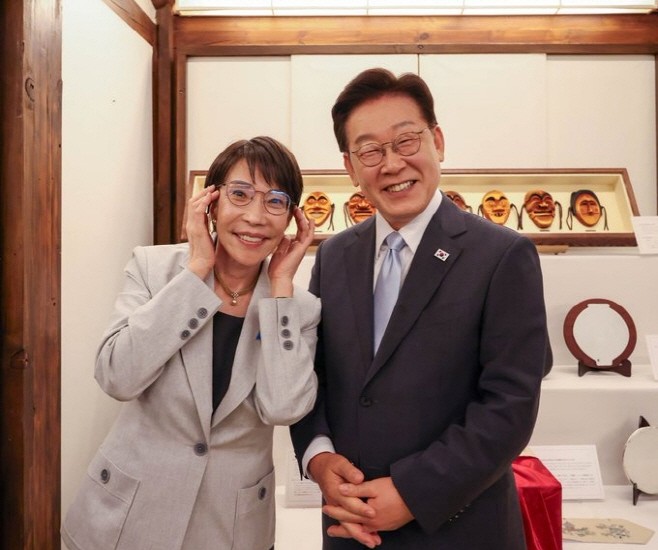 |
| President Lee Jae-myung, wearing glasses and smiling, alongside Japanese Prime Minister Sanae Takaichi (left). Following the Korea-Japan summit on May 19th, the Japanese Prime Minister's Office posted a photo on X showing the two leaders walking while swapping glasses, a moment not disclosed to the press. The post recorded over 11 million views. / Photo via Yonhap News |
The Japanese Prime Minister's Office is embarking in earnest on a direct public relations campaign led by X (formerly Twitter). Ostensibly, the move aims at rapid information dissemination and countering misinformation, but analysis suggests it is a public opinion management experiment by Prime Minister Sanae Takaichi to protect her high approval ratings. According to the Yomiuri Shimbun, the Takaichi Prime Minister's Office plans to transition the Cabinet Public Relations Office's X account to full-scale operation on the 2nd.
The Cabinet Public Relations Office has been operating X since last May as a time-limited trial account. Dividing roles with the existing prime minister's personal account and the prime minister's office official account, it focused on faster and more flexible informal information dissemination compared to official announcements. On the 31st of last month, noting that the account's followers surpassed 100,000, it stated, "Over the past month or so, we have pursued unprecedented communication and tried various things."
The most high-profile example was the Korea-Japan summit. Following the summit on the 19th of last month, the Prime Minister's Office posted a photo on X showing the two leaders walking while swapping glasses—a scene not disclosed to the press. The post recorded over 11 million views. The Prime Minister's Office is concurrently uploading short videos alongside refutations of information related to the prime minister. Soft scenes and human images spread faster on social media than the official achievements of diplomatic itineraries.
This movement is difficult to view merely as strengthening digital public relations. The June issue of Sentaku, a Japanese political monthly, analyzed in an article titled 'Takaichi Also Falls into "Approval Rating Phobia"' that the Takaichi administration relies on high approval ratings yet has fallen into a structure that fears a decline in support. This means that the actual source of power lies in public popularity rather than policy achievements or inner-party bases, and Prime Minister Takaichi and the Liberal Democratic Party remain conscious of this. Overlapping this analysis with the full-scale operation of the Prime Minister's Office's X account, Prime Minister Takaichi's social media politics takes on the character of a defensive line for approval ratings, spreading highly likable scenes and immediately refuting unfavorable information.
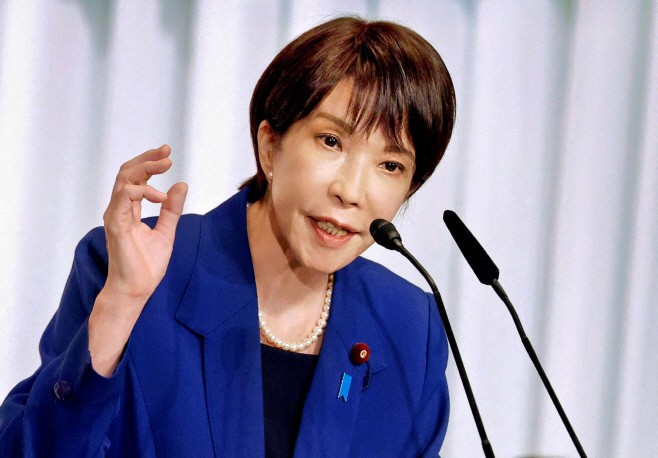 |
| It has been revealed that Prime Minister Takaichi's media response often involves lengthy opening remarks, with journalist questions limited to just one or two. The full text of her statements is subsequently posted on the Prime Minister's X account. While this appears to combine Q&A sessions with social media dissemination, the structure in reality allows the Prime Minister's Office to exert tighter control over the sequence, length, and emphasis of the message. / Photo via Yonhap News |
Brief Q&A sessions increase, but questions limited to one or two
The frequency of Prime Minister Takaichi's informal Q&A sessions with the press corps has expanded following criticism from public opinion. Known in Japanese politics as "Burasagari" interviews, this format involves the prime minister briefly answering reporters' questions while on the move. Prime Minister Takaichi responded to these informal Q&A sessions only four times in total across February and March, drawing criticism from the press corps that the frequency had decreased compared to past administrations, thereby impacting the public's right to know. Subsequently, across April and May, she responded to a total of 14 informal Q&A sessions, including encounters following telephone summits with Middle Eastern leaders regarding the situation in Iran.
It remains difficult, however, to conclude that media scrutiny has been sufficiently strengthened. The prime minister's opening remarks are frequently lengthy, and reporter questions are not uncommonly limited to just one or two. The full text of her statements is subsequently posted on the Prime Minister's X account. While this appears to combine press Q&A sessions with social media dissemination, the structure in reality allows the Prime Minister's Office to exert tighter control over the sequence, length, and emphasis of the message.
The Takaichi administration continues to display defensive responses regarding sensitive issues, conscious of public reactions toward prices, the Middle East crisis, energy procurement, and the controversy surrounding consumption tax cuts. The "approval rating phobia" pointed out by the monthly magazine Sentaku directly aligns with this behavior. While appearing to be a strong administration pushing forward with policies, it operates under a structure that becomes more sensitive to message management than to explaining policy in order to avoid a decline in approval ratings.
Ultimately, the Takaichi Prime Minister's Office's public relations campaign on X is not merely a matter of creating an additional promotional account. It represents a shift in the exercise of power, circulating the prime minister's image first through photographs, texts, and short videos selected by the Prime Minister's Office while simultaneously restricting the time allotted for media questions. The 11 million views recorded by the "glasses-swapping photo" from the Korea-Japan summit served as a symbolic scene demonstrating that potential. Social media politics aimed at maintaining high approval ratings now stands on the borderline between information disclosure and public opinion management.
Choi Young-jae
Most Read
-
1
Celltrion’s Omlyclo gains ground in major European..

-
2
Trump demands rates fall below 1% as Fed hikes for..

-
3
Trump makes $1 trillion bet ahead of midterm elect..

-
4
Iran resumes ballistic missile production, assembl..

-
5
Samsung Electronics, Mistral AI to jointly develop..

-
6
Trump warns countries not helping U.S. must pay re..

-
7
Apple launches first foldable, 1 million won prici..

PEOPLE






HEADLINE NEWS
- Trump to roll out ‘unprecedented welcome’ for Xi with B-2 bombers, F-22 fighters
- S. Korea, U.S., and Japan form united front on Taiwan and economic coercion..
- Trump administration moves to impose sweeping sanctions on International Cr..
- Xi to make state visit to U.S. Sept. 23-25, dispelling rumors over his heal..

-
Address : In-Young Bldg., 34, Uisadang-daero 1-gil, Yeongdeungpo-gu, Seoul
Copyright by ASIATODAY CO., LTD. All rights resereved